




 7 min. read
British Columbia’s three major political parties found rare common ground in the last provincial election on the forestry sector’s use of glyphosate. The common and controversial herbicide ingredient is used to kill off plants that might compete with planted trees for water, nutrients and sunlight.
During the 2024 campaign, the BC Greens promised to ban the use of all chemical herbicides in forestry. The BC Conservatives committed to stop all aerial spraying of glyphosate. And the BC NDP, which was re-elected with a slim majority that October, promised to phase out the sector’s use of glyphosate altogether.
Despite those commitments, chemical herbicides were sprayed across hundreds of hectares of forests in 2025, mostly in the area northeast of Prince George, B.C.
For James Steidle, founder of Stop the Spray B.C., it’s a “disappointment.”
Aerial spraying of forests has been most common in the province’s northeast. The areas sprayed last year fall within the Fraser River watershed, he noted. There, companies target species like fireweed, huckleberries and elderberries, he said. “All these really cool plants and berries that they think are out-competing the spruce trees,” he said. “These are things that animals eat.”

People use these areas as well, to harvest berries and other plants, to camp and to hunt, Steidle said. But he warned it’s not easy to access detailed information about planned spraying.
Companies have until June to report spraying activities from 2025 to the province. The data reported as of Jan. 22, 2026, shows Canfor, a Vancouver-based forestry company, was responsible for most of the spraying in the northeast last year. Steidle questions why the company continues to spray herbicides in cutblocks when many other local companies have given up the practice of aerial spraying. The Narwhal reached out to Canfor for comment but did not receive a response ahead of publication.
For Steidle, a bigger concern is that there are no laws or regulations to prevent spraying.
“The NDP has broken their promise, I’d say,” he told The Narwhal.
When asked by email if the NDP government remained committed to phasing out the use of glyphosate Premier David Eby’s director of communications deferred The Narwhal to a statement we had already received from the Ministry of Forests, which did not answer the question.
Concerns about B.C.’s approach to reforestation is just one of the challenges the forestry sector is grappling with amid major upheavals in the industry, including mill closures, reduced logging levels and ongoing trade pressures.
Chemical herbicides have been used to kill off plants that might compete with tree plantations
Herbicide use in B.C. forests dates back decades. Companies are responsible for managing the sections of forest they’ve logged until the trees they replanted are considered “free growing,” unimpeded by other vegetation.
To make sure they hit that target, and avoid potential fines from the B.C. government, companies clear away other plants that might compete with planted trees — a process known in the industry as brushing.
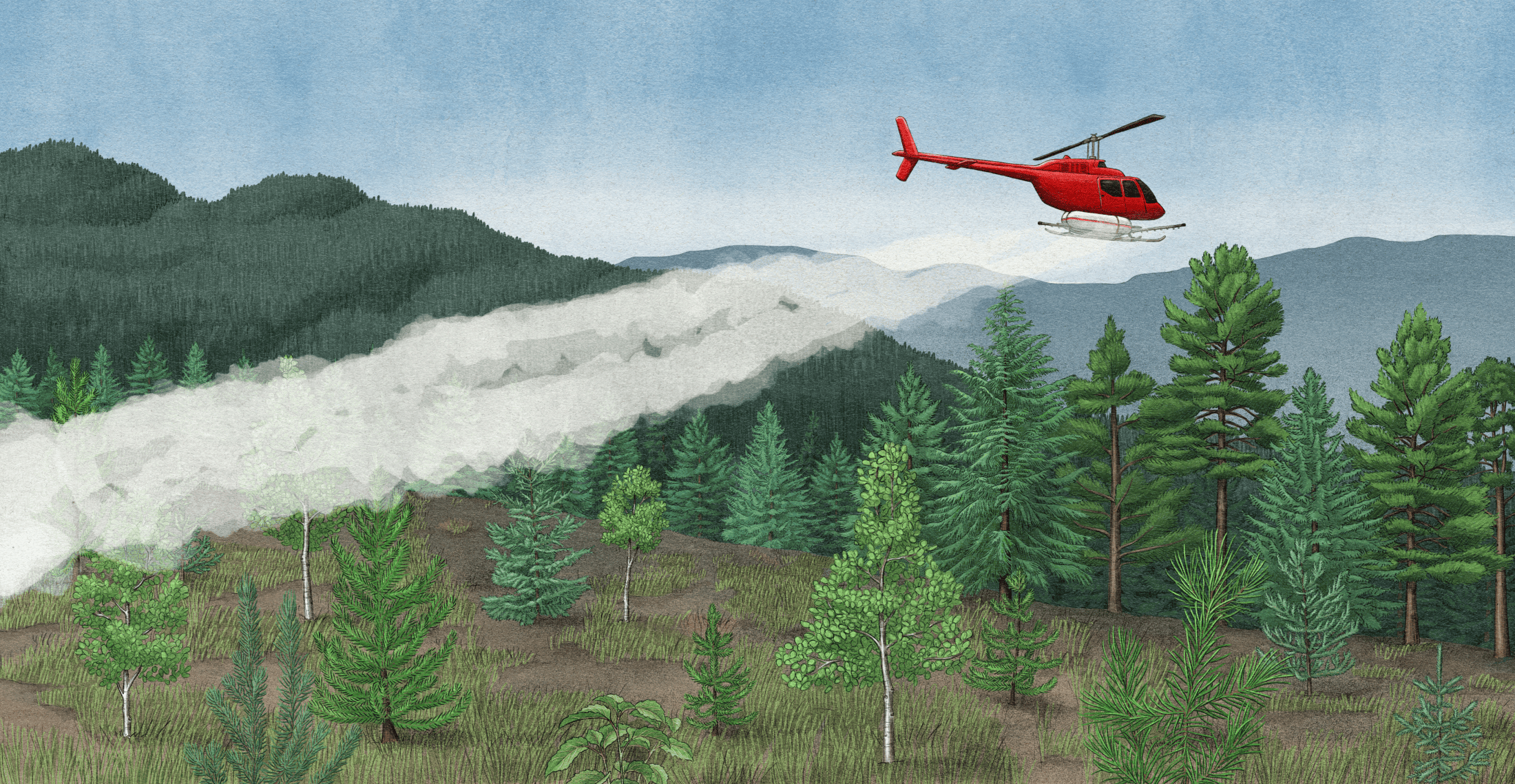
Forest professionals use various brushing methods to remove plants that might compete with planted trees, including manually or mechanically cutting back other plants, spraying herbicides, prescribed burning or using livestock to graze on vegetation, according to a statement from B.C.’s Ministry of Forests. Government data indicates companies most commonly cut back competing plants manually. They also use herbicides like glyphosate to kill off aspen and other plants that fall under the broad category of “herbaceous.” This can include plants like huckleberries and wild rose. Companies use backpack tanks to target species on the ground and helicopters to spray from the air.
Glyphosate, which the World Health Organization says is probably carcinogenic to people, is the main component in the common herbicide Roundup. When plants absorb the chemical it prevents them from taking up nutrients, essentially starving them to death.
In Dec. 2024, The Narwhal reported on the use of glyphosate in B.C. forests. At the time, we incorrectly reported more than 1 million hectares of forest had been sprayed with herbicides since the 1970s. A re-analysis of government data shows companies actually reported spraying more than 430,000 hectares across more than 1 million hectares of cutblocks. In many cases companies reported spraying only a portion of a particular cutblock.
However, the sprayed area available in the government application The Narwhal retrieved the data from only appears to be reported for the initial brushing treatment even if a cutblock was brushed multiple times.
When asked to confirm if more than 430,000 hectares have been brushed with herbicides, a spokesperson for the Ministry of Forests said its data recounts areas that have been sprayed multiple times and shows 738,000 hectares have been treated with herbicides since 1987. In the same time period, 7.4 million hectares of forests were harvested.
The spokesperson noted that most chemical herbicide treatments occurred in the 1990s and early 2000s. “The past 20 years have accounted for only a third of the total treated area,” the statement said.
The area forestry companies reported spraying with herbicides each year in B.C. has declined since 1989, when it peaked at about 40,000 hectares, according to a 2019 report by FPInnovations, which describes itself as a private non-profit focused on research and development in the forestry sector. In 2024, companies reported spraying about 340 hectares with herbicides. As of Jan. 22, 2026, companies reported spraying almost 600 hectares in 2025.
At the same time, the practice of brushing itself has declined alongside a “greater desire” to manage forests to strengthen biodiversity and build resilience to wildfire, the forests ministry statement said.
B.C. government mum on promised phase-out of glyphosate
But past herbicide use can have lasting impacts on forest ecosystems, potentially excluding or restricting the growth of certain trees and plants for years after. And while herbicide use has declined even in northeast B.C., Steidle said the practice still takes a toll.
“These might be small areas, but they’re important areas that people target for berry picking, for hunting,” he said.
Late last year, Lheidli T’enneh First Nation announced it was banning glyphosate spraying across its territory, which encompasses Prince George. Lheidli T’enneh Chief Dolleen Logan could not be reached for comment ahead of publication.
In November, Elder and Land Guardian Les Baker told reporters at a press conference announcing the ban that he’d heard concerns from the community about the use of herbicides.
“They don’t feel safe going and collecting their berries or their food from the bush anymore,” Baker said, according to CBC and the Prince George Citizen.
Forestry companies are generally required to develop and consult the public on pest management plans for their planned use of herbicides but don’t have to publicize exactly where and when they plan to spray — though notices must be posted around the treatment area itself.
According to the Ministry of Forests’ statement, BC Timber Sales, the government agency responsible for managing about 20 per cent of B.C.’s public timber harvest, has not used glyphosate or other herbicides for reforestation since 2022.
In a statement, a spokesperson for the Ministry of Environment and Parks said glyphosate use in forests has declined significantly and is typically used when other methods haven’t or aren’t expected to successfully remove competing plants.
The statement noted concerns raised by First Nations are “explored” during pest management plan consultations. It noted “band resolutions such as the [Lheidli T’enneh First Nation’s] position signal a need to continue these discussions and are used to support assessing potential infringement of Indigenous Rights and Title.”
The statement did not answer The Narwhal’s question about whether the ministry would prohibit forestry companies, like Canfor, from using chemical herbicides or if the government remained committed to phasing out the sector’s use of glyphosate.
Steidle ultimately wants to see an end to herbicide use in forests. Until that happens, he’s calling for greater transparency — specifically, he wants the maps companies submit to the province 30 days before spraying to be made public.
“The government has these maps, and they could release them,” Steidle said.
The Environment Ministry spokesperson said officials are working to improve the ministry’s digital systems to improve transparency in the pest management process.
Updated on Feb. 13, 2026, at 2:37 p.m. PT: This story has been updated to clarify that the 738,000 hectare figured referenced by the B.C. government referred to areas that had been brushed with herbicides