




 4 min. read
Emerging from a thicket behind me, the young bald eagle flew nervously across the river and crashed spectacularly into some tree branches, snapping them with an audible crunch.
I breathed a sigh of relief.
The day before was the eaglet’s first outside the nest, and another photographer had witnessed what he described as a possibly fatal collision with a thick tree trunk. Now I had proof of life.

The following day I saw the eaglet feeding back at its nest, its parents making regular deliveries of prey which can include raccoon, mink, duck and fish. Bumps and bruises are an important part of an eaglet’s maturation, getting them ready to leave their parents’ nest.


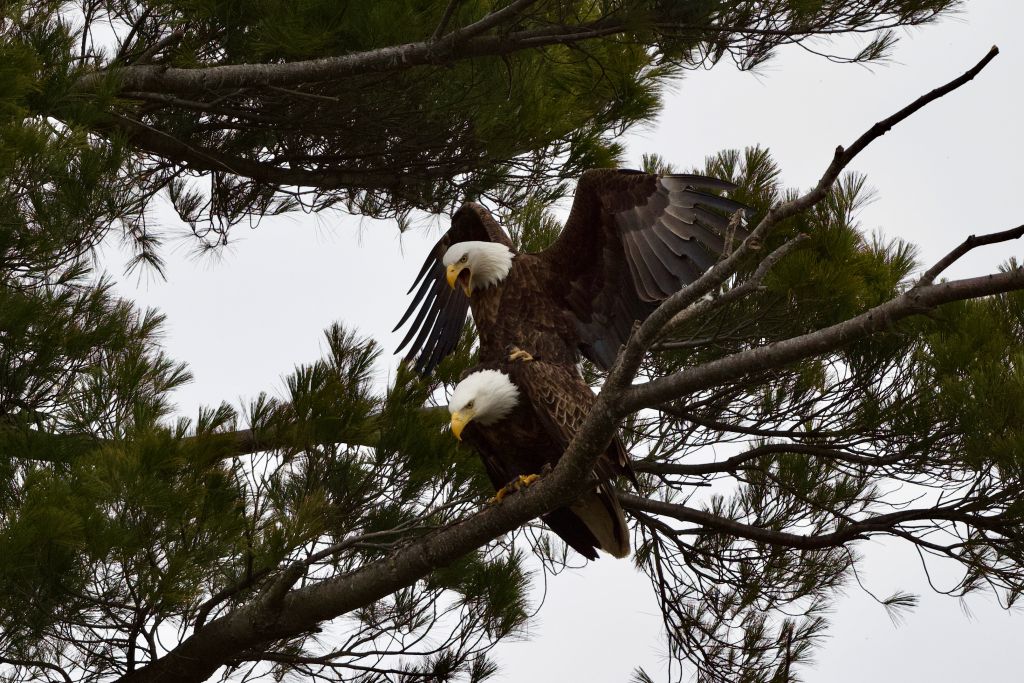
Adult bald eagles tend to return each year to the same location, constantly maintaining their nests by adding sticks snapped from nearby trees. For six years I’ve observed and photographed similar incidents at a nest in Ayr, Ont., along the Nith River. Four years ago this pair actually did move — about 100 metres upriver — to another tall pine. Soil erosion below the original nest wouldn’t pass a home inspection, so this savvy pair picked a more stable site.

Nearly every year that I’ve been watching them, a new brood was born to the couple in Ayr. I’ve watched as they cater to their young, and teach them to hunt and fly. Although eaglets are almost fully grown at three months of age — and have closely studied their parents’ behaviour — they still have to figure out the mechanics of flight. Should they leap or flap their wings first? And what constitutes a safe landing?

Some eaglets will assess the risk of flight, decide it’s too high and instead confine themselves on a branch for days. The adults will attempt to feed them in that position, but without a nest to catch them, meals often wind up on the ground below. It’s no wonder bald eagle mortality rates are roughly 50 per cent in their first year.


Still, this is one of hundreds of bald eagle nests across the province, an amazing number given the threats to the birds and their habitat.

The bald eagle population nearly collapsed in the middle of the last century due to pesticide use. Through bans and conservation efforts, it has gradually bounced back in recent decades, but while the bald eagle was removed from Ontario’s species at risk list in 2023, they are not out of the woods.
Lead poisoning is one major concern, as the birds are scavengers and can ingest ammunition fragments if they find an animal carcass left by hunters. Disease is another, as common prey such as waterfowl might carry avian flu, while mosquitoes are carriers of West Nile virus.


Adult eagles in Ayr have become tolerant of human disturbances like trains, planes, noisy bonfire parties and fireworks, not to mention birders and photographers lined up along the riverbank. It’s a skill their young need to learn to survive.


Over the coming weeks, they will practice tough love, spending less time at the nest so the young are forced to explore their surroundings. It’s a proven parenting method, implemented by a couple that has successfully raised dozens of eaglets.
They’ll enjoy a period of tranquility after the young leave to make their own territories. And by late autumn, the cycle will begin again.