



 3 min. read
The newly formed BC provincial government, under the leadership of Premier Christy Clark, has formally rejected the proposed Northern Gateway pipeline proposal.
A news release put out this morning from BC's Minister of the Environment, Terry Lake, states that there remain concerns about northern gateway project proponent Enbridge's ability to deal with oil spills:
"British Columbia thoroughly reviewed all of the evidence and submissions made to the panel and asked substantive questions about the project including its route, spill response capacity and financial structure to handle any incidents," Lake said. "Our questions were not satisfactorily answered during these hearings." Lake said Northern Gateway has not presented adequate evidence to explain how they would respond to a major spill, and for that reason the B.C. government can't issue a certificate for the pipeline to go ahead.
The BC government's formal submission to the Enbridge northern gateway pipeline project review panel can be downloaded here. [PDF]
In the introduction section of the BC government's submission, it is made clear that while Enbridge has made assurances that it has the ability to clean up a large oil spill on BC's coastal waters, the company provides very little details on how it would actually go about dealing with such a disaster:
"With respect to the pipeline itself, NG [northern gateway] has asserted that it will be able to effectively respond to all spills… however, NG has presented little evidence about how it will respond in the event of a spill."
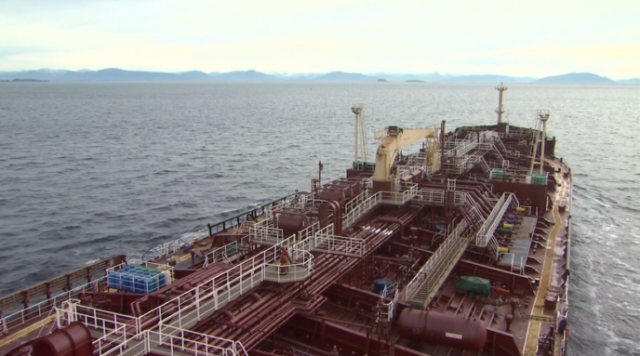
The Enbridge gateway pipeline would see 500 oil tankers a year plying the narrow and treacherous waters off BC's northwest coast. Many experts agree, that the question is not whether a major oil spill would occur, but when. A major spill on BC's coastal waters would put at risk billions of dollars already contributing to the BC economy through seafood harvesting, whale watching, eco-tourism and sport fishing.
Enbridge has run into trouble in the past for its inability to effectively deal with oil spills from their pipelines, with the most notable of late being a massive pipeline rupture in 2010 on Michigan's Kalamazoo river that is still being cleaned up today. The province's review notes Enbridge's history of spills, stating that:
"While the [northern gateway] project will be new, and built using modern technology, the fact remains that pipeline spills do happen. Indeed, Enbridge had 11 releases greater that 1000 barrels between 2002 and 2012."
The fate of the Enbridge gateway pipeline now lays squarely on Prime Minister Stephen Harper and his government, as Executive Director of BC's Dogwood Intiative, Will Horter explains:
“Ottawa could still grant a certificate for Enbridge while relying on promises to make the project better after the review, but today B.C. has clearly said that a certificate should not be granted. Since the public process is now over, this would mean any changes Enbridge might make to their proposal would presumably be evaluated behind closed doors. After the backlash over the HST, we’re not expecting either Ottawa or Victoria to make backroom changes to their position on such a controversial proposal.”
Image Credit: Enbridge Tanker Safety Video, screen shot.