





Last week DeSmog Canada published a video about the Site C dam on Facebook that — after generating nearly 120,000 views in 36 hours — was suddenly removed due to a complaint lodged by True North Entertainment, a B.C. government contractor.
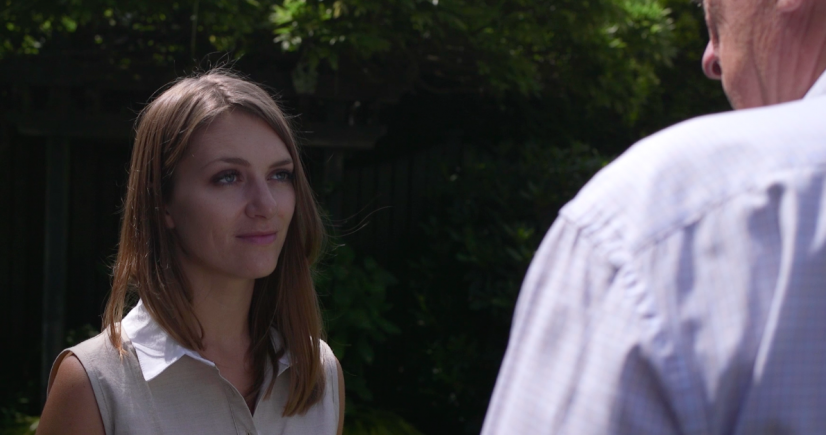
The video, Cutting Through the Spin on the Site C Dam, featured an interview with Harry Swain, chair of the provincial-federal panel responsible for reviewing the controversial hydro dam.
Swain, a high-profile critic of Site C, explained why he thinks it’s a mistake to build the dam and how the B.C. government has changed its story over the years to justify the $9-billion project, the most expensive public infrastructure project in the province’s history.
The five-minute video featured footage almost exclusively filmed by DeSmog Canada but also included some small selections of b-roll footage from the Province of B.C.’s YouTube page.
More than 3,300 people had shared the video on Facebook as of Thursday night but come Friday morning, the video had vanished from every single page it previously appeared on.
A notification from Facebook simply stated the video was removed due to a copyright infringement complaint. The only recourse available was to discuss the matter with Kyle Koch, president and creative director for True North Entertainment, the individual who filed the complaint.
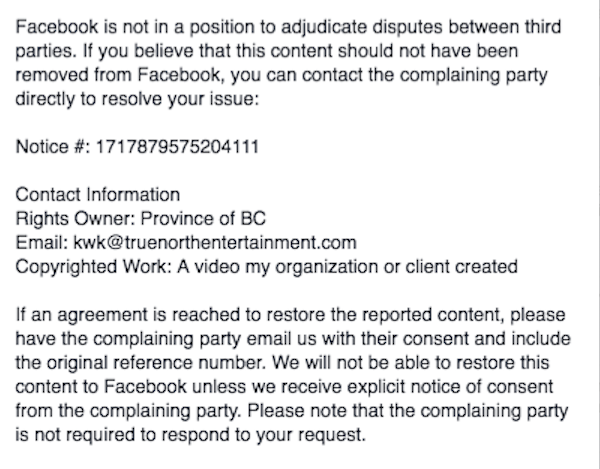
In a conversation with DeSmog Canada, Koch refused to specifically identify what footage he believed violated intellectual property rights.

The vast majority of the media created for the Province of B.C. is licensed under Creative Commons terms, ensuring photos and video paid for with provincial tax-dollars are available for public use with attribution.
But Koch said the Site C video drew from material his company licensed to the province under a one-time use only licence.
“The bottom line is they didn’t have a big budget. We gave them some opportunity to have some elements from our library,” Koch said.
Although he wouldn’t specify, it appears the footage Koch was referring to originated in a Government of B.C. promotional video for “Clean LNG.”
The video, which appeared on the province’s YouTube page is licensed under a “Standard YouTube Licence,” meaning it cannot be re-used. DeSmog Canada erred in drawing from that video.
Today we are releasing a revised version of the Site C film without the b-roll from that particular video.
The BC Liberals and Premier Christy Clark have come under criticism recently for hefty promotional budgets used to advertise government’s activities, policies and projects.
DeSmog Canada has learned that $1,641,253 in taxpayers dollars have been paid to True North Media for services provided to the government since 2006.
In this instance, the province produced tax-dollar-funded promotional material that can not be repurposed in other (even non-profit) media productions, but that is not necessarily the standard for governments.
The United States government, for example, doesn’t hold copyright over any material it produces.
All of this raises the question: if content is produced with government messaging, promoted on their channels and paid for with public dollars, shouldn’t the government hold copyright and make it available to the public who paid for it?