





 5 min. read
Summary
- Canada is looking for buyers of its fossil fuels, from bitumen to LNG, amid a global energy glut.
- The European Union has an objective of becoming the “world’s first climate-neutral continent” by 2050 and gets 70 per cent of its electricity from renewable energy or nuclear power.
- The federal government has gone back and forth over the years on whether to build export terminals on Canada’s East Coast to carry fossil fuels to Europe.
We’re trying out staff-written summaries. Did you find this useful?
Europe will give priority to clean energy sources and expects to continue to rely heavily on renewables and nuclear power, says a high-level European Union diplomat.
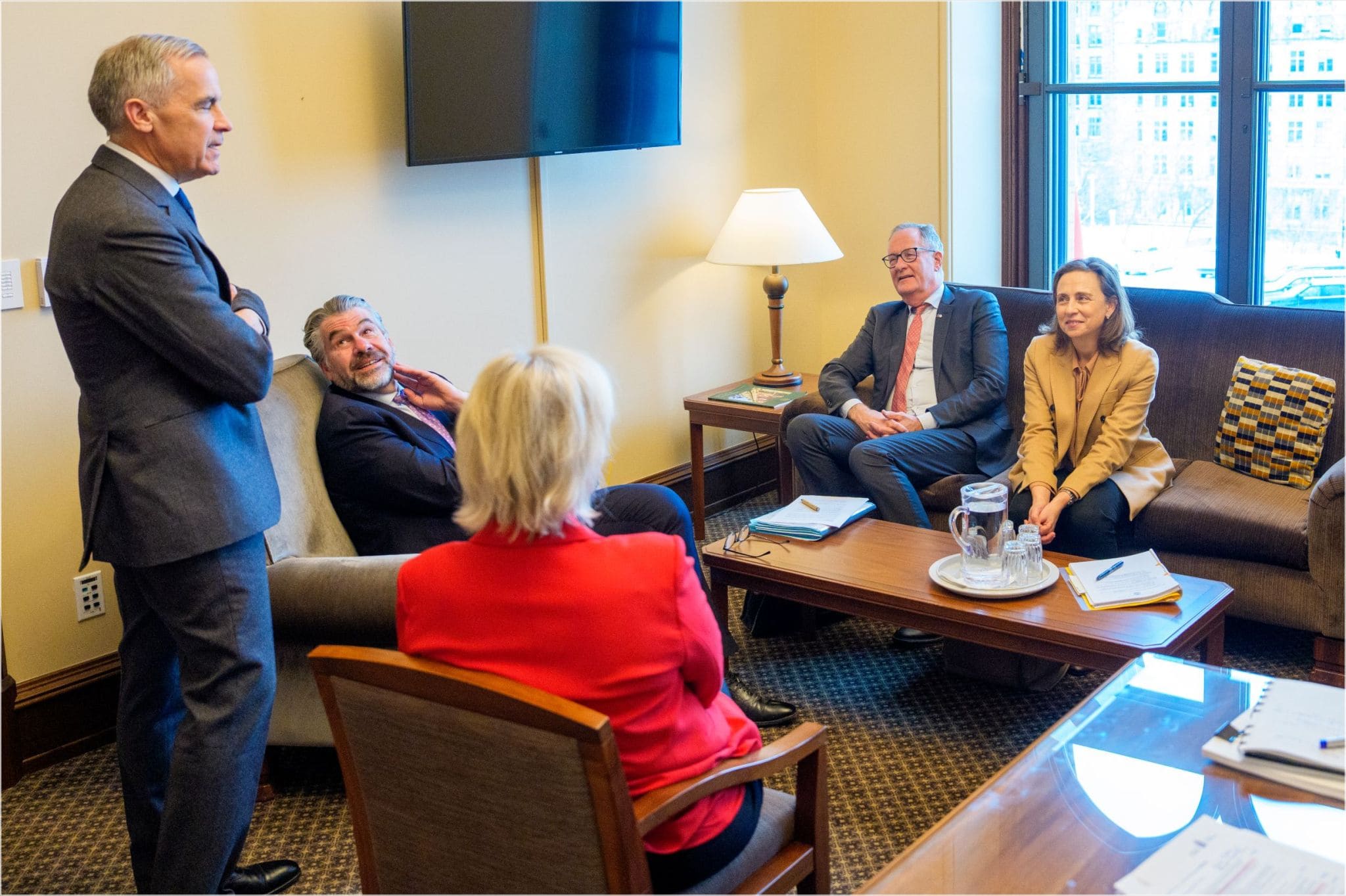
Belén Martínez Carbonell, secretary-general of the European External Action Service, the European Union’s diplomatic corps, made the remarks at a Feb. 27 press conference in response to a question from The Narwhal about whether Europe wants Canada’s oil and gas. She was in Ottawa as part of a visit to discuss a number of urgent foreign policy and defence priorities with senior Canadian government officials.
Her comments come as the world faces a global energy glut in fossil fuels, leading to questions — and challenges — for Canadian suppliers, including in oil-rich Alberta. The province just last week unveiled a budget showing depressed oil prices had led to a $7.5-billion decrease in royalties from the oilsands. But U.S. strikes on Iran in recent days, and retaliatory strikes throughout the region, have already impacted the global oil market and could send prices soaring.
Globally, the signals are mixed when it comes to prospects for Canadian fossil fuels. Canada’s trade relationship with the U.S., its biggest trade partner, has been fraught with uncertainty since the election of President Donald Trump. That uncertainty has led to increased interest in Canadian energy from China. The Indian government has also signalled it is eager to import Canadian oil and gas products, according to remarks by the Indian high commissioner, made as Prime Minister Mark Carney embarks on a visit to that country.
Meanwhile, Europe began importing higher volumes of liquefied natural gas (LNG) from the United States following Russia’s 2022 invasion of Ukraine. At the time, Europe moved to shut down Russian gas imports and phase out Russian oil. But relying on fossil fuels like methane-heavy LNG complicates the European Union’s objective of becoming the “world’s first climate-neutral continent” by 2050. That means Europe isn’t exactly rushing to buy Canadian oil and gas.
“Generally speaking, our policy is to give priority to clean energy sources, because we are on target to comply with our 2050 targets,” Martínez Carbonell said.
“More than 70 per cent of our electricity comes from clean renewables or nuclear, particularly small nuclear reactors. That’s the way forward. Simple.”
Talks ongoing on whether Canada’s carbon pricing can help avoid European tariffs on steel and more
This January, Europe enacted its Carbon Border Adjustment Mechanism, which implements a tariff on imports of carbon-intensive goods like steel and cement.
The mechanism raises the question of whether Canada’s own carbon pricing regime — which Carney has tinkered with, by first killing the consumer-facing carbon tax and then signing a deal with Alberta to allow more flexibility with its own — will be strong enough to keep up robust trade with Europe.
European diplomats say the two jurisdictions are holding many conversations on the topic, including between Carney and European Commission President Ursula von der Leyen, on how Europe can take Canada’s carbon pricing into account.
“This is, I would say, a question that comes up again and again, and there are some discussions to take that into consideration, to adjust the price,” said European Union Ambassador to Canada Geneviève Tuts, sitting beside Martínez Carbonell.
“We will not abandon the [tariffs] — but the price might be adjusted depending on what is done already in the country.”
Canada’s evolving energy relationship with Europe
The European Union and Canada are part of a “High-Level Energy Dialogue,” collaborating on things like developing a hydrogen supply chain, tackling methane emissions and developing nuclear power.
But the question of where Canada’s fossil fuels fit into the relationship has at times been a tricky one to answer.
Thirteen years ago, for example, the government under former prime minister Steven Harper was ultimately successful in opposing a push from Europe to discourage sales of fuel made from oilsands bitumen.
Crude oil from the oilsands is heavy and thick with sulphur. It requires extra steps in the upgrading and refining process compared to some other crudes to turn it into petroleum products like gasoline, which led some environmental organizations at the time to label it “dirty oil.”
More recently, oil and gas lobbyists in Canada argued after the Russian invasion of Ukraine that providing more fossil fuels to Europe would help support allies and displace foreign and hostile energy sources.
Months later, then-prime minister Justin Trudeau poured cold water on the idea during a meeting with his German counterpart in Montreal, when he said “there has never been a strong business case” to build LNG export terminals on Canada’s East Coast to ship more gas to Europe.
Under Carney, the message has changed again. On a trip to Berlin last year, Natural Resources Minister Tim Hodgson said Germany does, in fact, want to buy Canada’s LNG. Canada announced in August it would “begin discussions regarding the supply of LNG to German buyers.”
Hodgson has also said Canada wants to diversify its gas sales away from the United States, and the European Union’s energy commissioner has been open to that idea.
Europe’s reliance on fossil fuels for electricity is already dropping and that’s the ‘way to go’: secretary-general
Martínez Carbonell noted Europe’s decoupling from Russia has meant a change in the energy mix from many countries, including the U.S.
But she said the moving toward non-emitting electricity generation is “the way to go … continuing relying on renewables, diversifying energy imports when it comes to LNG, while bringing down to zero the energy exposure to Russia.”
At the same time, it’s unclear what kind of long-term demand Europe will have for oil and gas. Currently, the global explosion of LNG terminals is leading to a worldwide glut of natural gas.
Meanwhile, European Union statistics show electricity generated from fossil fuels decreased by 7.2 per cent in 2024 compared with the previous year and oil and petroleum products saw a 1.2 per cent drop in supply.