




 3 min. read
Guilt, panic and hopelessness are becoming familiar emotions for farmers facing increasingly extreme weather, according to new University of Guelph research examining how climate change is affecting mental health in the agricultural community.
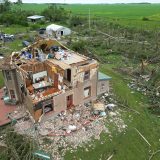
The findings are based on in-depth interviews with 36 Ontario farmers conducted by Rochelle Thompson, a PhD candidate in the university’s Department of Population Medicine. Thompson spoke with farmers between March 2023 and May 2024, all of whom had experienced climate-related disasters, including prolonged droughts, disease outbreaks or damage from severe weather events.
“I heard about the overwhelming, all-encompassing nature of extreme weather crises,” Thompson said. “A lot of people don’t even know what the first step is in situations like that.”
Several farmers questioned how many climate-related shocks they could endure before continuing to farm became unrealistic, Thompson said. Beyond financial losses, many described deep emotional strain associated with responsibility for land, animals and family livelihoods.
“There’s a lot of uncertainty for people after events like these,” she said. “Some question how many extreme weather events they can withstand.”
The interviews are part of a growing body of research at the university focused on farmer well-being. Thompson’s PhD supervisor, Andria Jones, has led two national surveys over the past decade examining mental health among Canadian farmers, collecting responses from thousands of participants.
“When you look at the stressors associated with farming, many are outside a farmer’s control,” said Jones, a professor and director of well-being programming at the Ontario Veterinary College. “Climate change is yet another stressor that contributes to uncertainty, which can lead to helplessness and hopelessness.”
A national survey released in 2016 found 45 per cent of farmers reported high stress, while 58 per cent experienced anxiety and 35 per cent reported depression. Those figures worsened during the COVID-19 pandemic, with a 2021 survey indicating that 76 per cent of respondents experienced moderate or high stress.
Jones said Thompson’s interviews add critical context to those numbers.
“You can see a bullet list of stressors, but it’s not until you hear it in someone’s words that you really understand what’s happening,” she said.
Farmers interviewed for the study described a “sinking feeling” when planning after climate disasters and anxiety about the well-being of livestock that depended on them. One participant summed up their experience simply: “For God’s sake, just rain.”
Beyond directly supporting farmers, Jones said the research also helps bridge the gap between the public and the realities of food production.
“If people don’t understand the challenges farmers are facing, how are we going to talk meaningfully about food security and food sovereignty?” she said.
Thompson hopes to publish the results of her qualitative study in 2026. Meanwhile, a third national survey of farmer mental health in Canada is set to launch in January, aiming to track how farmer well-being has changed over the past decade amid compounding pressures from climate change and the pandemic.
Researchers are also expanding their focus to equity-deserving groups within agriculture, including Black, LGBTQ+ and women farmers. Later this month, Jones and colleague Marsha Myrie will co-host a symposium for Black farmers to gather feedback, build connections and identify practical solutions.
Farmers interested in participating in future studies can register through the AJ Research Group’s website.