

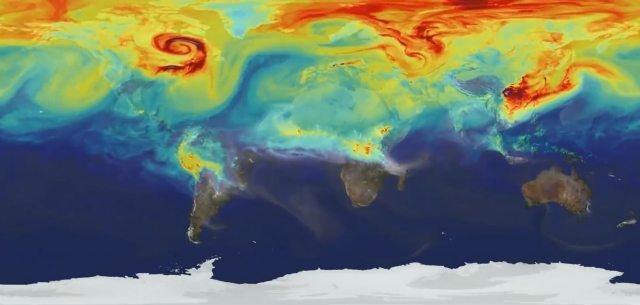

NASA scientists have brought to life the invisible carbon emissions floating around the atmosphere in a vivid, swirling simulation.

The “Year in The Life of Earth’s CO2” computer model is the first to show in such fine detail how carbon dioxide in the atmosphere moves across the globe.

The new model clearly shows that carbon is not distributed uniformly across the globe. Wind carries away the long streams of emissions spewing out of North America, Europe and Asia, with much of it winding up above the Arctic.

“While the presence of carbon dioxide has dramatic global consequences, it’s fascinating to see how local emission sources and weather systems produce gradients of its concentration on a very regional scale,” said Bill Putman, lead scientist on the project from NASA’s Goddard Space Flight Center.

Carbon pathways

“Simulations like this, combined with data from observations, will help improve our understanding of both human emissions of carbon dioxide and natural fluxes across the globe.”

Despite carbon dioxide’s significance, a lot is still unknown about the pathways it takes from emission source to the atmosphere or into carbon sinks such as oceans and forests.

The super-computer model, which depicts emissions from 2006, shows the seasonal carbon fluctuations as plants absorb CO2 in the spring and summer. With autumn comes decreased photosynthesis and the subsequent accumulation of carbon in the atmosphere.

But only half of the CO2 emitted by fossil fuels is absorbed by plants and oceans, while the rest remains in the atmosphere.

Rising temperatures

As Putman pointed out: “Although this [seasonal] change is expected, we’re seeing higher concentrations of carbon dioxide accumulate in the atmosphere each year, this is contributing to the long-term trend of rising global temperatures.”

Carbon dioxide levels have been rising in our atmosphere since the industrial revolution. And last spring, the levels of atmospheric carbon dioxide – the key driver of global warming – exceeded 400 parts per million for the first time in modern history; a symbolic moment highlighting that our dependence on fossil fuels is out of control.

NASA’s data modelling will be used to help scientists better predict future climate conditions. The project will be combined with satellite observations such as those from NASA’s Orbiting Carbon Observatory-2 launched in July to chart atmospheric CO2 levels.

@kylamandel

Photo: NASA

How our journalism makes a difference
Here at The Narwhal, we do journalism differently. As an independent non-profit, we’re accountable to you, our readers — not advertisers or shareholders. So we measure our success based on real-world impact: evidence that our reporting influenced citizens to hold power to account and pushed policymakers to do better.

Our stories have been raised in legislatures across the country and cited by citizens in petitions and letters to politicians.

Take our reporting on Alberta’s decision to allow cougar hunting in parks, which was cited in an official ethics complaint against the parks minister. And, after we revealed an oil and gas giant was permitted to sidestep the rules for more than 4,300 pipelines, the BC Energy Regulator started posting the exemptions it grants publicly.

This kind of work takes time, money and a lot of grit. And we can’t do it without the support of thousands of readers just like you.

Will you help us dig deep by joining as a monthly or yearly member, for any donation amount you can afford?
How our journalism makes a difference
Here at The Narwhal, we do journalism differently. As an independent non-profit, we’re accountable to you, our readers — not advertisers or shareholders. So we measure our success based on real-world impact: evidence that our reporting influenced citizens to hold power to account and pushed policymakers to do better.

Our stories have been raised in legislatures across the country and cited by citizens in petitions and letters to politicians.

Take our reporting on Alberta’s decision to allow cougar hunting in parks, which was cited in an official ethics complaint against the parks minister. And, after we revealed an oil and gas giant was permitted to sidestep the rules for more than 4,300 pipelines, the BC Energy Regulator started posting the exemptions it grants publicly.

This kind of work takes time, money and a lot of grit. And we can’t do it without the support of thousands of readers just like you.

Will you help us dig deep by joining as a monthly or yearly member, for any donation amount you can afford?

We’re fighting for our right to report — and your right to know. Stay in the loop about our trial against the RCMP and get a weekly dose of The Narwhal’s independent journalism
Red text in bold, capital letters: JOIN OUR FIGHT FOR PRESS FREEDOM
We’re fighting for our right to report — and your right to know. Stay in the loop about our trial against the RCMP and get a weekly dose of The Narwhal’s independent journalism
Red text in bold, capital letters: JOIN OUR FIGHT FOR PRESS FREEDOM