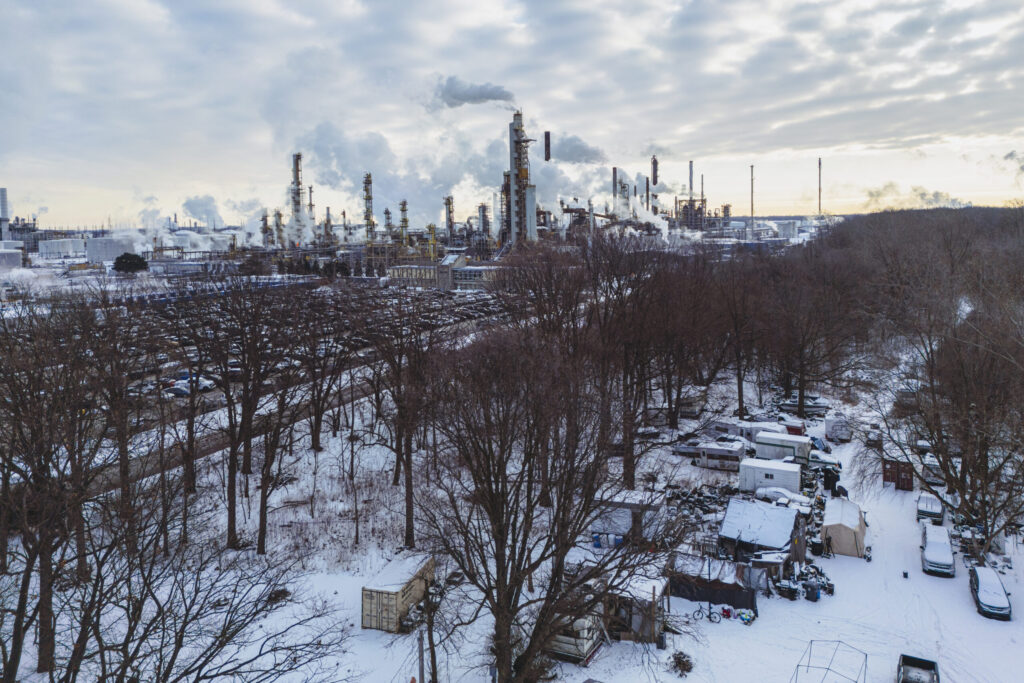
The joint effort to clean up Chemical Valley could serve as a model for the rest of the country, Aamjiwnaang First Nation Chief Janelle Nahmabin said this week at a signing ceremony.
Photo: Carlos Osorio / The Narwhal
The plan to take the chemicals out of Chemical Valley
Aamjiwnaang First Nation and the federal government will work together on a pilot project to address contaminated air, soil and water near Sarnia, Ont.
It’s been a pretty big week for Aamjiwnaang First Nation, an Anishinaabe community located next to an industrial area known as Canada’s Chemical Valley, in Sarnia, Ont.
For decades, the First Nation has fought for governments to take action against the cluster of petrochemical plants that surround it and release toxic chemicals like benzene, a known carcinogen, into the air. And for decades, that exposure has put people at a higher risk for cancer — corroborated by studies — and become emblematic of environmental racism that Canada has only recently begun to address.
Reporter Emma McIntosh was on the ground in Sarnia for the official announcement this week. It wasn’t her first time visiting Chemical Valley: she contributed to a story about petrochemical leaks there seven years ago, as a student journalist. Ever since, she’s kept her eyes open for an update that would point to solutions.
So when Emma met Aamjiwnaang Chief Janelle Nahmabin last fall — at a press conference where Nahmabin outlined how the nation was taking a new path forward to tackle pollution — the two kept in touch. And when Nahmabin invited her and photographer Carlos Osorio to cover the news in Aamjiwnaang this week, the answer was an immediate yes.
“Although we are strong, resilient, beautiful people who are rich in community and ambition, we still have been impacted for decades by systematic pollution and lack of environmental protection,” Nahmabin said at the conference. “Aamjiwnaang will be a pilot for how this rolls out across Canada, and we are ready.”
The agreement stems from a new federal law that takes aim at environmental racism. What happens here, Emma told me, could have massive consequences for other Indigenous, Black and racialized communities that are disproportionately harmed by industrial pollution and contamination.
“For so long, Aamjiwnaang has been portrayed as a victim. And the community has been affected by pollution — just last April they announced a state of emergency for sky-high levels of benzene in the air. But they also have agency, and they’re also, as Chief Nahmabin put it, a community that’s rich in ambition,” Emma told me.
Need more good news? The Narwhal just won gold for the best feel-good story at the Canadian Online Publishing Awards! Freelancer Leah Borts-Kuperman earned the recognition for her reporting on Nipissing First Nation’s efforts to undo environmental damage by counting moose poop, planting wild rice and “doing some really good science.”
“It’s all connected, right?” Curtis Avery, the nation’s environment manager, told Leah. “The fish in the stream to the moose on the banks — that whole system is in itself an environment and capturing that now allows us to understand what we need to do to protect it and make it more resilient in the face of more development, climate change, extreme weather events and forest management … we need the data in order for it to make sense.”
There’s a lot to say about what’s going wrong in the world these days, and those stories are important. And it’s just as important to shine a light on solutions and the people making an effort every day to make their little part of the planet a better place. Go check out the story of Nipissing First Nation’s work to heal the land, which offers a timely reminder of that truth.
This week in The Narwhal
Opinion: Tariff threats have unified Canadians around resource extraction — at the expense of Indigenous Rights By Michelle Cyca
B.C. Premier David Eby and other political leaders shouldn’t use this moment to backtrack on environmental protections or reconciliation.