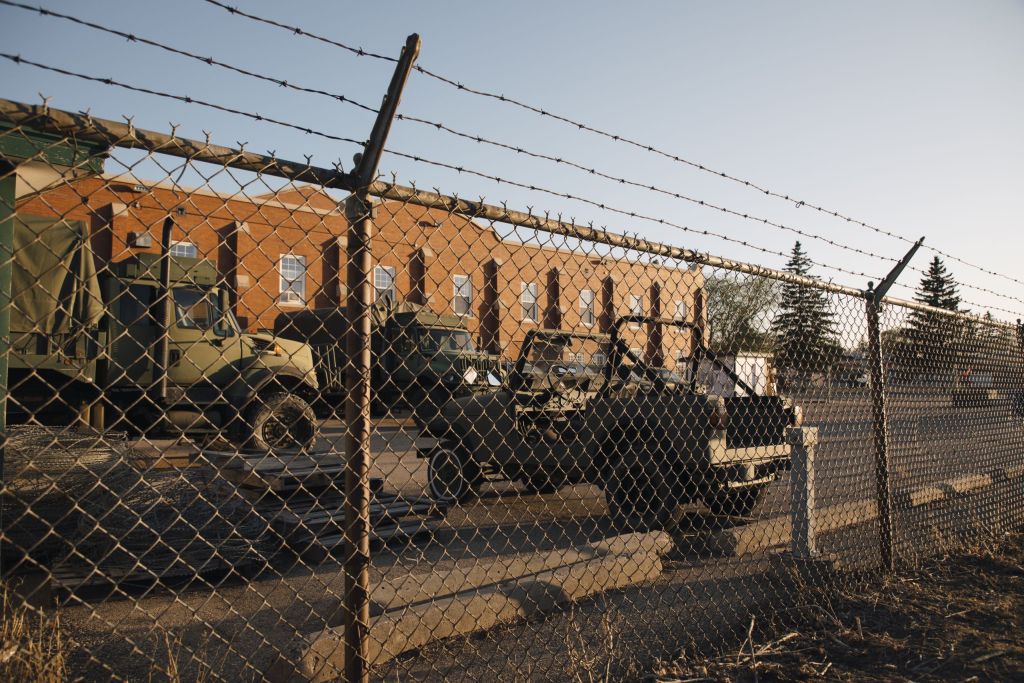
The military base in Moose Jaw, Sask., is a federally listed contaminated site. Current and former employees are sounding the alarm over a rash of cancers and other illnesses they say are related to toxins in the ground and water.
Photo: Amber Bracken / The Narwhal
Canada has big plans for its military future. The federal government has pledged to dramatically increase defence spending and hire thousands of people in the next decade or so. To house some of those new service members, the Department of National Defence has promised 668 new residential units on Canadian Armed Forces bases across the country.
But will that housing be safe for military families? Freelance reporter Leah Borts-Kuperman has been trying to answer that question for months. When the housing was announced in January, Leah was already looking into contamination at the Canadian Forces base in Moose Jaw, Sask., where current and former employees were trying to draw attention to a rash of cancer and other illnesses. And the planned new housing? Leah quickly noted that every one of the bases chosen is listed on the public inventory of contaminated sites owned by the federal government (alongside CFB Moose Jaw).
The inventory lists thousands of places across Canada where federal projects and activities have left per- and polyfluoroalkyl substances (PFAS, often referred to as “forever chemicals”), polychlorinated biphenyls (PCBs) and other toxins in the water and soil. The contaminants are linked to various cancers, heart issues, immune dysfunction and problems with fertility, pregnancy and child development.
So Leah pitched two investigations about contamination on military sites: one about people pushing for answers in Moose Jaw and one about what kind of cleanup it would take to build safe homes. At the heart of both stories are military members, civilians and families — including a group that calls itself Brats in the Battlefield — advocating for justice and a better future.
We published Leah’s story about CFB Moose Jaw three weeks ago, and it quickly became one of The Narwhal’s most-read stories this year. Among the tens of thousands of readers were Armed Forces members who reached out to tell Leah their own experiences, some of which made it into the housing story, which we published today — including those of former aircraft technician George Westcott, who believes his wife’s cancer death is linked to asbestos exposure on CFB Trenton, where they lived for years.
National Defence says it works to protect people and the environment, but acknowledges military activities have significant impacts. In 2023-24, the department was responsible for fully half of the federal government’s greenhouse gas emissions. And, as Leah has reported before, foam from firefighting training has led to PFAS-contamined water across Canada, including on some of the bases in today’s story.
The good news, Leah learned, is that effective soil cleanup is possible, with enough time and money. An expert she spoke with said remediating contamination and repurposing what are known as “brownfields” for housing is a “win-win” for everyone. Hopefully, the hundreds of millions of dollars being spent to remediate government sites across the country will inform both policy and process, spurring cleanup of industrial contamination on sites owned by private businesses.
But that doesn’t do much for those who say their health has already been harmed. In New Brunswick and Quebec, National Defence has compensated service members and their families who say they have contamination-related illness (while sometimes continuing to deny a direct connection). At other sites, determining the true human cost of these toxins seems to have barely made it onto the department’s agenda.
The Narwhal is celebrating two award nominations from the U.S.-based Institute for Nonprofit News — including for a project that freelance photojournalist Gavin John called “a highlight of my career.”
Gavin is a finalist for the Insight Award for Visual Journalism, which honours portrayals of communities that have traditionally been underrepresented or misrepresented in news media. Over three days, Gavin travelled with journalist Jimmy Thomson and photographed efforts to restore buffalo to Blackfoot territory across Montana and southern Alberta. Gavin’s stunning photographs included moving portraits, detailed images of beadwork and breathtaking vistas of the land and animals the community is working to care for.
We’re also a finalist for the award for the best investigative journalism, for a five-part series exposing oil and gas giant TC Energy’s campaign to influence media and government, with reporting led by Matt Simmons, Mike De Souza and Fatima Syed. Their dogged efforts led to an internal review by a provincial lobbying watchdog and a public apology from TC Energy.
As a non-profit outlet funded by readers like you, we’re proud to be honoured alongside other news leaders across North America. The winners of the Nonprofit News Awards will be announced at a ceremony in New Orleans in September.
This week in The Narwhal
Alberta spent $30m on unpaid land rent for delinquent oil and gas companies in 2024 By Sharon J. Riley
When oil and gas companies are unable, or unwilling, to pay their land rent, the provincial government will pay it for them. More than 99 per cent of the time, the government never gets its money back.
What we know about fossil fuel subsidies in Canada By Drew Anderson READ MORE
A record year for Great Lakes piping plovers By Lester Graham READ MORE
Leah Gazan grew up chasing waterfalls ... literally By Savannah Ridley READ MORE
Remember to put waste in its designated place — and then remind your friends to subscribe to The Narwhal’s newsletter for stories about the human impacts of environmental problems they won’t find anywhere else.