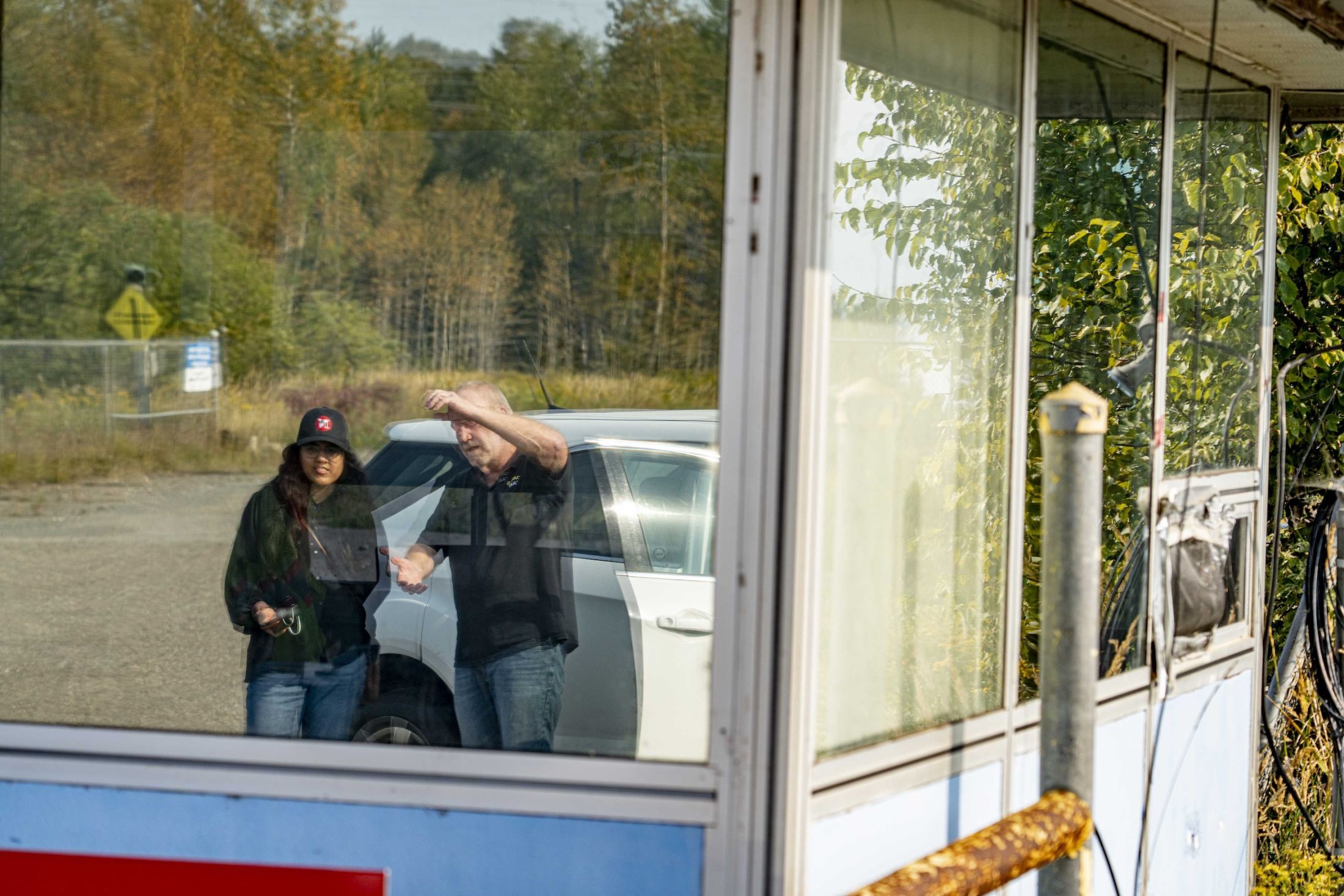
Ontario reporter Fatima Syed met Thunder Bay resident Robin Doherty when he picked her up in a taxi. He shared a wealth of knowledge on the changing local shoreline.
Photo: David Jackson / The Narwhal
Fatima Syed has been reporting on energy issues and more from Mississauga, Ont., since 2019, digging into documents obtained through freedom of information requests and speaking regularly with industry sources.
On Thunder Bay's Lake Superior shoreline, we dive into a decades-long effort to clean up a century of industrial pollution.
Taxi drivers are incredible and underappreciated carriers of local history. In their minds is an ever-changing map of the city they drive around daily — a portal to the past and unfolding future.
Take Robin Doherty, a lifelong resident of Thunder Bay, Ont. Last fall, he picked me up from the airport on a wonderfully warm September day. He asked me what brought me to the city — and I’m so glad he did.
Thunder Bay’s shoreline along Lake Superior — the greatest of the Great Lakes, codified in songs, poems and lore — has been the subject of a decades-long effort to clean up a century of pollution by the paper and pulp mill industry that once defined the city. I came to report that story.
How lucky for me that Doherty had worked in one of those mills. How lucky that he pointed out the old mill sites to me on our drive. How lucky that he told me the water wasn’t always that oceanic blue; that it was once a slimy grey that stuck to swimmers — a normalized cost of the riches that industry once brought to the town.
The shift began in 1987, after Thunder Bay was declared an “area of concern” under the Canada-U.S. Great Lakes Water Quality Agreement — one of 43 sites targeted for decades of environmental degradation. That initiated a huge collaborative effort of scientists, First Nations and policymakers in Thunder Bay. Together, they have brought native plants back to the shoreline, built parks, cleaned up beaches and restored waterways — and now look to the daunting task of vacuuming out the remaining mercury from the city’s North Harbour. As one scientist who spent the day with me put it: “This is rehab for the environment.”
You can read about their work in my story, and see the results through David Jackson’s magical photos.
The change is as visceral as it is profound. I thought about it every time I crossed a pedestrian bridge that now connects downtown Thunder Bay to the waterfront. Halfway across, someone had graffitied the floor with red crayon: “bad days build better days.” It felt like a metaphor for a city that is reconnecting with nature after a history of destroying it.
Thunder Bay’s transformation is both a win and a warning — proof that it is possible to restore once-damaged habitat and a reminder to keep it that way, especially as the mining industry is knocking at the city’s door, and as the Ontario government is removing all environmental regulations in its way with its controversial Bill 5.
As Doherty told me repeatedly on the tour he took me on, nobody will let Lake Superior be muddied again: “Not up here. Not here.”
Take care and build better days,
Fatima Syed
Ontario reporter
P.S. Last week’s newsletter was about the strange echoes between Ontario’s proposed Bill 5 and B.C.’s proposed Bill 15. The bills are so similar, even we got confused: at one point we mislabelled Ontario’s legislation as Bill 15. We apologize for the error and any confusion — and thanks to the sharp-eyed reader who pointed it out!
We’re excited to announce that The Narwhal has partnered with filmmaker Daniel J. Pierce on a new documentary, Trouble in the Headwaters, premiering in Victoria next month!
The powerful 25-minute film, out this summer, is about the hidden impacts of clear-cut logging — and the root causes of devastating flooding in Grand Forks, B.C.
The documentary follows Dr. Younes Alila, a professor of forest hydrology at the University of British Columbia, as he investigates the upstream impacts of industrial clearcut logging in the Kettle River watershed. With compelling field footage and scientific insight, the film reveals how loss of forest cover has triggered a cycle of flooding, landslides and drought — transforming the landscape and endangering communities downstream.
You can watch the trailer now on our YouTube channel (while you’re there, please hit subscribe!).
And if you’ll be near Victoria on Thursday, June 12, we hope you’ll join us for the premiere screening at the Vic Theatre. After the film, there will be a lively Q&A followed by a reception with Pierce, Alila and Narwhal staff. Seating is limited — get your tickets here.
This week in The Narwhal
How BC Wildfire Service is fighting misinformation with compassion By Matt Simmons
As more people engage with posts about wildfires on social media, the government agency is trying a new approach to combat the spread of misinformation.