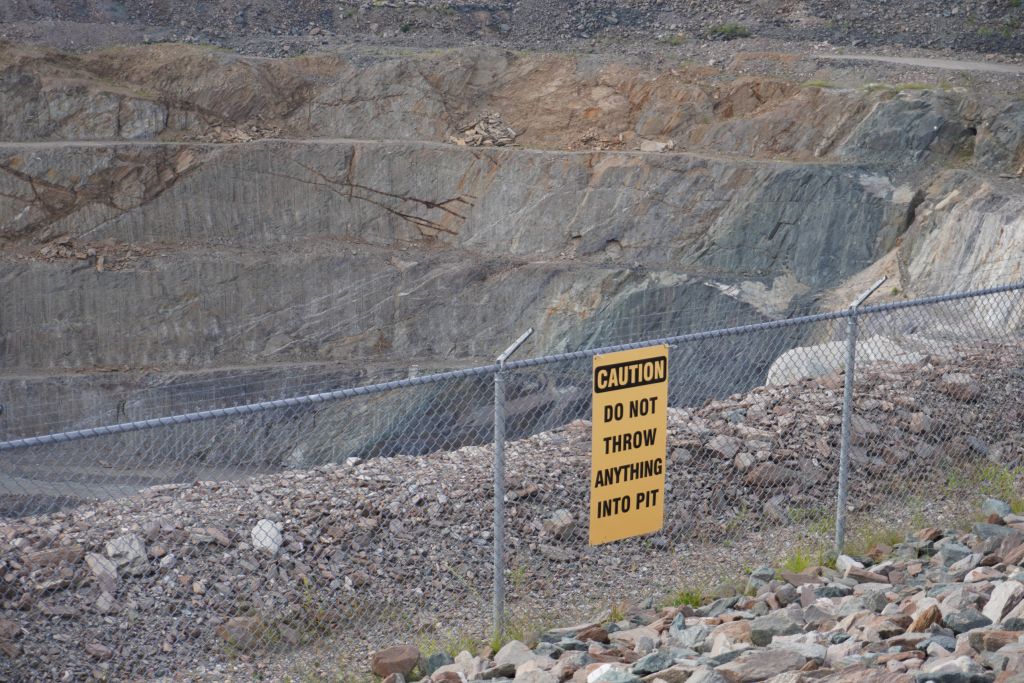
The City of Timmins converted its Shania Twain Centre from a figurative money pit into a literal one when it sold the tourism attraction to the gold mine next door in 2013.
Photo: Leah Borts-Kuperman / The Narwhal
A past effort to attract fan tourism to Shania Twain’s hometown of Timmins didn’t go well. A proposed nickel mine has the town wondering if it can only go up from here
Thanks to 219 (and counting!) readers like you, we’re in great shape to keep sending journalists out into the world to report stories you won’t find anywhere else — and hold politicians accountable for the impact of their decisions on Canadians. Speaking of which …
If you’ve ever been to Timmins, you know two things to be true. First, mining is at the core of the northern Ontario town: public spaces are named after mining companies and a popular lookout trail in town gazes out over the hole left in the ground by a recently shuttered gold mine. Second, Canadian pop-country legend Shania Twain grew up there.
But while the local mining industry has seen its share of boom and bust, the town’s past ambitions to build a Shania-based tourism economy were just a bust. The Shania Twain Centre opened in 2001 but failed to attract the expected influx of visitors. The real value, it turned out, was underground. The town cut its losses and sold the site in 2013 to a mining company — the centre was demolished to allow expansion of the gold mine next door, and locals would soon look out over an even bigger open pit.
Critical minerals are a hot topic. There’s a Canada-wide strategy to get them out of the ground — in part to fuel electrification, but also for less eco-friendly ventures like data centres — and towns like Timmins are seeing fresh opportunity. In 2016, the town was one of the slowest-growing communities in the country, and major mines in the area continue to close, taking jobs with them. It makes a proposal for a massive nickel mine about 40 kilometres north all the more enticing.
The company behind the Crawford Nickel mine is well into the federal impact assessment process, designed to suss out the ways the project could affect the environment and communities that rely on it, including harm to 147 hectares of fish habitat the company deems “unavoidable.” Everyone Leah spoke to recognized the economic opportunity in the mine, but many still have questions and want more details on possible short- and long-term impacts.
Any plan for mines better walk the line, but critics say Ontario’s mining law is doing little to hold them to it. And the Doug Ford government has even further degraded the law over its tenure, including by empowering the mining minister, rather than technical experts, to approve mine closure plans. (Okay, so you’re a rock scientist?) More recently, fast-tracking measures advanced through Bill 5 could see mines hurtle ahead with little provincial oversight or assessment.
For this story, Leah spoke with Taykwa Tagamou Nation Deputy Chief Derek Archibald, who sees both sides of the coin. His nation invested $20 million in the Crawford Nickel project for a share of nearly nine per cent. But when it comes to Bill 5, legislation the province passed without Indigenous consultation, that don’t impress him much. He says the province is trying to “bulldoze” over rights in the effort to push projects through.
“First Nations don’t need to be bypassed; we’re ready to lead and jump in,” he said. “We’re building a partnership based on consent.”
Since the re-election of President Donald Trump, the U.S. government has made quick work of slashing environmental programs. Wildlife migrations, though, aren’t constrained by political lines on maps — neither are the impacts of those cuts.
“We know British Columbians need in-depth, critical coverage to understand what’s happening in our province, particularly in regions where important stories would otherwise go unreported,” B.C. bureau chief Lindsay Sample said.
Meet the Saskatchewan farmers trying to do things better By Delaney Seiferling
Regenerative. Sustainable. Organic. Holistic. In Saskatchewan, farmers are sorting through the hype to find new agricultural approaches that help the soil — and their bottom lines.
‘Our water should never be that dirty’: the water crisis in First Nations is about staffing too By Savannah Ridley READ MORE
Alberta’s new plan for its electricity market punishes renewables By Drew Anderson READ MORE
B.C. spent $200 million to connect one LNG plant to the electrical grid By Shannon Waters READ MORE
Nothing gets a Narwhal reporter excited quite like the chance to go find out what’s really happening on the ground. If what they learn might be exciting to someone to you know, send them a link to subscribe to our newsletter!