
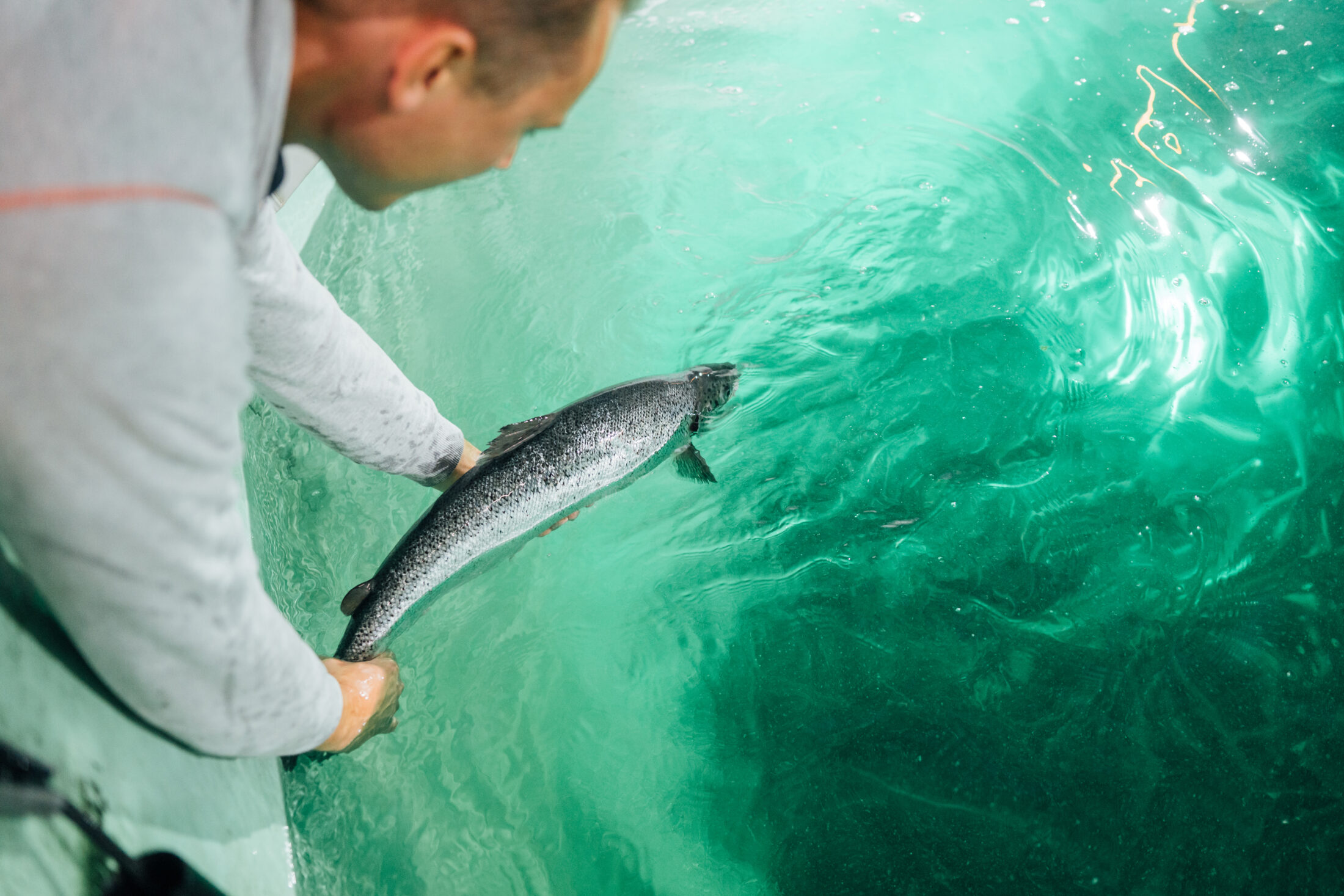
How does fresh, farm-to-table salmon raised in a desert in the United Arab Emirates or the mountains of Switzerland sound to you? Would you be willing to dig into the world’s first genetically modified food animal: salmon grown at twice the speed in land-based containers on Prince Edward Island?

It may sound incompatible with our idea of seafood, but land-based salmon farming is emerging as a sustainable source of protein for the world’s growing population. The practice is increasingly taking hold, but like any technological advancement, it comes with both risks and advantages. 

As wild fisheries collapse or reach peak harvest, land-based salmon farming offers an alternative to sea-based open net pen farming, which has been associated with the escape of Atlantic salmon into the Pacific Ocean, and with spreading disease to vulnerable wild salmon populations. 

Land-based salmon farming offers advantages such as proximity to markets, flexible waste management, ideal growing conditions free of disease and pesticide or antibiotic use, and protection for wild populations and marine ecosystems. 

But there are limitations. Land-based farming is capital intensive and bringing fish to market with a new project can take five years or longer. When it comes to farming genetically modified fish, the risk of human error and genetic contamination of wild species arises. Then there is the issue of disclosure: Canada does not require genetically engineered foods to be labelled. Concerns also exist for Indigenous Peoples like the Mi’kmaq, for whom salmon is sacred.

Nevertheless, successful application of land-farming technology around the world is happening at scale, on track to significantly outpace B.C.’s farmed production — 99 per cent of which happens at open net pen farms. But the BC Salmon Farmers Association insists that “the science to produce large numbers of salmon on land just isn’t there yet,” and the government of Canada is stepping back its promise to transition away from open net pen farming by 2025.

Taken together, we are left with unanswered questions about the future of sustainable salmon policy, technology and the industry writ large.


How our journalism makes a difference
Here at The Narwhal, we do journalism differently. As an independent non-profit, we’re accountable to you, our readers — not advertisers or shareholders. So we measure our success based on real-world impact: evidence that our reporting influenced citizens to hold power to account and pushed policymakers to do better.

Our stories have been raised in legislatures across the country and cited by citizens in petitions and letters to politicians.

Take our reporting on Alberta’s decision to allow cougar hunting in parks, which was cited in an official ethics complaint against the parks minister. And, after we revealed an oil and gas giant was permitted to sidestep the rules for more than 4,300 pipelines, the BC Energy Regulator started posting the exemptions it grants publicly.

This kind of work takes time, money and a lot of grit. And we can’t do it without the support of thousands of readers just like you.

Will you help us dig deep by joining as a monthly or yearly member, for any donation amount you can afford?
How our journalism makes a difference
Here at The Narwhal, we do journalism differently. As an independent non-profit, we’re accountable to you, our readers — not advertisers or shareholders. So we measure our success based on real-world impact: evidence that our reporting influenced citizens to hold power to account and pushed policymakers to do better.

Our stories have been raised in legislatures across the country and cited by citizens in petitions and letters to politicians.

Take our reporting on Alberta’s decision to allow cougar hunting in parks, which was cited in an official ethics complaint against the parks minister. And, after we revealed an oil and gas giant was permitted to sidestep the rules for more than 4,300 pipelines, the BC Energy Regulator started posting the exemptions it grants publicly.

This kind of work takes time, money and a lot of grit. And we can’t do it without the support of thousands of readers just like you.

Will you help us dig deep by joining as a monthly or yearly member, for any donation amount you can afford?

We’re fighting for our right to report — and your right to know. Stay in the loop about our trial against the RCMP and get a weekly dose of The Narwhal’s independent journalism
Red text in bold, capital letters: JOIN OUR FIGHT FOR PRESS FREEDOM
We’re fighting for our right to report — and your right to know. Stay in the loop about our trial against the RCMP and get a weekly dose of The Narwhal’s independent journalism
Red text in bold, capital letters: JOIN OUR FIGHT FOR PRESS FREEDOM