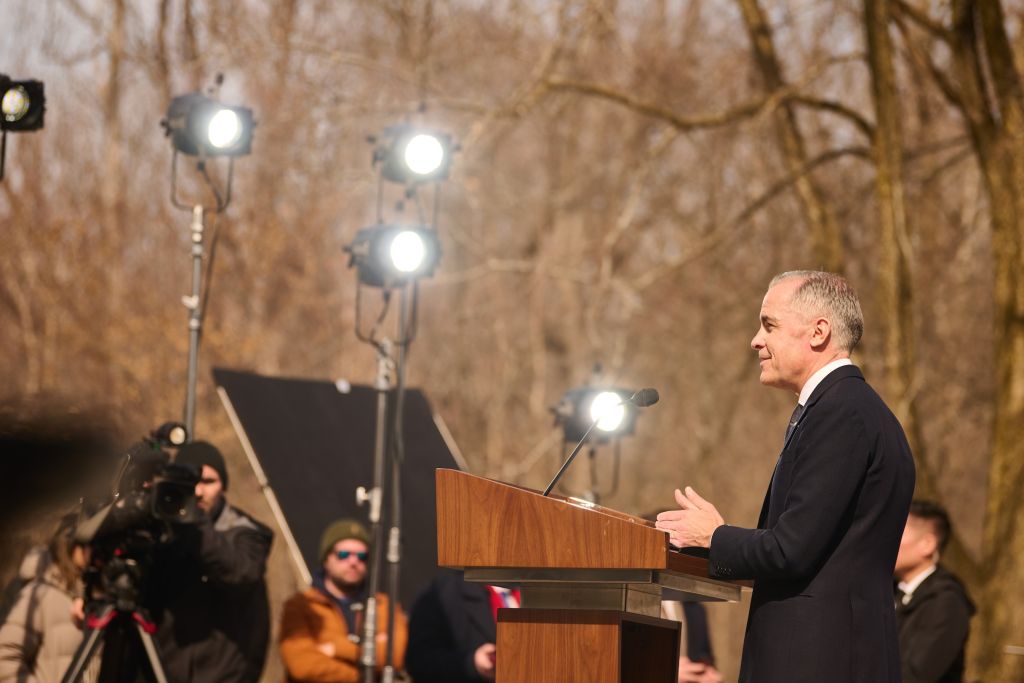
Mark Carney, pictured here in Ottawa after a ceremony to swear in his cabinet in March 2025, has big plans to push forward big projects across the country.
Photo: Kamara Morozuk / The Narwhal
“We used to build in this country, and we are building our nation again.”
Prime Minister Mark Carney said those words today at a news conference in Terrace, B.C., where he announced a fresh round of “nation-building” projects he’s referring to the federal Major Projects Office for possible fast-tracking.
Among them is the Ksi Lisims liquefied natural gas (LNG) export plant — a massive, floating facility planned for British Columbia’s northwest coast. B.C. politics and environment reporter Shannon Waters has been following that project closely, as well as the North Coast transmission line, which also made the latest round of Carney’s priority list and could — eventually — bring hydro power to Ksi Lisims.
But wait — the provincial and federal governments jointly approved Ksi Lisims back in September. If it already has the go-ahead, what role does the Major Projects Office actually play, and what does fast-tracking actually mean?
Amid all the major-projects hoopla, I’ve been doing my best to sort hype from reality. What I’ve recently learned has totally changed how I think about this stuff. Did you know:
Nothing has been designated a federal project in the “national interest” — so far
Nothing has been designated to be “fast-tracked” by the federal Major Projects Office — so far
Nothing has been given any special ability to avoid any federal permits or requirements — so far
Carney’s priority project list is more than just symbolic, though. Dawn Farrell, CEO of the Major Projects Office, explained a little more at the news conference. The office’s main focus, she said, is helping to secure financing that makes the projects competitive internationally.
“The world only pays a certain price for our goods, and we need to meet them at those prices,” she said.
The Major Projects Office can also help with other things, Farrell said, such as lining up permits and a skilled labour force.
I’m left wondering: was that legislative power play just for show, or is the moment when it becomes necessary to Canada’s nation-building ambitions yet to come?
My colleagues and I will keep asking, and answering, these questions. There’s so much at stake, and it’s not lost on me that the federal government is throwing its weight behind a huge LNG facility on the same day it’s boasting about climate change leadership at a global conference abroad.
Who’s afraid of the big, bad coywolf? By Evert Lindquist
Reports of a larger, more aggressive coyote wandering Toronto streets understandably draw attention, but behind the myth of the coywolf is the truth about Ontario’s wolf problem.
The day pipeline security followed me — and what I learned later about Canada’s spy agency By Matt Simmons READ MORE
B.C.’s century-long feast on big, old trees has sent forests into freefall By Zoë Yunker READ MORE
‘We have a way to save communities’: Indigenous fire keepers share knowledge across colonial borders By Aaron Hemens READ MORE
When a major federal announcement drops hours before a Thursday newsletter deadline, you can bet Narwhal reporters are hot on the case. That’s why more than 100,000 readers rely on our weekly newsletter to stay in the loop — remind a friend to subscribe!