

 7 min. read
Summary
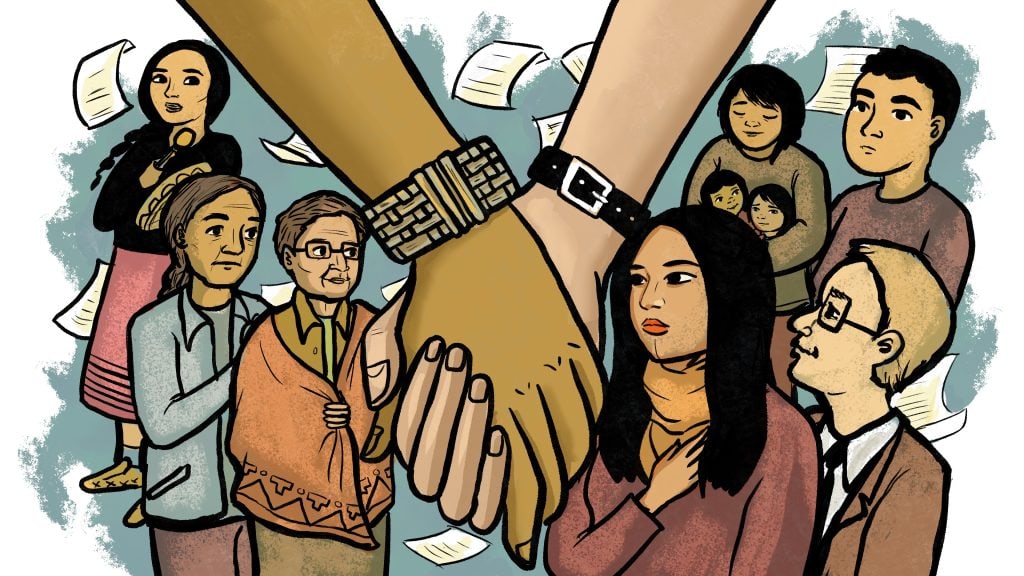
“This body of records that has really important information of Survivors … is going to be destroyed,” Connie Walker says.
The Pulitzer and Peabody Award-winning investigative journalist and member of Okanese First Nation in Saskatchewan is talking about the 38,000 testimonies from residential school survivors collected by the federal government between 2007 and 2012.
They contain first-hand experiences recounted by some of the estimated 150,000 children who attended residential schools operated by the Canadian government. The schools operated for two centuries; the last to close was Kivalliq Hall, in Rankin Inlet, Nvt., in 1997. Many children experienced physical and sexual abuse, disease, neglect and despair. Over 3,200 deaths at residential schools have been confirmed, a far higher mortality rate than that of non-Indigenous children at the time — and the true number of deaths is likely greater. Those who died in institutions were usually buried there.
These testimonies are the largest body of residential school records in Canada — an irreplaceable body of evidence, containing more than six times as many testimonies as the Truth and Reconciliation Commission. And in September 2027, it is set to be destroyed.
Walker is trying to stop them from being destroyed without giving survivors a choice. As an assistant professor and the Velma Rogers Research Chair at the Toronto Metropolitan University, she is leading the Indian Residential School Records Project, to raise awareness about the imminent destruction of records.
Along with the Yellowhead Institute, her partner on the project is lawyer Kimberly Murray, a member of Kanehsatà:ke Mohawk Nation and a former executive director of the Truth and Reconciliation Commission. In 2022, she was appointed the independent special interlocutor for missing children and unmarked graves and burial sites associated with residential schools.
“We know that some spoke about deaths and burials, and also about having dug the graves of other children that have died,” Murray tells The Narwhal of the testimonies.
In 2024, Murray’s office released Sites of Truth, Sites of Conscience, a report examining “missing and disappeared” Indigenous children’s unmarked burials and mass graves across Canada. In its introduction, the report reads: “The buildings, burial grounds, and cemeteries on the sites of former Indian Residential Schools are etched deeply in Survivors’ memories. Once places of silence and suffering, they are now sites of truth.”
“Once places of brutal violence and genocide, they are now sites of conscience. Survivors can never forget the memories of trauma and death held in these sites; now Canada and all Canadians must do likewise.”
But the truth is at risk of being lost if Canada destroys the records. Murray says it would not just serve to hide the horrors that happened at the schools, but contribute to the disappearance of stories about Indigenous lives before children were taken from their families.
“They write about how they lived on the land, how they were being taught on the land by their parents and grandparents,” Murray says.
Why is Canada set to destroy thousands of residential school records?
The testimonies weren’t collected in an effort to document and preserve the history of residential schools. The process was a response to a tidal wave of lawsuits thousands of Survivors launched against the federal government and churches starting in the 1990s.
In 2007, the federal government initiated a class-action settlement to deal with them all. It was designed to compensate Survivors of federal boarding schools (excluding thousands that attended day schools, or institutions run by religious orders or provincial governments). The base lump-sum payment was $10,000, plus $3,000 for each year of attendance.
To receive more, Survivors were required to testify through the Independent Assessment Process, so an adjudicator could determine if their claims were credible and merited additional compensation. The process promised confidentiality to those who testified. In 2017, the Supreme Court of Canada determined that promise meant the records must be destroyed.
The court created a 10-year window between the decision and the destruction, during which the government had to notify Survivors, who could choose to preserve their records. Walker and Murray are skeptical sufficient efforts have been made to contact them.
“We talk to Survivors who don’t remember being notified, don’t remember if a letter came or an email,” Walker says. “Survivors who don’t even know these records are going to be destroyed.”
Another hurdle is only the survivor can request their records be preserved, leaving no recourse for the many records of those who have since passed away.
Important evidence is contained within these testimonies, Murray and Walker emphasize. Survivors’ stories were only used to determine compensation; allegations of abuse were not prosecuted and information about burials or gravesites was not investigated. But they still could be, even informally.
As Indigenous communities across Canada search for unmarked graves and burial grounds at residential school sites, information about where to search is likely contained in countless testimonies.
“We know that some may not have been buried on the site of the institution, but in a municipal cemetery or offsite,” Murray says. “These pieces of historical documents, these records that Survivors filed in courts — they may have some of that missing information that can help the communities doing these searches.”
Residential school survivor testimonies to be destroyed as disinformation rises
The testimonies are also important bulwarks against the residential school denialism that has taken root. Fueled by disinformation, some Canadians have come to believe Survivors exaggerated — or fabricated — their experiences. But the Independent Assessment Process was one of intense, even brutal, scrutiny.
Those who requested a hearing were required to name their abusers. Walker recounts reading the transcript, with names redacted, of a survivor who was asked to describe in graphic detail the sexual abuse he endured from a priest when he was eight or nine years old, including whether he was aroused at the time. Some Survivors, after recounting everything they could remember about their abuse often decades after it occurred, had their claims denied.
The evidence in these claims is damning. But no matter how many testimonies were found credible, abusers did not face charges.
As Walker and Murray fight to delay the destruction of this particular body of evidence, they’re also using the court filings that prompted the settlement process to construct another one.
Between 14,000 and 20,000 lawsuits were filed across the country, Walker says. With the help of law students at Toronto Metropolitan University, her team is pulling some of those court filings to investigate the histories of five residential schools in Ontario, including cross-referencing them with details from the testimonies to try and identify abusers.
It’s a similar method she used making her 2022 podcast Stolen: Surviving St Michael’s. For that, she and a team of investigative journalists compiled 482 lawsuits filed by Survivors of the St. Michael’s Indian Residential School in Duck Lake, Sask., to document the widespread, harrowing abuse of children by priests and nuns who ran the school.
“There’s this idea about the [Truth and Reconciliation Commission], like, ‘Oh, that happened, and now we know the truth.’ “ Walker says. “But actually, that should have been the beginning.”
On Sept. 30, Yellowhead Institute is hosting “The Right to Truth: Protecting Indian Residential Schools” featuring Connie Walker and Kimberly Murray, as well as former commissioner of the Truth & Reconciliation Commission Marie Wilson and former premier of the Northwest Territories Stephen Kakfwi. Registration is free. Attend in person in Toronto or online.
Updated Sep. 28, 2026 at 6:51 a.m. PT: This story has been updated to clarify that Walker and Murray’s project is focused on the survivors’ choice in the fate of their records.