A company is eyeing Olds, Alta., for the future home of an AI data centre that would consume as much power as the city of Edmonton.
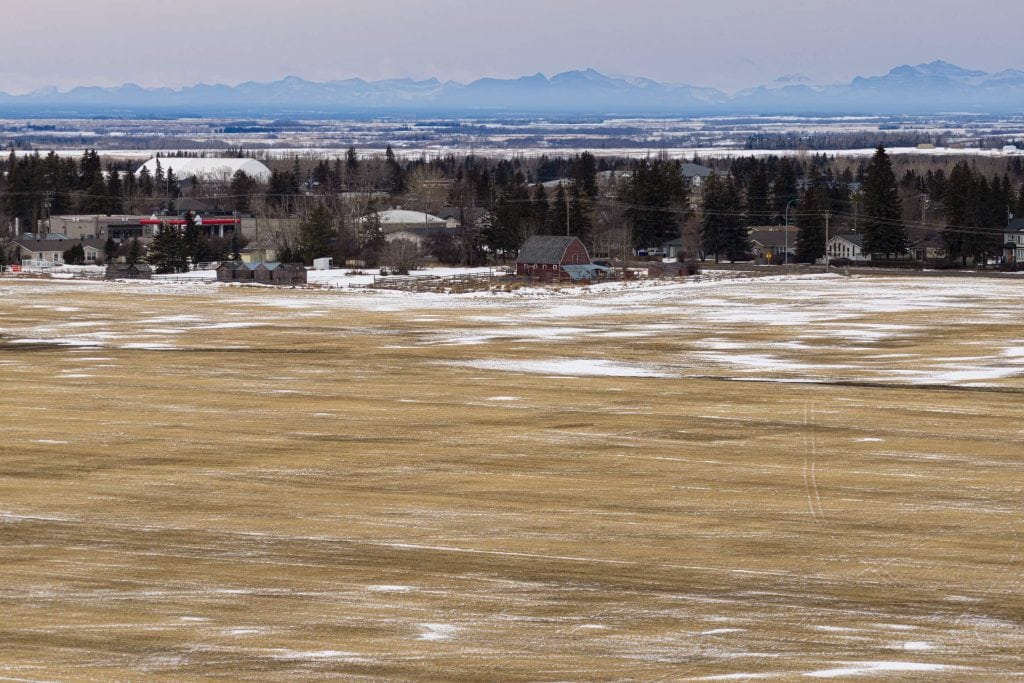
Photo: Gavin John / The Narwhal
The artificial intelligence industry is changing our lives and landscapes at an unprecedented pace. Here’s what that could mean for Olds, Alta. — and for our work at The Narwhal
Driving north from Calgary, you could easily pass by the rural town of Olds, Alta. — population 9,679 — located a couple kilometres off the main highway to Red Deer, and surrounded by a sprawling patchwork of Prairie farmland.
But a company called Synapse Data Centre Inc. has a $10-billion plan that would really put Olds on the map. It wants to build an AI data centre so big that it would consume as much electricity as the city of Edmonton. The power would come from natural gas, burned at an adjacent power plant that, if built, would be the second largest in Alberta.
Prairies reporter Drew Anderson and photojournalist Gavin John recently travelled to Olds to find out more. People who live there first learned of the ambitious proposal in late January. The company hopes to get shovels in the ground in March.
As the town’s mayor told Drew, we don’t yet know a whole lot about what those impacts would look like: “A lot of their questions and concerns that they had directed towards council, we didn’t have answers on yet because these studies and assessments haven’t taken place yet.”
Artificial intelligence technology, and the resources it demands, is changing our lives and our landscapes at an astonishing pace. At The Narwhal, we strive to report stories that help people better understand its consequences for the natural world.
At the same time, we’re thinking carefully about what it means for us behind the scenes, in terms of how we do our jobs and run our organization.
And today, we are sharing our guidelines on generative AI: the type of artificial intelligence that creates new content, such as text, images or media, based on inputs (e.g. “analyze this spreadsheet and provide a list of key insights”).
First and foremost, we make this commitment to you: we do not use AI to write articles, or to create photos, videos or illustrations. Reporting will always be led by our journalists, in line with our code of ethics.
Like everything we do at The Narwhal, our approach to using AI tools is rooted in preserving the trust we’ve worked so hard to build with you, our readers.
While we won’t be using AI to write stories, we are exploring ways that we can use the technology to serve you better. For years, we’ve been hearing from people who want to listen to our articles, rather than read them.
So we’re trying something new: AI-voiced audio versions of written articles. You can check it out on Drew’s story, and we hope to include this accessibility feature more regularly as we work out the kinks in the process. That includes human oversight, as we do our best to ensure words and names are pronounced correctly.
You may also notice another new feature on Drew’s story, and others on our site: bullet-point summaries at the top of the article, with an overview of the key points. While some outlets turn to AI to generate these summaries, all of ours will be human-written, just like the stories that follow.
We hope these changes help more people access The Narwhal’s reporting in ways that work for them.
As we experiment with AI, we’re doing so with caution and intention — weighing both its benefits and its environmental costs, and staying open to talking about it. Let us know what you think by replying to this email or filling out this survey about the use of AI tools in our journalism.
Earlier this year, The Narwhal revealed that LNG Canada’s facility in Kitimat, B.C., is burning a lot more natural gas than expected, in a process called flaring, due to an issue with its equipment that will take three years to fix.
After that investigation was published, freelance journalist Lauren Watson spoke with experts who told her that the long timeline is likely a business decision: it might be cheaper to keep flaring huge volumes of natural gas than to shut down operations and replace the equipment.
As the surrounding community continues to deal with impacts from noise and smoke, some are wondering why the BC Energy Regulator hasn’t ordered LNG Canada to bring flaring down to the level authorized by its permits — or penalized the company for exceeding it.
“Canada and B.C. governments pay lip service to the widely accepted polluter-pays principle but rarely apply it in practice,” David R. Boyd, an environmental lawyer and professor at the University of British Columbia, told Lauren in an email. “Large corporations frequently break environmental laws but are rarely penalized for doing so.”
LNG Canada did not directly answer questions about the three-year timeline, but said it is listening to the community and responding to its concerns. The BC Energy Regulator did not say if it would impose penalties on the company for the flaring, but noted the door remains open to do so.
Saskatchewan is on a crash course with Canada’s coal phaseout. Will the feds step in? By Carl Meyer
Federal rules require provinces to shift away from coal-fired power plants by 2030, but the Prairie province is putting millions into extending the life of its fossil fuel fleet.