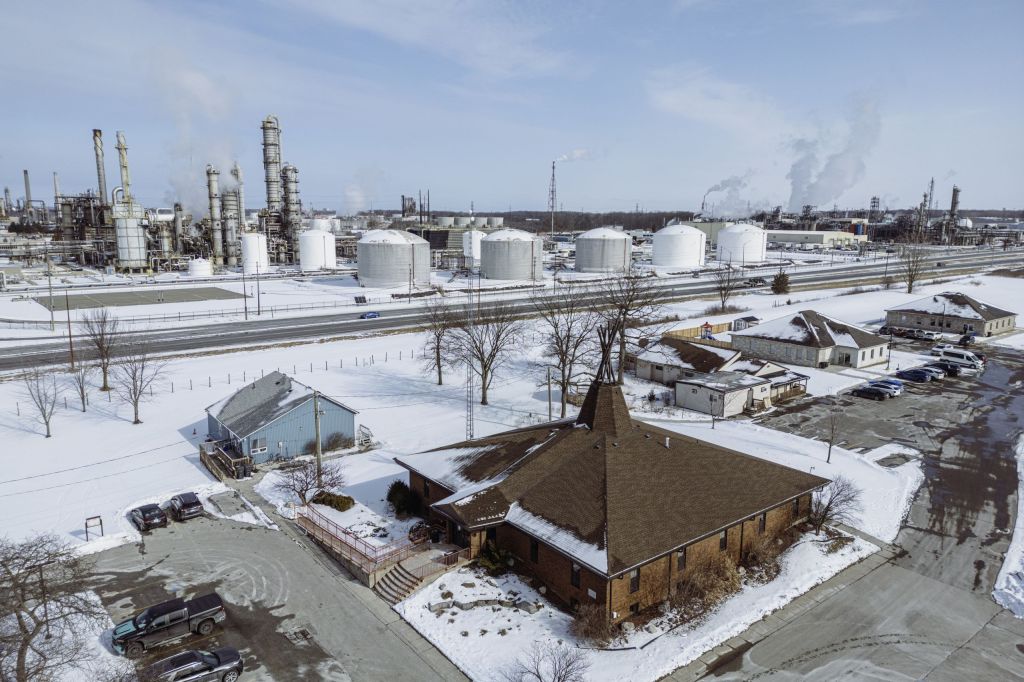
INEOS Styrolution owns a chemical plant across the street from the Aamjiwnaang First Nation band office. The facility began operations in 1943 and was recently decomissioned.
Photos: Carlos Osorio / The Narwhal
‘I absolutely had to do the story’: investigating air pollution in Chemical Valley
In southern Ontario, Aamjiwnaang First Nation is taking action on exposure to carcinogenic pollutants and stepping up where provincial regulators failed to
Between extreme heat and wildfire smoke, the air that surrounds us and the risks it carries is on my mind — and probably yours, too. For residents of Aamjiwnaang First Nation, which neighbours an area known as Ontario’s Chemical Valley, worries about the dangers that come just from breathing aren’t seasonal or transient: they’re constant.
The community, located in Sarnia, declared a state of emergency last year as monitors picked up spiking levels of carcinogenic benzene in the air. Several people went to the hospital with headaches and nausea.
Benzene, a petroleum product used to manufacture Styrofoam and other products, is a clear liquid that evaporates easily into air. It is known to increase risks of cancer and other health issues: the more you breathe in, the higher the risk.
And, as former Narwhal reporter Emma McIntosh uncovered, the Ontario government knew about the health risks to the Aamjiwnaang community, and failed for years to take action that would meaningfully control benzene exposure.
The graphic above represents different concentrations of benzene, averaged over a 24-hour period. On the left is the level, measured in micrograms per cubic metre of air, that the Ontario government says could indicate a higher cancer risk, with long-term exposure. The centre image represents levels in Aamjiwnaang on April 16, 2024, when people fell ill. On the right is the level the Ontario government said, in 2019, it would use to evaluate the risk of acute exposure from emissions from a chemical plant, located across the street from Aamjiwnaang’s band office, playground and sports fields.
That last number comes from one of the compliance orders — the tool the government uses to compel a company to address pollution — that Emma dug up in her investigation.
(Ontario’s Environment Ministry didn’t answer our questions; the company that operated the chemical plant said it “consistently operated within the strict limits” set by the ministry.)
“When we hear a phrase like ‘compliance order,’ it sounds scary, it sounds serious, it sounds like they’re doing something, they’re taking action,” Emma told me. “But when I actually read it, it kind of just slowly dawned on me that none of this was very urgent, none of this was very extreme.” And even these very relaxed measures, she found, saw pushback from industry for being too much, too soon.
“That was the moment when I knew I absolutely had to do the story.”
Emma first wrote about Chemical Valley nearly a decade ago when the nation was pushing for change in how industry was managed at their doorstep. “One thing that I noticed that was really different when I visited this time was the way Chief Janelle Nahmabin and Aamjiwnaang are really reclaiming their power in this situation,” she says.
When Emma and photographer Carlos Osorio visited in February, Chief Nahmabin was talking to industry and government representatives about a new pipeline law the nation had written for its territory — after years of governments failing to properly regulate them. The nation was also signing terms of reference with the federal government to address environmental racism.
“I think this story is going to be one to watch for many years to come because Aamjiwnaang is in the driver’s seat,” Emma says. “And when you see the documents and see how the government has approached this issue, you absolutely understand why they have to be.”
Emma’s investigation is published in two parts: the first dives into what the Ontario government did, and failed to do, to rein in benzene emissions from the chemical plant next door; the second looks at government plans that could have helped address pollution in the area — but were abandoned. I hope you’ll find some time this week to check them out.
I’m writing this newsletter from my desk in southern Ontario, where my kindergartener was sent home from school this week, feeling ill as her classroom sweltered. Other Narwhal staff have similar stories, whether about their own kids or their friends and families: a fifth-grade classroom that was 33 C at 8 a.m., a teacher who came across a dazed child wandering an oppressively hot hallway, hardly able to speak.
Despite decades of research on the realities of global warming, governments across Canada have not prepared for how extreme heat is hitting aging schools. That affects children, who need to recoup learning loss from COVID-19 lockdowns but might be safer at home (if the home has air conditioning). It affects teachers, who are trying to educate their students and keep them safe, while being at risk for heat-related health problems themselves.
All told, it affects millions of us across the country — and it often seems like nothing is being done.
Ontario schools are closing for the summer this week, but we want to keep the heat on this issue. Get in touchif you have a story to tell about extreme heat in schools. We’d especially love to hear from parents and educators trying to address this issue, which isn’t going away come fall.
— Elaine Anselmi, Ontario bureau chief
This week in The Narwhal
WATCH: Here’s what you need to know about Indigenous sovereignty By L. Manuel Baechlin
Indigenous sovereignty and Indigenous-led conservation are both crucial to Canada’s future — but they’re also widely misunderstood. We explain in our latest video.
Make Canada Build Again? Canadian politicians are suddenly in a rush to get shovels in the ground By Shannon Waters READ MORE
Two Albertas: rural town halls and Big Oil’s halls of power By Drew Anderson READ MORE
Can Toronto still enforce its green building standard? Ontario says no, but the city disagrees By Kathryn Mannie READ MORE
‘You don’t have to go to the North Pole to experience adventure’ By Denise Balkissoon READ MORE
Perspective: when you’ve found that perfect spot to escape the heat. Tell your friends and family to subscribe to The Narwhal’s newsletter for environmental reporting that keeps a cool head.
Here at The Narwhal, we do journalism differently. As an independent non-profit, we’re accountable to you, our readers — not advertisers or shareholders. So we measure our success based on real-world impact: evidence that our reporting influenced citizens to hold power to account and pushed policymakers to do better.
Our stories have been raised in legislatures across the country and cited by citizens in petitions and letters to politicians.
Take our reporting on Alberta’s decision to allow cougar hunting in parks, which was cited in an official ethics complaint against the parks minister. And, after we revealed an oil and gas giant was permitted to sidestep the rules for more than 4,300 pipelines, the BC Energy Regulator started posting the exemptions it grants publicly.
This kind of work takes time, money and a lot of grit. And we can’t do it without the support of thousands of readers just like you.
Here at The Narwhal, we do journalism differently. As an independent non-profit, we’re accountable to you, our readers — not advertisers or shareholders. So we measure our success based on real-world impact: evidence that our reporting influenced citizens to hold power to account and pushed policymakers to do better.
Our stories have been raised in legislatures across the country and cited by citizens in petitions and letters to politicians.
Take our reporting on Alberta’s decision to allow cougar hunting in parks, which was cited in an official ethics complaint against the parks minister. And, after we revealed an oil and gas giant was permitted to sidestep the rules for more than 4,300 pipelines, the BC Energy Regulator started posting the exemptions it grants publicly.
This kind of work takes time, money and a lot of grit. And we can’t do it without the support of thousands of readers just like you.
Your access to our journalism is free — always. Sign up for our weekly newsletter for investigative reporting on the natural world in Canada you won’t find anywhere else.
Your access to our journalism is free — always. Sign up for our weekly newsletter for investigative reporting on the natural world in Canada you won’t find anywhere else.
As a journalist who has spent decades asking questions that cut through noise, I’m cautious where I place my trust. The Narwhal has earned it — through rigorous, independent reporting, careful, on-the-ground storytelling and a clear commitment to the public interest. It’s why I’ve become a member myself. Will you join me? The Narwhal needs to add 400 new members this month to keep telling these important stories. And if you join now, you’ll get a special tote bag as thanks.
Anna Maria Tremonti, founding host of CBC Radio’s The Current and member of The Narwhal’s board of directors
As a journalist who has spent decades asking questions that cut through noise, I’m cautious where I place my trust. The Narwhal has earned it — through rigorous, independent reporting, careful, on-the-ground storytelling and a clear commitment to the public interest. It’s why I’ve become a member myself. Will you join me? The Narwhal needs to add 400 new members this month to keep telling these important stories. And if you join now, you’ll get a special tote bag as thanks.