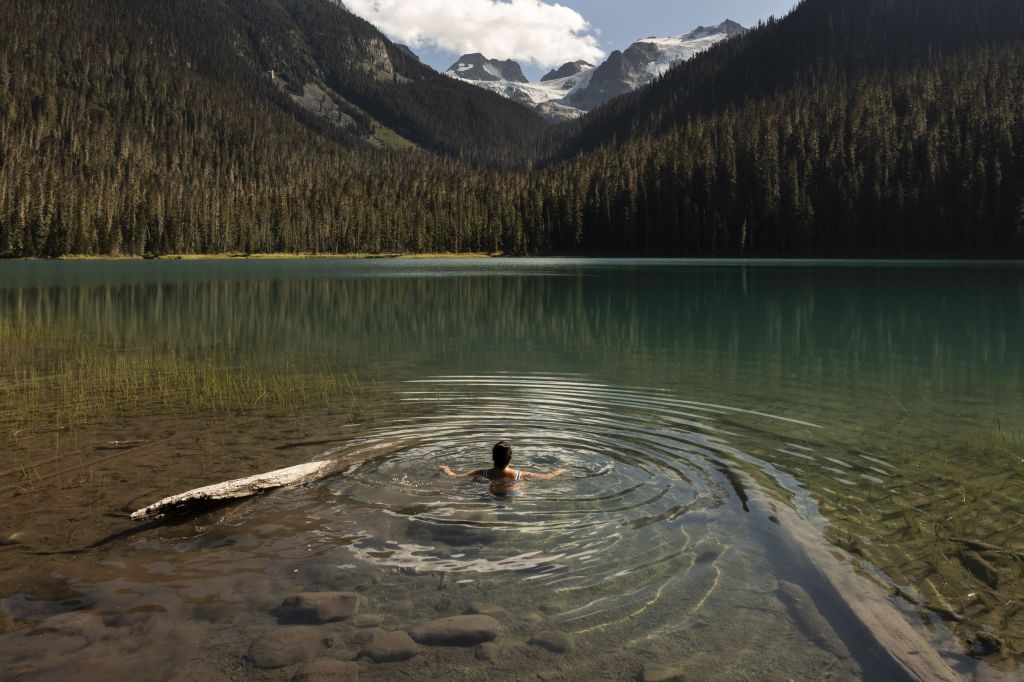
Jessie-Lynne Joe visited Joffre Lakes Park for the first time in September, during a reconnection period. “I’m pretty happy that I made it,” she said.
Photo: Paige Taylor White / The Narwhal
Some had never visited the park, called Pipi7íyekw in the Ucwalmícwts language, even though it’s on their traditional territory. Its turquoise waters and hiking trails, about an hour’s drive from Whistler, B.C., are so popular that free day passes book up immediately, and cars spill out of the parking lot onto the shoulder of the highway.
“Nature needs a rest,” Lhpat (Maxine Bruce) explained. “Mother Earth loves us every day … Every day, we need to love Mother Earth too, and give back.” The temporary closures of Joffre Lakes and other provincial parks have drawn criticism from many people in British Columbia. So Líl̓wat and N’Quatqua invited reporter Steph Kwetásel’wet Wood and photographer Paige Taylor White to visit during the closure and see the park at rest, to show why it’s important for the First Nations — and for the land itself.
While reporting, Steph heard about the excuses and pleas that the nations’ members and BC Parks staff hear often: “Can I take my wedding photos here?” “Can I just go to the first lake?” “Can the nation give us permission to bring in two more people?” Many want to be the exception to the rules. Some people camp illegally; others try to sneak in while the park is closed. “B.C. sees this as recreation,” Casey Gonzalez, director of k̓wezúsmin̓ (title and rights) for Líl̓wat, told Steph. “We see this as medicine, as cultural.”
But most interactions are positive, Gonzalez added. The nations believe most people understand that nature requires care and stewardship, too, and they wanted to show that value. “These reconnection periods are not to exclude people from Pipi7íyekw,” she said. “They’re for Pipi7íyekw to regenerate and heal.”
Before Joffre Lakes Park welcomes the world back again, we hope you’ll take some time to read Steph’s story and marvel at Paige’s photographs — taken over four visits between April and September. They show a side of this famous place that we rarely get to see.
Take care of yourself and the land you love,
Michelle Cyca
Bureau chief, conservation and fellowships
Almost exactly two years ago, I asked Jane Goodall what was next for her in front of an audience of more than 3,000 people. She looked at me with that coy smile everyone has come to recognize, cheekiness glimmering in her eyes, and pointed high above her into the big, bright stage lights. She knew her time was limited, and she still smiled. That moment is on my mind this week, with the sad news of her passing.
Everyone who works in the environmental space will tell you that Jane Goodall is one of their heroes, and that includes the team at The Narwhal. Her chimpanzee research and conservation work transformed our understanding of the natural world from a place of fear to one of love and belonging, and she spent her whole life persuading people it was worthy of our protection and care.
For the last several years, she had been searching for and spreading hope. That’s the message she shared with Narwhal co-founder Emma Gilchrist in 2022, and again with me on that stage. I desperately needed hope then, as we all stared down Donald Trump’s second term, the genocide in Gaza and a shift away from proven climate policies. Jane Goodall didn’t have clarity, but she did have commitment: with enough conviction, any of us could fight for the world we wanted in any space, be it a jungle or a boardroom, she said.
I hope she was right. And I hope she knew that even though we were from different generations and different worlds, I’ll keep her legacy going, and, with her blessing, evolve it to keep the nature she loved so much safe.
— Fatima Syed, Ontario reporter
Where there’s smoke …
After I wrote a story in July about Kitimat, B.C., residents adjusting to life alongside LNG Canada, I started getting emails from people sharing their personal experiences. Canada’s first liquefied natural gas export plant was excessively noisy and spewing toxic smoke, they said, and the impacts are not equally distributed.
A few neighbourhoods near the industrial site on the Kitimat River estuary are hardest hit, though earlier this year the noise and smell reached residents roughly 12 kilometres away.
‘In the opinion of the minister’: Ontario’s draft rules to create special economic zones limit oversight By Fatima Syed & Carl Meyer
The Doug Ford government’s pitch for fast-tracking development under Bill 5 empowers cabinet and dismisses First Nations’ feedback.
Why is there a drilling rig on Ontario’s Georgian Bay? By Fatima Syed READ MORE
Dozens of nations move to safeguard international waters, but not Canada — yet By Ainslie Cruickshank READ MORE
Appetite for investing in electricity projects shifting ‘away from Alberta,’ say investors By Drew Anderson READ MORE
The former head of Canada’s busiest national park reflects on ‘dark times’ and what to do about them By Sharon J. Riley & Will Pearson READ MORE
In the words of Jane Goodall, “You can’t have any more unconditional love than a dog.” After you’ve had a snuggle with your favourite animal, why not spread the love by sharing this newsletter with your favourite humans? Remind them to subscribe!