





 13 min. read
Summary
- Around 10,000 Starlink satellites represent more than two-thirds of all satellites in low orbit, and SpaceX has ambitions to launch a million more — raising serious environmental and safety concerns.
- Usually satellites burn up on re-entry, leaving heavy metals and plastics in the atmosphere, but sometimes they leave debris on the ground. Canadians who live near the 50th parallel are under the densest band of satellites.
- Currently, Canada has no reporting system for space debris and no ability to limit the number of satellites launched into orbit. Existing space laws do not apply to private companies such as SpaceX and space is not covered by any environmental regulations.
Billions of people watched in awe as the Artemis II mission took an astronaut crew that included Canadian Jeremy Hansen around the moon and back. It was an awe-inspiring moment for space exploration — but not all the news from space is good for Earth.
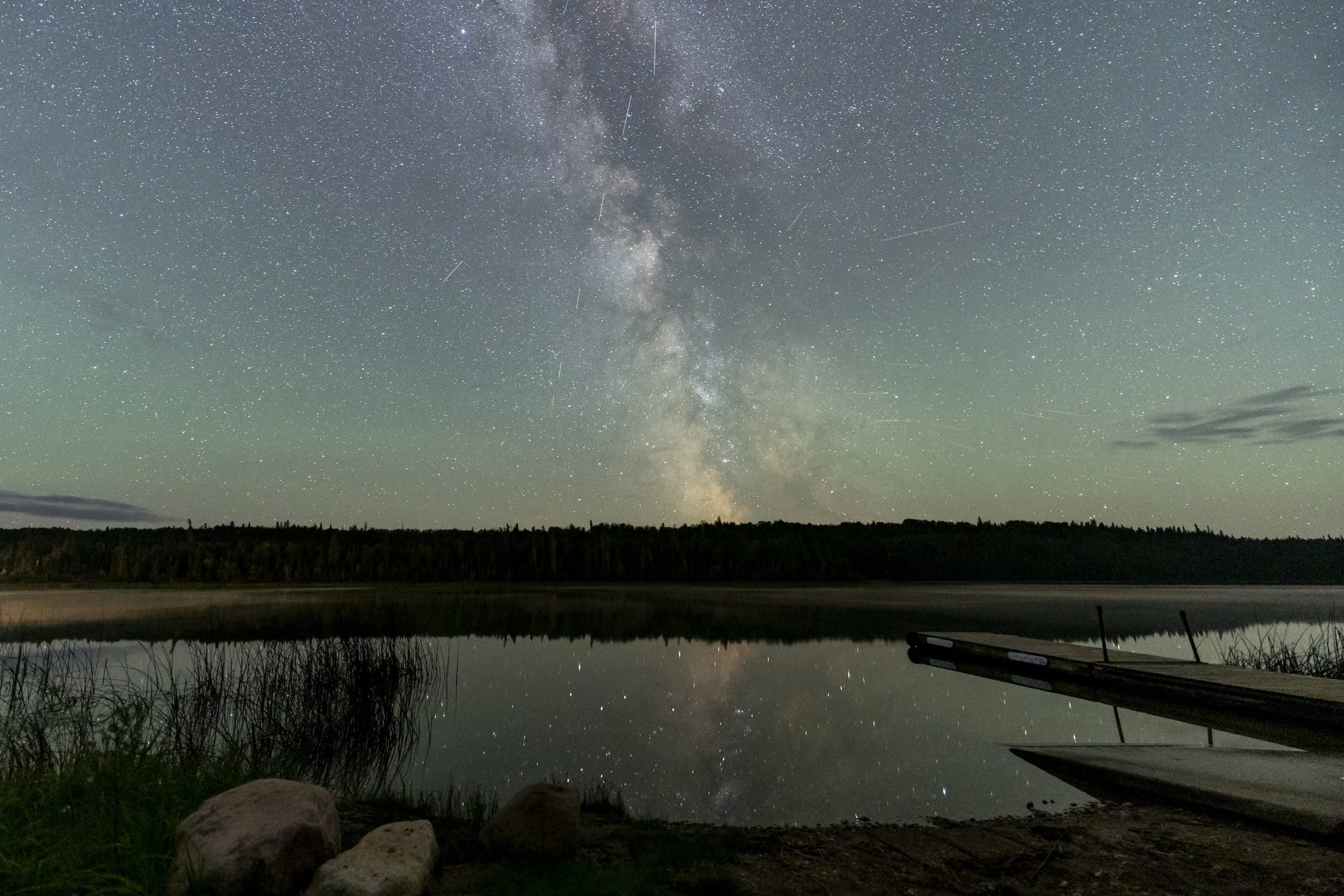
There are thousands of satellites in low orbit, which means 2,000 kilometres or less above the earth. Many were sent there by Elon Musk-owned SpaceX, which launched its first Starlink satellite in 2019 and has come to dominate the sky, representing more than two-thirds of all satellites in orbit. Wherever you are in Canada, when you look up at the increasingly bright night sky, you are seeing more satellites and fewer stars.
Starlink is an internet provider used by rural farmers, northern First Nations and airplane passengers criss-crossing Canadian skies. Each of its satellites has a lifespan of roughly five years, after which they re-enter Earth’s atmosphere at a rate of one or two satellites per day.
At this point, they become what’s known as space junk — burning up entirely or, occasionally, scattering debris. But those occasions will become more common if SpaceX fulfills its ambitions to launch a lot more satellites in the years to come, coinciding with the explosion in data centres and artificial intelligence. That would mean more light pollution in the night sky and more space junk falling back to Earth.
Samantha Lawler is a professor of astronomy with the University of Regina and goat farmer — and she is concerned about space junk. She spoke with us from her farm in Saskatchewan (where she did not use Starlink to connect to Zoom) about why we should be concerned about the growing number of satellites over Canada — including the potential for satellite collisions that could make low orbit unusable for everyone, a scenario called Kessler syndrome.
“We’re right on the edge of that already,” she said, adding that someone needs to take on the engineering challenge of providing rural internet and other services with fewer satellites. “There is a limit to how many we can safely have in orbit, and I think we’ve crossed that limit.”
SpaceX didn’t respond to The Narwhal’s questions about the environmental or safety impacts of their plan, and the Canadian Space Agency didn’t respond when asked if and when an official reporting system might be created. But Lawler had a lot more to say about the current lack of regulations protecting us from their impacts in the sky — or here on Earth.
This conversation has been edited for length and clarity.
What’s your work all about?
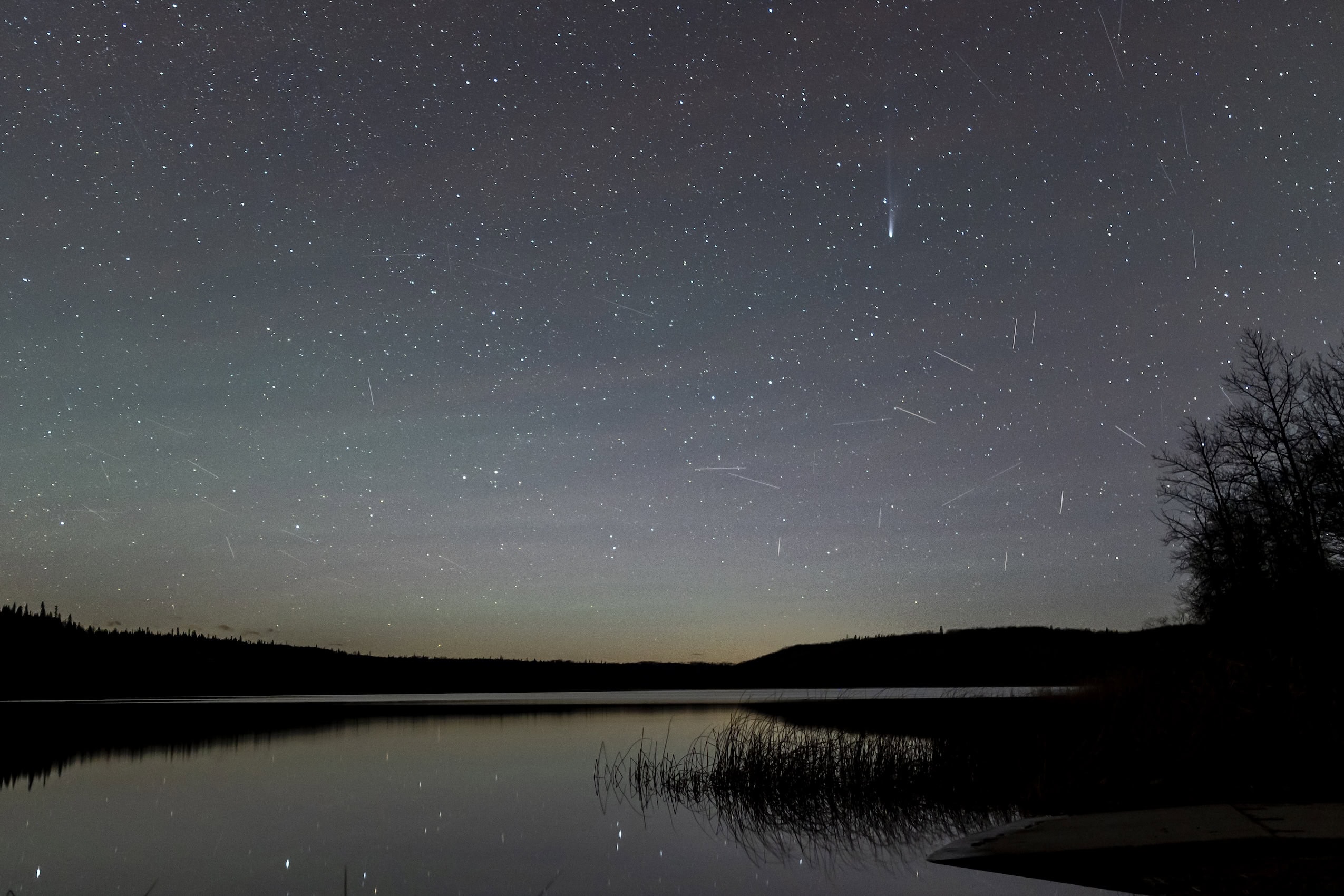
I study orbital dynamics in the Kuiper belt — so, looking at small icy rocks in the outer solar system and measuring their orbits. I started my position at the University of Regina and moved to a farm with access to dark skies in 2019, right when the first Starlink satellites launched, so I could watch the change in my night sky that I suddenly had access to and see the change in my research data, too. Increasingly, there were more and more satellite streaks in my data.
So, I had this unique perspective of seeing that wow, this was pretty bad, and it’s going to get a lot worse.
In 2021, you published an article that said one out of every 15 points of light in the night sky would soon be a satellite, not a star. At the time, what were the environmental and scientific concerns about that figure?
So, at the time, that one in 15 represented 65,000 satellites — which, when we wrote that paper, I thought was ridiculous. Like, there’s no way we’ll ever get to that. But here we are at around 15,000 with no signs of slowing down. So we might get there, and now there are proposals for millions of satellites. But at the time, I think very few astronomers — and almost no one outside the astronomy community — had any idea how bad this was.
There was a small group of astronomers that noticed, “Hey, this is very bad for astronomy. But have you thought about how many of these are going to be burning up, and how many are going to be launched, and how much danger there is in orbit?” I think that’s starting to change now — I’m glad that more people are aware of the issues, but they continue to get worse.
So, in the vein of things getting worse, in January SpaceX requested the authority of the U.S. Federal Communications Commission to launch ‘a constellation of a million satellites’ to serve as an orbital data centre. How much worse would a million satellites be?
It’s so bad in every possible way. There’s no way we can get to a million satellites — there will be collisions in space and we’ll be in full Kessler syndrome before we get there. But if somehow, they managed not to crash, they have five-year lifetimes. That would be one re-entry every three minutes. And those satellites would have to be bigger than Starlink satellites because of the complexity of a data centre versus an internet provider, right? In some of the articles we were writing quickly, we were estimating two tonnes per satellite, but it sounds like from various things SpaceX has released that they’ll actually be much bigger than that.
So these are as big as the International Space Station in terms of reflecting area, which means the simulations I ran were actually an underestimate of how bright they would be. So — everything is bad and actually it’s worse than the assumptions I made initially. Really, really bad.
Satellites are so bright because they reflect sunlight back at Earth to avoid overheating. The bigger they are, the more they reflect.
Just to linger on that for a minute — all satellites that go up eventually have to come down, and they usually burn up on re-entry. What happens when they don’t?
So everything that’s in low Earth orbit, which is most of the satellites — including all of the 10,000-plus Starlink satellites — at the end of their life, they get burned up in Earth’s atmosphere, because it’s convenient. And so far, it looks like Starlink is actually doing a pretty good job of burning up. There was one piece of a Starlink satellite that was found in a farm in Saskatchewan a couple of years ago, but they seem to be doing a pretty good job.
What that means, though, is that all the mass of the satellites — the solar panels, plastic, metal, batteries — it’s all getting melted and deposited in the upper atmosphere. So, that’s not a good thing. There was a period of time, about six months, where Starlink burned up 500 satellites. That’s around three per day. In that time period, they exceeded the natural infall rate from meteorites by at least twice as much — so, adding at least twice as much aluminium as what naturally comes into the atmosphere every day for six months.

So what does that do? We don’t actually know. There are a few preliminary studies showing this aluminum can become alumina, which can cause ozone depletion and change temperatures in the upper atmosphere, but we don’t know the full effects. And because space is not legally considered an environment, all satellites launched from the U.S. are categorically excluded from any kind of environmental regulations.
If they get to their steady state of having 42,000 Starlink satellites alone — that’s only one of many mega-constellations they have planned — that’s something like one satellite being burned up every hour in the atmosphere. These are satellites half the size of a Ford F-150 pickup truck. They’re not small. That’s a lot of metal being added to the upper atmosphere, and we don’t know the full effects of it.
Why is this changing so rapidly? In 2019, Starlink launched its first satellite — seven years later, we are looking at the possibility of mega-constellations that will blot out the stars?
SpaceX does all the launching — all the other mega-constellation companies [such as One Web and Amazon’s LEO] are using SpaceX to get to orbit. It has the infrastructure to do all the launches, they have a lot of U.S. government funding to do those launches, so they’re doing them very, very quickly. It’s very impressive engineering, it just ignores so many of the larger effects.
We’re in different provinces, but you and I — and most Canadians — live close to the 50th parallel. You’ve mentioned people on our latitude are particularly affected by satellites. For Canadians who aren’t experts looking for data in the sky, what will they be seeing?
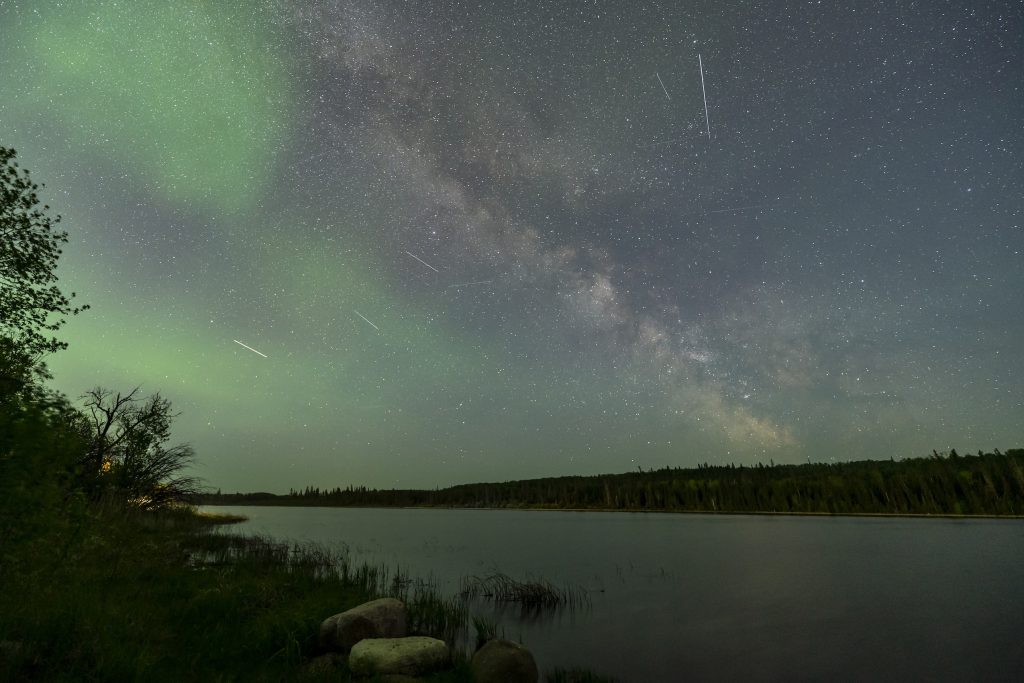
I know in my sky, there’s a line where I can always see a Starlink satellite in motion. Just always. So, people might notice that. We are also the highest-risk for satellites that aren’t burning up completely, because they’re right over our heads. These are all uncontrolled re-entries, so they just re-enter somewhere along their orbit, and we’re under the densest part. I think that was demonstrated by the piece that was found in Saskatchewan.
That was in 2024, when a farmer found a piece of SpaceX debris on his farm?
Actually, there are two separate things: one was a big debris fall in Ituna, Sask., which was part of the SpaceX Dragon truck. It’s part of the capsule that brings astronauts up to the space station. When it doesn’t burn up completely, it falls — so that was a bunch of very large pieces discovered across many farms. I know of six pieces from that, but there are probably more that people haven’t reported because there is no way to report them. There’s no official reporting system.
The second incident was a smaller piece from a Starlink satellite, about the size of a laptop, discovered near Hodgeville, Sask.
With the Ituna debris, it was reported to the Canadian government, and there was some kind of interaction between the Canadian and U.S. governments. In Ituna, SpaceX contacted the farmers directly and came to pick up the pieces. With Hodgeville, the farmer got in touch with SpaceX, and they had him FedEx [the debris] back. So no one in the Canadian government knew about it, which is bad.
The Ituna debris fall was spectacular because the pieces were so large and there were so many. But the Starlink debris is much scarier to me, because there are 10,000 of these over our heads, and if they’re not burning up completely, then that’s a lot of pieces that are hitting the ground. Here in Saskatchewan — I look out my window and it’s just bare fields. It’s the easiest place to find the pieces. But how many pieces are we not finding? These pieces look like something that fell off a car; if you found one in the city, you wouldn’t think it was space junk.
Every time there’s a re-entry, they just roll the dice, like, “It’ll probably burn up.” But we don’t actually know, there’s no data released on that, and the only way we find out if they aren’t burning up completely is if we find pieces on the ground.
You’ve said there’s no reporting system in Canada — do you think that will change?
I’ve been in touch with the Canadian Space Agency and they say they are working on a plan. But I don’t know. Aaron Boley at the Outer Space Institute has set up an email address — [email protected] — but it’s not official. We’re astronomers, we’re not supposed to be collecting this, but no one else is.
After I heard a Starlink piece had fallen in Saskatchewan, I got in touch with the farmer by going on the Evan Bray radio show — like, the lunchtime farmer call-in show, where I go to talk about astronomy all the time — and asking who found it. Saskatchewan is a giant small town, so I actually got in touch with the guy by doing that.
And he mentioned that his neighbour has some space junk too, and sent me a photo of this big piece of, like, corrugated metal. I was like, “Come on, that’s not space junk — it’s a piece of tractor or something.” But then he sent me a letter that this guy got from the Canadian government back in 1980, saying, “Thank you for sending us this piece of a Soviet rocket.” So, Saskatchewan has been the debris detector for decades.
So maybe 1980 was the time for the Canadian government to start thinking about a space debris plan! But what kind of power does it have?
Everything that goes into orbit is covered by the Outer Space Treaty and the Liability Convention, which are these Apollo-era treaties, written at a time when only the U.S. and the Soviet Union were launching stuff into orbit. They’re really not written for private companies. It’s just not set up for our current situation, where most of the satellites are owned by private corporations — by one private corporation, mostly.
Senator Paula Simons has launched a Senate inquiry into space junk falling on Canada, which is awesome. So there is starting to be some interest. But nothing has really happened substantively.
What feels possible in terms of Canada’s leverage here? It’s hard to imagine the U.S. being receptive to Canada saying, “Hey, slow down the satellite launches until we have a legislative and accountability framework in place.”
It’s hard, because Canada could say, “SpaceX, you are causing our taxpayer-funded astronomy research to suffer, so you need to pay a fine.” But then SpaceX could turn around and say, “Okay, the Canadian market isn’t that big, we just won’t broadcast to you.”
A lot of Canadians are benefitting from Starlink right now — which I don’t think is a good idea, but rural internet is terrible. And then Canada would get all of the downsides and none of the upsides.
Is it fair to say SpaceX has a kind of monopoly on space now?
SpaceX controls orbit, totally. They have two-thirds of all satellites in low orbit and if you want to go into space, you effectively have to ask them for permission. During the Artemis launch, they had all these blackout periods where there were Starlink satellites they had to avoid. By their own admission, Starlink does a collision avoidance manoeuvre every two minutes.
I wrote a paper with a bunch of other people that’s being reviewed, but in June, when we wrote it, it predicted that it would take five-and-a-half days for a catastrophic collision [between satellites] to happen if there were no avoidance manoeuvres. It’s since dropped to three days. So if SpaceX gets hacked, or there’s a bad software update, or a giant solar storm, the time we have to avoid a giant collision in orbit is getting shorter and shorter. That’s a bad situation.
Why does SpaceX even need 42,000 satellites to provide internet, if OneWeb is doing it with 800? They’ve never been asked to justify the number.
Hmm, all this sounds really bad. Is there anything Canadians can or should be doing?
We need alternatives on the ground to these internet provider mega-constellations. We need better rural internet. So something Canadians can do very easily is write to all levels of government about getting better internet to rural and remote communities, especially First Nations. I mean, no wonder everyone is using Starlink — I live 10 kilometres from the nearest town and I can connect to power lines and phone lines and natural gas lines but I can’t connect to broadband internet.
That’s something we can all advocate for — because if people have good internet options based in Canada, then they don’t need to rely on an American billionaire-owned company.