




 2 min. read
By Christopher Cheung for The Tyee.
The construction industry has a big role to play as Canada aims to meet to its commitment to the Paris climate agreement and transition to a greener economy, according to a new report.
“We need that construction workforce to get us to net zero,” said Bob Blakely, the COO of Canada’s Building Trades Unions (CBTU), an alliance of 14 unions.
There hasn’t been much Canadian research on the construction industry’s role in reducing greenhouse gas emissions, so the CBTU commissioned a study by think tank the Columbia Institute to investigate potential job growth as Canada moves towards a low-carbon economy.
According to the study, Jobs for Tomorrow – Canada’s Building Trades and Net Zero Emissions, a low-carbon economy could create almost four million direct building trades jobs by 2050 — and that’s a conservative estimate. These jobs include boilermakers, electrical workers, insulators, ironworkers and masons.
Here is a breakdown of the study’s job creation estimates.
- New eco-friendly construction and retrofitting could create almost two million direct non-residential construction jobs.
- Building small district energy systems in half of Canada’s metropolitan areas could create over 547,000 construction jobs.
- Building $150 billion worth of urban transit infrastructure, from rapid transit tracks to bus lanes, could create 245,000 direct construction jobs.
- Moving to an electrical supply grid composed primarily of hydroelectric (40 per cent), wind, solar, geothermal and tidal power generation (43 per cent), and legacy nuclear (five per cent) could create over 1.1 million direct construction jobs.
“This neither means nor implies the sudden end of the use of fossil fuels,” said Blakely,“but it does mean a shift in how fossil fuels are used and in what quantities.”
Lowering Canada’s reliance on fossil fuels will protect against price shocks, the report found. For example, the OPEC-induced crash of oil prices in 2015 resulted in more than 35,000 people losing their jobs in the oil patch.
Canada’s population is projected to grow to 48 million by 2050 from the current 36.3 million.
Ensuring a greener future is going to take collaboration, said business manager Lee Loftus of the B.C. Insulators Union.
“This is a conversation with the federal government, every [provincial] government in Canada, and the municipalities,” said Loftus. “Every one of those governments has a role in helping us execute the changes that need to take place, from procurement to development to bylaws.”
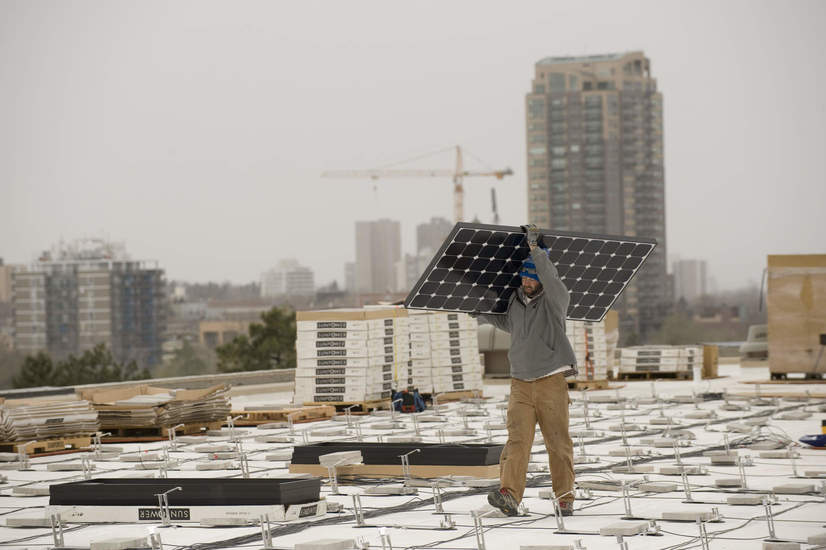
Photo: Topher Donahue, Aurora Photos