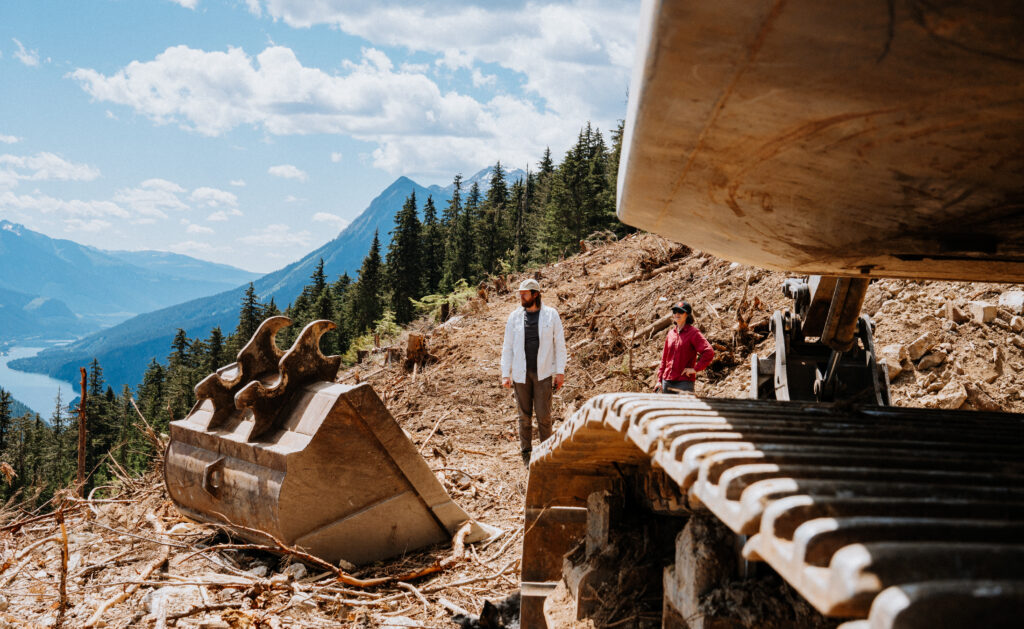
Conservationist Eddie Petryshen found groves of old-growth trees are on the chopping block — despite the B.C.’s promise to protect ancient forests and biodiversity.
Photo: Bailey Repp / Wildsight
Shrinking wildlife habitats — and a note on press freedom
In our latest newsletter, we bring you two on-the-ground stories on disappearing old-growth trees and delays in ice freezing, along with a note on the killing of journalists in Gaza and beyond
This July, reporter Sarah Cox got a bird’s-eye view of some of the reasons why B.C.’s deep-snow caribou populations are dwindling.
A reporting trip — following an old-growth detective into the shrinking bounds of a disappearing inland temperate rainforest — led her down a path that was perhaps crossed earlier by migrating caribou, bears or deer.
After navigating the maze of logging roads in Nagle Creek Valley, 150 kilometres north of Revelstoke, B.C., Sarah and Eddie Petryshen found themselves hiking deeper into the globally rare rainforest to ground-truth the age of trees.
According to BC Timber Sales, the provincial agency responsible for planning and auctioning off logging cutblocks, the cedar and hemlock trees in the forest are between 224 and 336 years old. Forests older than 400 years are automatically off-limits to logging: classified as ancient, they meet B.C.’s criteria for old-growth logging deferrals.
Petryshen, who works with the conservation group Wildsight, wanted to verify the age of the trees himself. Sarah watched him use a diameter measuring tape to gauge the age of ancient cedar trees in one of the planned cutblocks.
“This is a red-listed ecosystem right at imminent threat of ecosystem collapse,” he told Sarah. “The longer we wait to act, the closer we get to that collapse.”
As Sarah’s in-depth feature suggests, sometimes you just have to be on the ground to get the full picture.
And so, to the east, in Churchill, Man. — often dubbed “the polar bear capital of the world” — journalist Trina Moyles documented another shrinking wildlife area: ice.
By this time of year, you’d expect Churchill’s shore to be frozen in — and for polar bears to be out on the ice doing the polar-bear things they’re hardwired to do. This year, that’s far from the reality.
Ice patterns have changed over time. But in 2023, as El Niño exacerbated by climate change brings warmer temperatures, locals have observed sudden southerly winds shifting and blowing the ice off the shorelines of western Hudson Bay — bringing the planet’s largest land predators in closer contact with humans.
That’s not to say that many northern communities haven’t learned to coexist with the creatures — residents of Churchill already do, and Inuit communities across the Canadian North have for thousands of years. But even in these places, climate change poses new challenges.
To date, at least 63 journalists have been killed, according to the Committee to Protect Journalists, making this the deadliest conflict for journalists since the organization started collecting data in 1992. The vast majority, 56, were Palestinians killed mostly by Israeli airstrikes, according to the Committee to Protect Journalists. Four journalists were Israeli, killed during attacks by Hamas on Oct. 7, the organization found, and three were Lebanese. In addition, it found 11 journalists have been reported injured, three journalists are reported missing and 19 journalists have been arrested.
The Israeli government has told Reuters and AFP it cannot guarantee journalists’ safety and there have been several communications blackouts making it nearly impossible for journalists to share in real time. Despite this, journalists are risking death to get the news to the outside world.
Recently, several Palestinian reporters took to social media to say they have no hope for survival, that they are now going to prioritize living over bringing us the news.
Every time a journalist dies — either out in the field or while taking shelter — a light goes out, another path to truth is obstructed.
— The Narwhal
This week in The Narwhal
Canada thinks LNG exports can reduce carbon pollution. Now it’s digging for proof By Carl Meyer
Documents show Natural Resources Canada is on the hunt for emissions data that could bolster the LNG industry’s ‘social license.’
The Conference of the Parties taking place right now in Dubai is the 28th edition of the annual meeting for climate action. In Grist, experts tell Tik Root that COPs have outlived their usefulness and are due for an overhaul.
Hunted almost to extinction for their pelts, sea otters are being reintroduced to their traditional haunts in Haida Gwaii, to the consternation of some fishing communities. Leyland Cecco has the story in the Guardian.