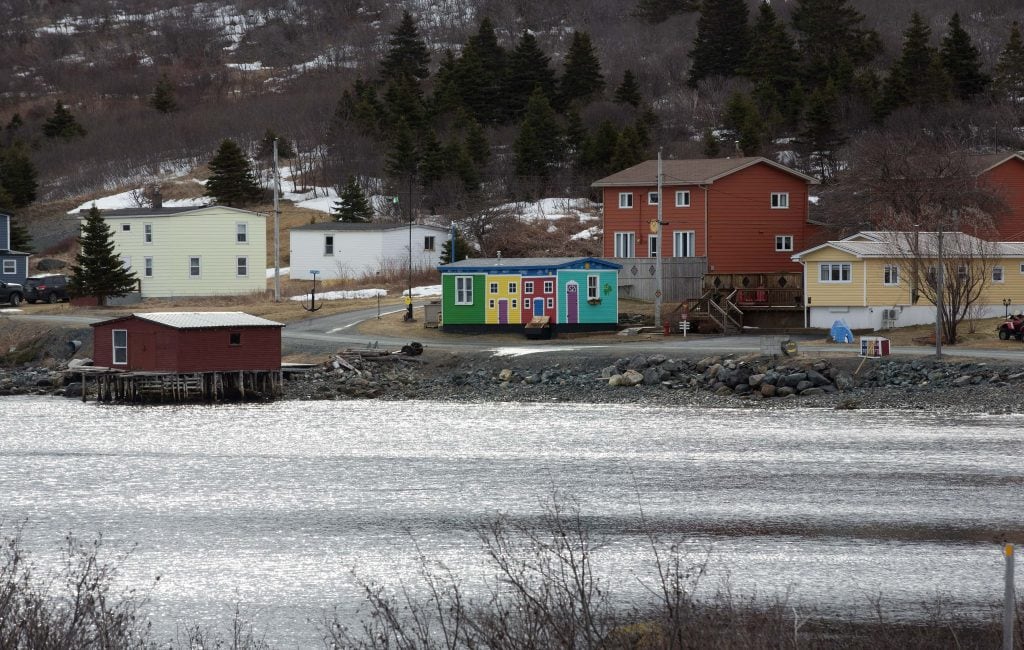
In Newfoundland, residents of the small village of Fermeuse wonder what a proposed LNG plant would mean for their future.
Photo: Paul Daly / The Narwhal
More than that, you’ll get the comfort of knowing your donation is directly supporting the work of journalists like Matt, who are bringing important stories to light by doing the real work: talking to people, asking tough questions and digging up information governments and companies might prefer to keep hidden.
Over to you, Matt!
— Arik Ligeti, director of audience
“I hope you don’t mind me reaching out. I am from a small rural fishing village in Newfoundland.”
Valerie Walsh’s email said she wanted to talk to “anyone that has real-life experience with living near an LNG facility.” She explained a company was planning a project in her community of Fermeuse, and she worried what it would mean for the village.
Like many coastal communities in Newfoundland and Labrador, Fermeuse was hit hard by the collapse of the cod fishery in the 1990s, which put more than 35,000 people across the province out of work overnight.
For the past several months, I’ve been reporting on Canada’s first major liquefied natural gas export project and the changes it’s bringing to Kitimat, an industry town on the northwest coast of British Columbia. Kitimat, though larger than Fermeuse, has a similar story of economic downturn, suffering for years after its pulp mill and methanol plant shut down in the early 2000s.
LNG Canada promised jobs and prosperity, which many in the community welcomed with open arms. The massive export facility also came with a cost — burning the waste or excess gas, in a process called flaring, is a source of light pollution, noise and emissions.
Walsh and some of her neighbours wanted to know what it would look, feel and sound like if Crown LNG, under the name of its Newfoundland and Labrador affiliate, Fermeuse Energy, built a floating LNG plant in the harbour.
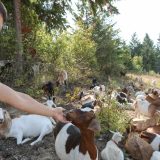
Brenda Aylward, a small-scale sheep farmer, said she’s worried how loud noises from an LNG plant might affect her flock. “Livestock are quite skittish, to noise and to light,” she told me on a phone call. “I don’t know a whole lot, Matt — I don’t know how bad these sounds are going to be.”
As I spoke with residents of Fermeuse, that not knowing was a common thread. In Kitimat, residents know a few things at least, like what living beside a flame that can get as tall as the Statue of Liberty is like.
“[My] house was lit up like daylight and shaking from the noise,” one source wrote in a message to me after I reached out. “On top [of that] there was an ear-piercing whistle.”
Another sent me photos taken from their backyard in a neighbouring community, 70 kilometres away, an orange glow lighting up the night sky.
“If you were looking at a peaceful water view, it is not going to remain the same. People’s expectations that the view is not going to change or the noise levels will not change or the traffic will not change, I think is wrong — because it will change. Industrialization will bring all those things.”
The company has not yet submitted an official proposal for the LNG facility, but “if the political will and the community support comes along, then we will move ahead with the project by the end of this year or next year,” Kataria said.
As governments navigate a labyrinth of geopolitical conflict and economic uncertainty, industrialization is increasingly seized upon as a way out. The consequences of building out more industry are always felt most profoundly at the community level.
Walsh, whose family has called the village home for generations, said the cost would be too great. “I think this will be the end of the harbour and any natural thing for us,” she said. “There will be no whales coming in anymore, no puffins, no fishery, no boats, no anything.”
My work as a journalist relies on people like Walsh and the many residents of Kitimat who come to me with their questions, their concerns and the things they are noticing in the place they call home.
In my reply to that first email, I told Walsh of course I don’t mind her reaching out. And I want to hear from you, too.
Do you have any questions about LNG development in Kitimat, Fermeuse or elsewhere that I might be able to help answer? Reply to this email to let me know — I look forward to hearing from you.
Take care and always reach out to a friendly journalist,
Meet The Narwhal’s 2026 Indigenous Journalism Fellow
Santana Dreaver got her start in journalism early: “I must have been five or six when my photograph and interview made the local newspaper,” she recalls. “My grandma was the school receptionist and had the newspaper clipping hung up in the staff room. I remember feeling pride seeing it there.”
Expect to hear a lot more from Santana in the months ahead — including at next week’s webinar about how First Nations are leading the clean energy shift in British Columbia. We hope to see you there!
Internal documents reveal Ontario will not share endangered species plans with public By Elaine Anselmi
The Doug Ford government will not publish guidance for bringing at-risk species back from the brink — plans that were underway when Bill 5 passed, removing requirements for recovery planning.
‘Significant effort’ has been made to address concerns about northeast B.C. waste facility, energy minister says By Shannon Waters READ MORE
Indigenous-led trust invests its first $21.6M in conservation in Northwest Territories By Chloe Williams READ MORE
Why B.C. is flooding — again By Shannon Waters READ MORE
Will Canada meet its goal to protect 30% of land and waters by 2030? By Julia-Simone Rutgers READ MORE
A Narwhal tote bag is the perfect accessory to carry emergency snacks, strike up conversations with strangers and let everyone know you support journalism about the natural world in Canada that makes a real splash. Become a member this month to get yours!