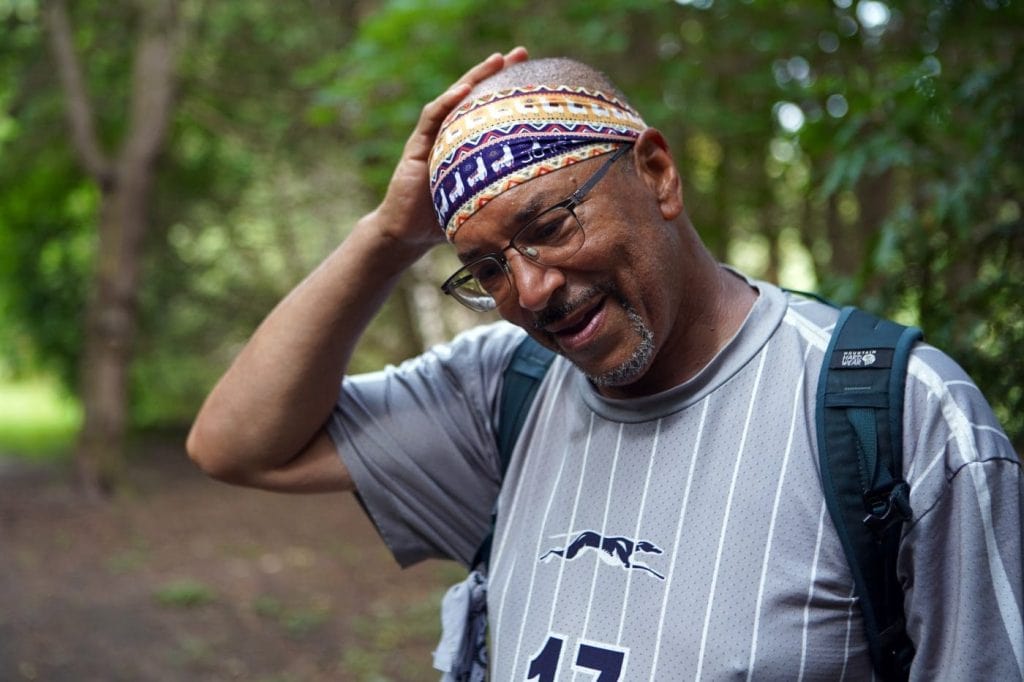
Ken Johnston stopped at significant Ontario Black history sites on his long walk, inspired by freedom seekers who came to Canada.
Photo: Canice Leung / The Narwahal
Moved by his ancestors, Ken Johnston walked 265 kilometres from Niagara Falls to Owen Sound, following the Underground Railroad path of early Black settlers
“Look how dense it is in there,” Ken Johnston said last summer, pointing to a thick stand of trees in Wellington County, Ont., as mosquitos buzzed around him. “Freedom seekers would have had to fight their way through that.”
He walked from Maryland to the U.S. side of Niagara Falls, then into Canada. And then he kept going north, stopping at significant sites of Black history in southern Ontario, eventually making it all the way to Owen Sound.
Johnston taught Canice about the expert outdoor skills people escaping enslavement needed to survive. “Like a modern wilderness guide, Tubman navigated water and land, read stars, foraged for food and plant medicine,” Canice writes. Others such as Josiah Henson, an early settler in what is now Dresden, Ont., had to learn how to clear and farm land very different from the places they had lived before.
Canice both wrote the story and took the photos. Her words explore the realities of racism and betrayal many Black people faced once they made it to Canada, while her photos document Johnston’s patient steps.
She walked with him in summer and winter, through hot, green fields and bright, snowy towns, snapping portraits of Johnston as he met Henson’s great-great-granddaughter, other descendants of the enslaved and people from across the region interested in a living history lesson.
Stories like this take time to develop. Canice emailed me with this idea last summer and spent multiple days over two trips walking alongside Johnston.
And our shared work to broaden the scope of Canadian journalism goes back about 15 years, when we were part of a group of racialized journalists in Toronto that created a new home for our stories, since other publications kept rejecting them.
That online magazine is gone now, but it gave lasting community and confidence to a cohort of reporters and editors who might have left this industry without each other.
Now, we get to say yes to each other’s pitches — and tell stories like this one. Johnston wrote to Canice this week to say he “loves the story with a capital L.” I hope you do too.
Due to unexpected delays, including those laid out by editor-in-chief Carol Linnitt in a short video two weeks ago, the trial is expected to pick back up in April — time initially set aside for closing arguments. Instead, final arguments will likely be heard in June.
The case continues to receive significant attention from journalists and media outlets across the country. Justin Brake, reporting for Ricochet Media and The Independent, attended the trial in person last week and published several video updates, including a recap of some of RCMP Assistant Commissioner John Brewer’s testimony.
Brake was himself arrested in 2016, while covering an Indigenous land defence action in Labrador. The charges against Brake led to a court decision that lays out factors judges must consider in cases involving journalists reporting within injunction zones. As such, the Brake decision significantly informs the legal basis of The Narwhal and Amber’s case.
Each additional day in court significantly increases the costs to The Narwhal to bring this case forward. We can only do it because supporters have stepped up with more than 2,600 generous contributions to our legal fund. With you by our side, we’ll keep up our fight for press freedom for as long as it takes. Thank you so very much.
Love is in the air
Since last week, more than 8,000 people have found the nest-mate of their dreams by taking The Narwhal’s Lovebirds of Canada quiz. We’re flying high on the enthusiastic response to this little experiment, and tickled by the kind words you’ve sent to our inbox:
At first I thought this was incredibly corny, but as a ‘birder’ I did it anyway … then I realized what a clever exercise you folks set up. Connecting emotions to a species (especially cute chicks) is the best way to get people to care about them, feel protective, get informed and then want to apply conservation measures. Well done Narwhal!
Yet another reason why I so adore The Narwhal. Like, WHERE ELSE would this be a thing?
And the results are in: 39 per cent of you matched with the Canada Goose — the quintessential “wife guy,” expressing devotion through lifelong commitment, fiercely protecting the nest and sharing parental responsibilities.
You swiped right on this Canadian icon twice as often as the second most popular lovebird: the bald eagle.
It’s perhaps no surprise so few people (about one per cent) found alignment with the hummingbird, with its interest limited to … err, let’s say, fleeting … romantic encounters.
If your nest is feeling a little empty, take the quiz to find a feathered friend that fits just right. You’ll get a special Valentine featuring the lovebird of your dreams, with art by Gabrielle Drolet.
This week in The Narwhal
Life on ‘Na̱mg̱is territory, at the edge of the ocean Photos and story by Matt Simmons
Off the northern tip of Vancouver Island, in the tiny community of Alert Bay, B.C., residents hold deep connections to the land and waters.
First Nations-led Ring of Fire report calls for immediate environmental monitoring By Carl Meyer READ MORE
‘Get ready’: Manitoba premier is serious about oil and gas industry’s interest in Hudson Bay By Julia-Simone Rutgers READ MORE
Ottawa sued over delayed protection of imperilled caribou habitat By Ainslie Cruickshank READ MORE
The energy boom is coming for Great Lakes water By Brett Walton READ MORE
WATCH: LNG Canada burned 1.7 million cubic metres of gas on a single day in September
Produced by L. Manuel Baechlin
Northwest B.C. reporter Matt Simmons lays out his reporting that found faulty equipment at LNG Canada’s facility in Kitimat led to increased natural gas flaring — with significant impacts on the surrounding community.
Silly goose! You don’t need to prove your love by taking on a herd of cattle — just forward The Narwhal’s newsletter to that special someone, and remind them to subscribe!