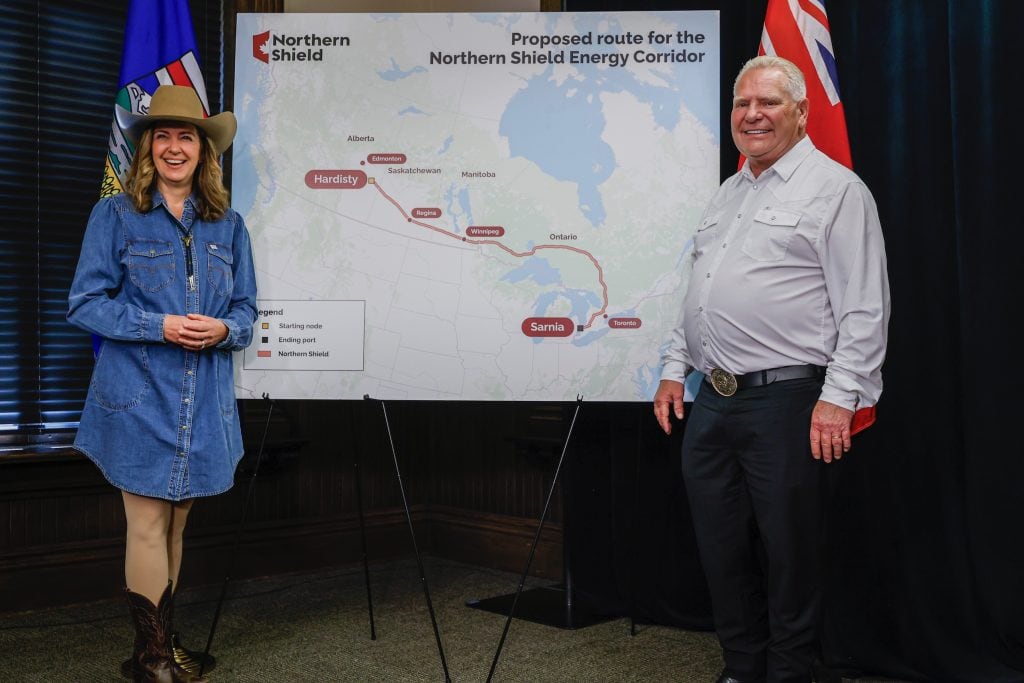
Alberta Premier Danielle Smith and Ontario Premier Doug Ford want to see a new pipeline connect the provinces.
Photo: Jeff McIntosh / The Canadian Press
Emma Gilchrist grew up in an oil and gas town in northern Alberta and has been reporting on the environment since 2007. She co-founded The Narwhal in 2018 and is based on Vancouver Island.
What a week. Amidst the blur of FIFA World Cup shenanigans and Canada Day festivities, politicians dropped not one, not two, but three massive pipeline announcements.
Within the span of five days, we learned about a new potential pipeline to the B.C. coast, funded with billions of taxpayer dollars. This pipeline would largely follow the existing Trans Mountain pipeline right-of-way, but would end south of Vancouver at Roberts Bank terminal (which would be upgraded to the tune of $10 billion in federal money). Meanwhile, it seems that the oil tanker ban on the north coast of B.C. will survive after all. And then on Monday, the Ontario and Alberta governments proposed another pipeline going east to Sarnia, Ont.
I spent the week scouring the internet, trying to get my head around it all. The most insightful commentary I came across was from Amy Janzwood, an assistant professor in political science and the environment at McGill University — so I called her up to pick her brain on, well, all of it.
We talked about how uncritically legacy media has been covering all this pipeline talk, and how pipelines have become an outdated economic security blanket for Canadians — who continue to strongly support climate action but also increasingly express support for new pipelines in the face of economic threats from south of the border.
“Pipelines have become kind of a stand-in for the future of oil and gas. It’s become a stand-in for a lot of really difficult conversations,” Janzwood told me.
“We’re told we need to double down and it’s necessary for economic prosperity. But what we’re seeing is the bill that’s racking up that taxpayers are on the hook for — when there’s an industry that can very well pay for it, and is unwilling to because they know they have a government that will backstop it.”
Premier Doug Ford’s government has spent the first year of its third term rewriting the rules governing Ontario’s environment.
From species protections and mining approvals to climate policy and public oversight, reporting fellow Rajpreet Sahota compiled the highlights in a sweeping new article.
Of course, dismantling environmental laws is nothing new for this government, and The Narwhal’s Ontario team has kept a close watch since the early Ford years.
That’s no small feat. Check out the latest volume in what we unofficially call “The Dougie List” over here. (Keeners may also wish to peruse previous editions, covering Ford’s first and second terms.)
This week in The Narwhal
Canada relies on Black farm workers. So why are there so few Black farm owners? By Jacqueline L. Scott
From Ontario to the Okanagan, Black and racialized workers power agriculture, but barriers to land ownership mean they rarely own farms. That gap is shaping Canada’s food future.
Alberta’s AI data centre dreams run into global shortage of gas turbines By Drew Anderson READ MORE
Meet Gary, an exotic cat that B.C. just outlawed as a pet By Michelle Cyca READ MORE
Osoyoos Indian Band plans to restore wildfire-ravaged forests with native plant species By Aaron Hemens READ MORE
When politicians drop a pipeline announcement (or three!), you can count on The Narwhal to get to the bottom of it. Remind a friend to subscribe to our newsletter to stay in the loop on big energy moves in Canada.