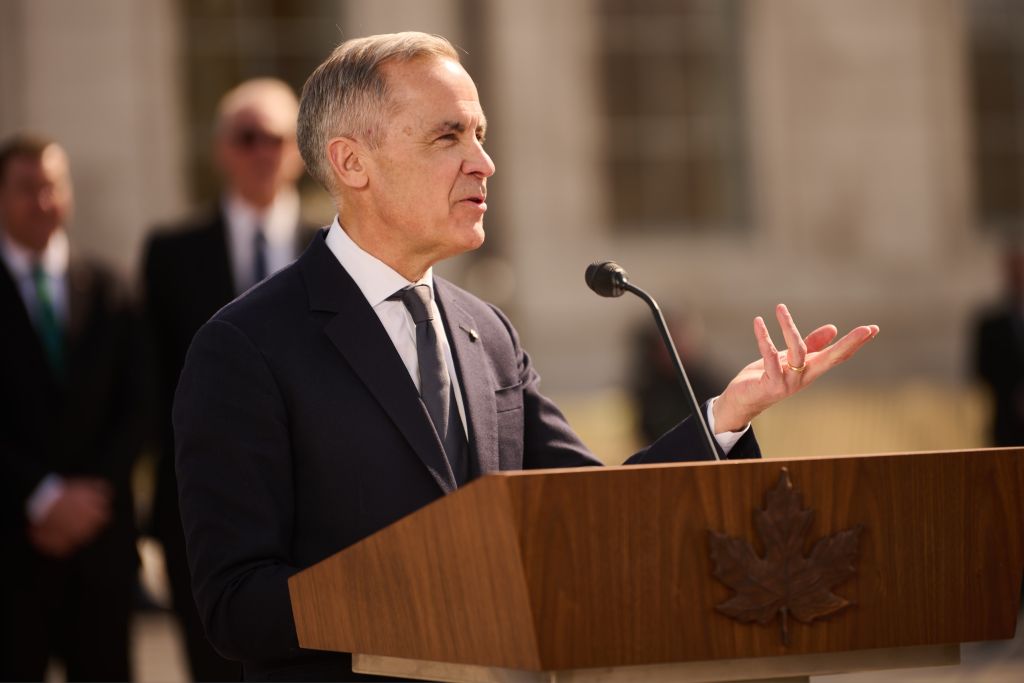
Prime Minister Mark Carney wants to get major projects built — and it has some Canadian premiers fighting for his attention.
Photo: Kamara Morozuk / The Narwhal
Across Canada, autumn brings shorter days, cooler weather, harvest bounties — and a fresh round of politicking in provincial and federal legislatures. The Narwhal is watching out for the big decisions that impact this country’s resources and natural world. I asked our reporters what’s in the forecast.
A numbers guy, Ontario reporter Carl Meyer will be scouring the upcoming federal budget (slated for Nov. 4). “Prime Minister Mark Carney has promised ‘a budget of austerity and investment,’ ” Carl told me. “Following the trend of this government so far, I expect there could be significant cuts to environmental programs — paired with more support for the oil and gas sector.”
Carl wrote about just that this week — he’ll be updating the article as Carney’s term progresses. “I’ll be looking to see if the government introduces legislation or regulations that roll back Trudeau-era environmental rules,” he said.
Our politics nerds are also watching Carney’s promise to fast-track projects in the “national interest.” These include the Port of Montreal expansion, which would threaten an endangered fish found only in Quebec. Freelancer Caitlin Stall-Paquet just wrote about it — in both official languages! You can read the story in English or, for the first time in Narwhal history, French.
Meanwhile, the nation-building push has a brouhaha brewing between western premiers: “B.C. Premier David Eby wants Ottawa to pick the North Coast transmission line for its next round of nation-building projects, instead of giving Alberta Premier Danielle Smith a still-hypothetical oil pipeline to the West Coast,” B.C. politics reporter Shannon Waters explained.
Eby called Smith’s pipeline pitch a work of political fiction that threatens real projects. Smith clapped back, calling Eby’s rejection “un-Canadian” and “unconstitutional.”
Prairies reporter Drew Anderson will be keeping an eye on another of Alberta’s pushes — its “controversial plan to deal with the province’s massive oil and gas regulatory problems — a ‘giant stinking pile of shit,’ in the words of the premier’s special advisor.”
Over in Ontario, reporter Fatima Syed is expecting business-as-usual: “lots of heated chatter about building everything quickly, from highways to mines,” she said.
“Like a good journalism nerd, I’ll be paying close attention to what happens behind the scenes of the legislative theatre,” Fatima added. “The Doug Ford government has historically made its biggest moves through broad, wonky changes of complicated laws, and I predict more of the same. I’m expecting the government to release new regulations for energy storage, special economic zones (and everything else arising from Bill 5), provincial parks and more.”
I was 12 years old when I first learned about the struggle to protect the Porcupine caribou herd’s sacred calving grounds in the Arctic National Wildlife Refuge from oil and gas development. This year, I turned 40.
When I took up the invitation to visit Old Crow, Yukon, in May, I sensed some fatigue from community members. Rightfully so; they’ve been calling attention to this issue for decades. But I was inspired to meet up-and-coming leaders who explained that Gwich’in people are born into their relationship with caribou — and with that comes the responsibility of advocating for them, too.
One Elder told me following our interview, “you are a part of the circle now,” which filled me with a sense of responsibility as a storyteller.
The Porcupine caribou herd is a rare success story in the wider context of caribou in Canada. I hope you’ll take some time to read the latest chapter.
— Trina Moyles, author and freelance journalist, Whitehorse
Treacherous waters
What do Timothée Chalamet and a drought-stricken region of Alberta have in common? They’re both connected to the ambitions of Kevin O’Leary: Canadian businessman, Shark Tank judge, co-star of Chalamet’s new table tennis movie and — hang on, we’re getting to the Narwhal angle — the man who dreamt up Wonder Valley, which could become the world’s largest artificial intelligence (AI) data centre, in the Municipal District of Greenview, Alta.
As Savannah Ridley reports, O’Leary’s data centre dream is just the biggest wave in a tsunami of water-hungry AI data centres popping up across Canada — and many, like Wonder Valley, are being proposed in regions gripped by long-term drought. What will these facilities mean for power, water and jobs in Canada? There are many questions, and not a lot of satisfying answers.
Savannah recently completed her Indigenous editorial fellowship at The Narwhal (she’s now reporting for the Toronto Star), and left quite a story as a farewell gift — dive in!
— Michelle Cyca, bureau chief, conservation and fellowships
This week in The Narwhal
Military’s own study finds harmful contaminants in Moose Jaw base building By Leah Borts-Kuperman
The base is one of many across Canada dealing with contamination issues. Internal studies obtained by The Narwhal reveal an apparent discrepancy as the federal government maintains the site is safe for employees.
Those reporters at The Narwhal sure have a nose for what’s really happening on the Canadian political scene. If you know someone who likes to be in-the-know, remind them to subscribe to our newsletter!