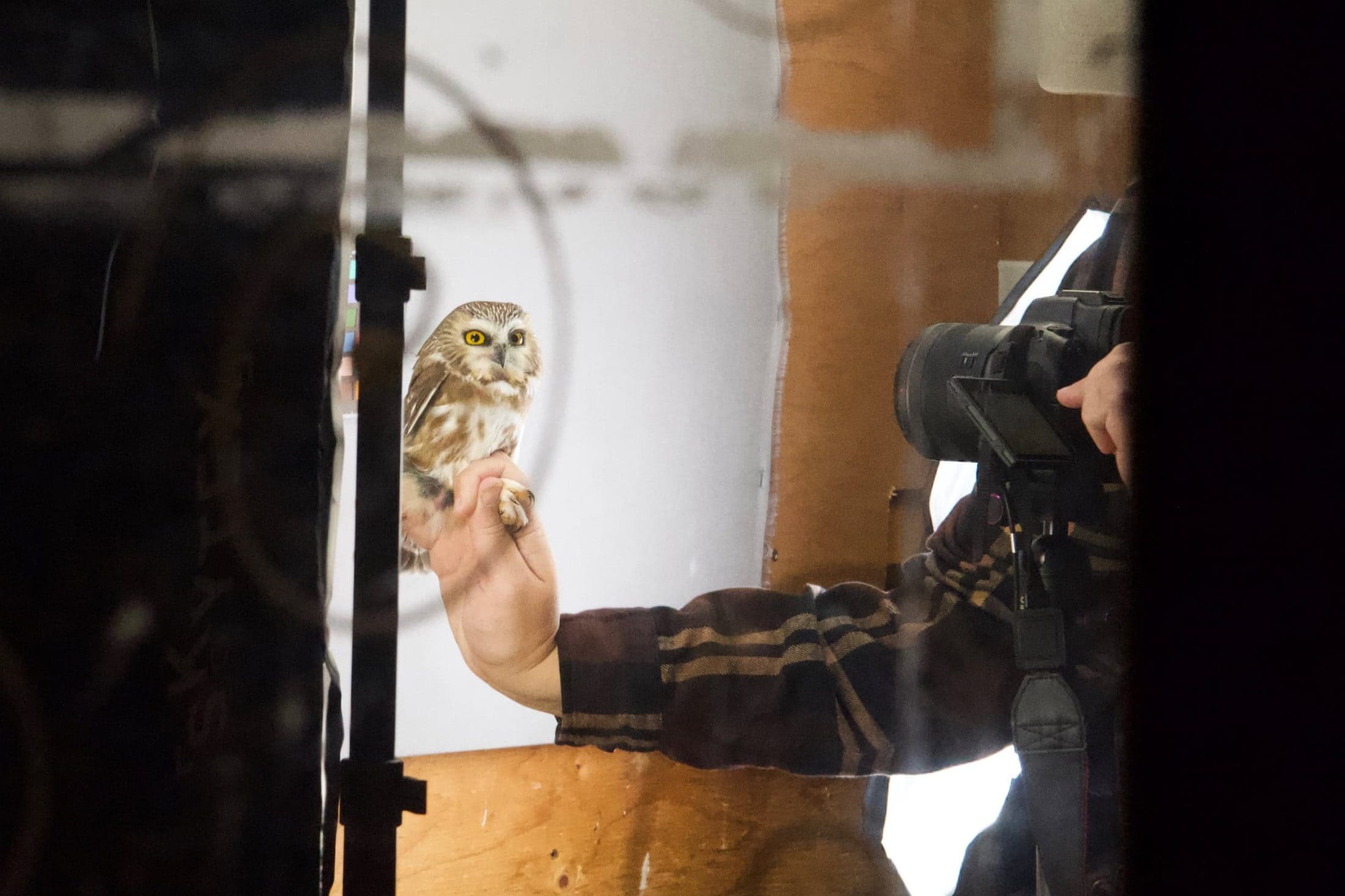
Station manager Ashley Jensen photographs details of a banded saw-whet owl in a dedicated photo area at the Prince Edward Point Bird Observatory in Ontario.
Photo: Paula Razuri / The Narwhal
Maybe you can tell from our stories (or our Lovebirds of Canada quiz), but The Narwhal is staffed by a lot of bird enthusiasts. We love birds — vengeful crows, tiny sandpipers, unfairly maligned Canada geese — and we love stories about them.
So when Paula Razuri, a writer and photographer based in Toronto, pitched a photo essay about the scientific effort to track birds by accessorizing them with cute little anklets, she set us all atwitter.
Paula came to The Narwhal through our partnership with Room Up Front, a Canadian mentorship program for photographers who are Black, Indigenous or people of colour. Our 2025 BIPOC photojournalism fellowship offered a paid opportunity for a participant in that program to work with The Narwhal to bring one of their ideas to life.
It’s important work, and intensive: banders often spend an entire season waking before sunrise, working day in and day out in isolated locations, adhering to high standards for data collection and bird welfare.
What motivates them, Paula found, is a love for these creatures — and the camaraderie they find among their fellow birders. “Birds connect the world,” Stéphane Menu, the bander-in-charge at the Bruce Peninsula Bird Observatory in Ontario, told her.
Those connections rely on international co-operation: as Paula reports, the United States and Canada maintain a joint database of migratory bird data, containing more than 85 million banding records. But the U.S. government has proposed sweeping budget cuts that would decimate bird-banding research, and some banders are worried about the future.
But for now, there’s hope — and plenty of bird science that is both important and adorable.
Case in point: this week we also published, in partnership with IndigiNews, an owl-some story by Aaron Hemens. It’s about the Upper Nicola Band’s burrowing owl recovery program, which releases these tiny birds of prey into the hilly grasslands of their Interior B.C. territory.
It’s working. “The program has exceeded all our expectations,” Loretta Holmes, an Upper Nicola Band member and senior resource technician, told Aaron. “The owls, which we call sq̓əq̓axʷ, have responded better than we dared to hope 10 years ago.”
Paul’s photographs offer an intimate peek at the domestic life of sandhill cranes, great horned owls, coyotes, deer and other feathered and furry friends. They capture a few of the things all parents have in common — and a few they do not.
Beyond photos that will coax involuntary high-pitched squeals of adoration from your vocal cords, these three stories are reminders that all of us are engaged in relationships with the natural world, and can take meaningful actions to nurture its survival — one bird or beast at a time.
Take care and ruffle some feathers,
Michelle Cyca
Bureau chief, conservation and fellowships
P.S. These important stories about cute animals are brought to you by thousands of members who help this work take flight. Will you join the flock?
Nipissing First Nation was eager to see the piles of mining waste, and its low-level radioactivity, gone from their community. For years, they led efforts to remediate and remove the innocuous-looking gravel, but solutions didn’t come easy.
An Ontario Ministry of Mines plan to move it to an old mine site outside Sudbury got flack from the community nearby — rerouting the trucks south.
In a new story this week, Ontario reporter Leah Borts-Kuperman traced the mining waste along its 645-kilometre journey to the one place that agreed to accept it: a hazardous waste facility near Sarnia. Close by, the Aamjiwnaang First Nation, already facing myriad impacts from the industrial cluster known as Chemical Valley, had no idea.
As Ontario ramps up its nuclear energy ambitions, questions about where the waste goes, and who gets to decide, become more urgent. I hope you’ll check out the full story on our website.
— Elaine Anselmi, Ontario bureau chief
Party like it’s 2002
The Narwhal’s RSS feed now supports full articles! We want you to be able to read The Narwhal wherever you like to read it, whether that’s on our website, Apple News or RSS (that’s short for Really Simple Syndication).
We tested our feed with a couple different RSS readers, but if you notice any issues with yours please let us know at [email protected].
— Andrew Munroe, web developer
This week in The Narwhal
B.C.’s DRIPA drama — explained By Shannon Waters
Premier David Eby said changing DRIPA was ‘non-negotiable.’ Then he proposed suspending the law. Then he said changes could wait until the fall. What gives?
Trump has an energy ‘tiger team.’ Carney’s fast-tracking office ‘operates similarly,’ docs say By Carl Meyer READ MORE
Could this be the moment for offshore wind energy in the Great Lakes? By Stephen Starr READ MORE
Meet a millionaire who wants Canada to tax the rich By Matt Simmons READ MORE
Did you hear the news? All those fresh bird stories by The Narwhal are totally fly! Become a member if you want to see more independent journalism about the natural (and avian) world in Canada.