


 24 min. read
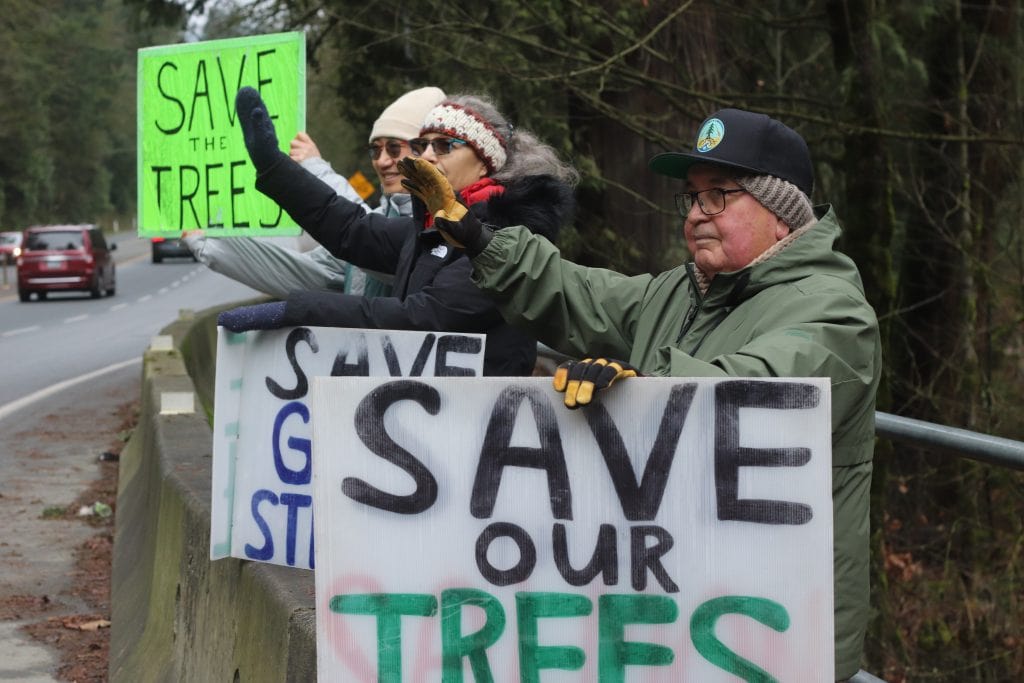
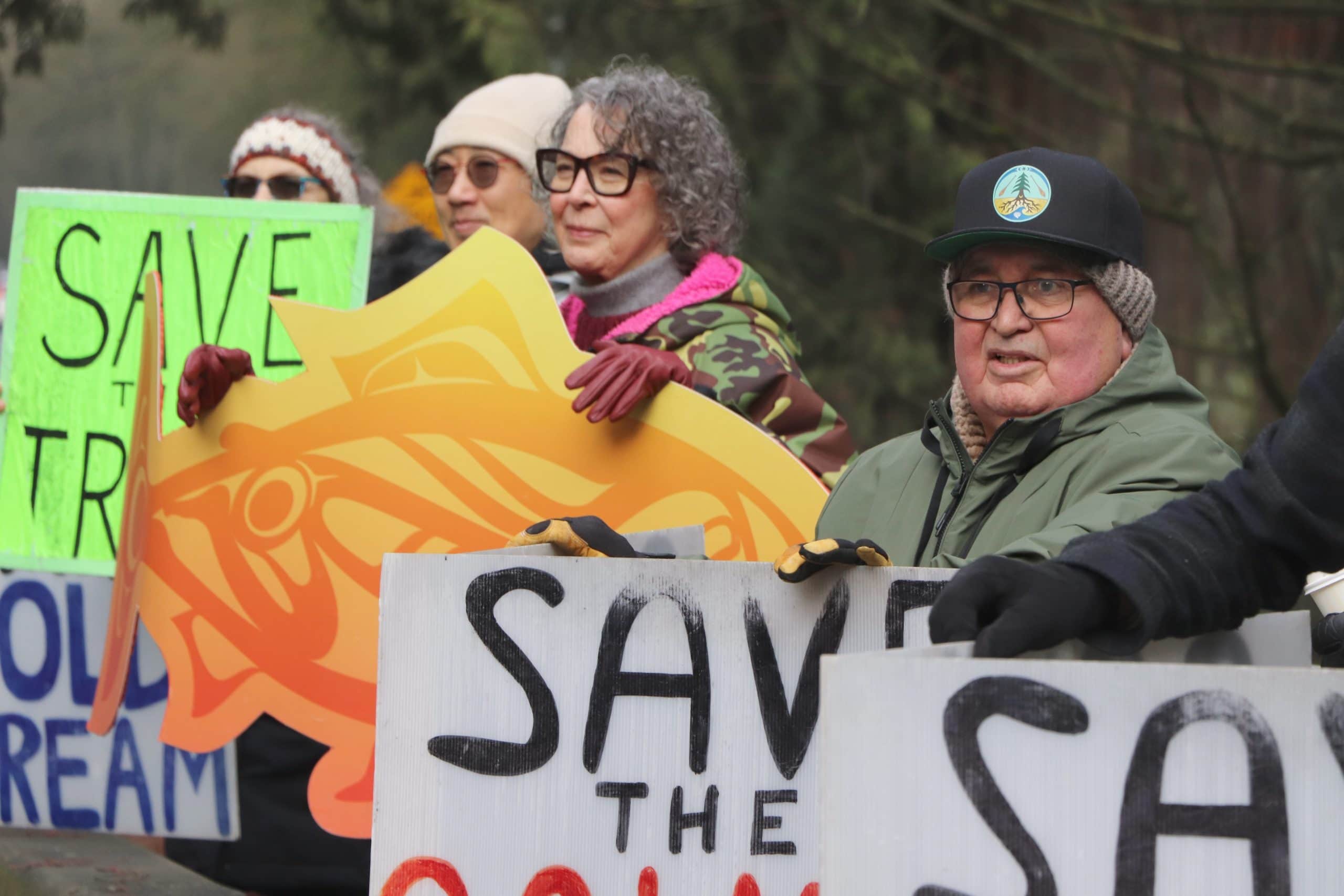
The sound of cars passing is a constant hum, so constant it’s almost meditative. Every so often one bleats out a honk of support. On the shoulder of the highway stands a man, holding a sign that reads: “Save the Salmon.”
Cheeks ruddy from the cold, he clutches it with gloved hands from behind a waist-high concrete highway barrier. Dark eyes glitter warmly behind glasses, and over his knitted wool toque is a black baseball cap emblazoned with the image of a tree, water and paddles.
This is Tsartlip First Nation Elder Carl Olsen, also known by his traditional name, ZȺWIZUT. He’s 78 years old. For the last three years, he’s been coming out here every Tuesday — through rain, snow and even sickness — to stand out on the shoulder of the Malahat highway and protest.
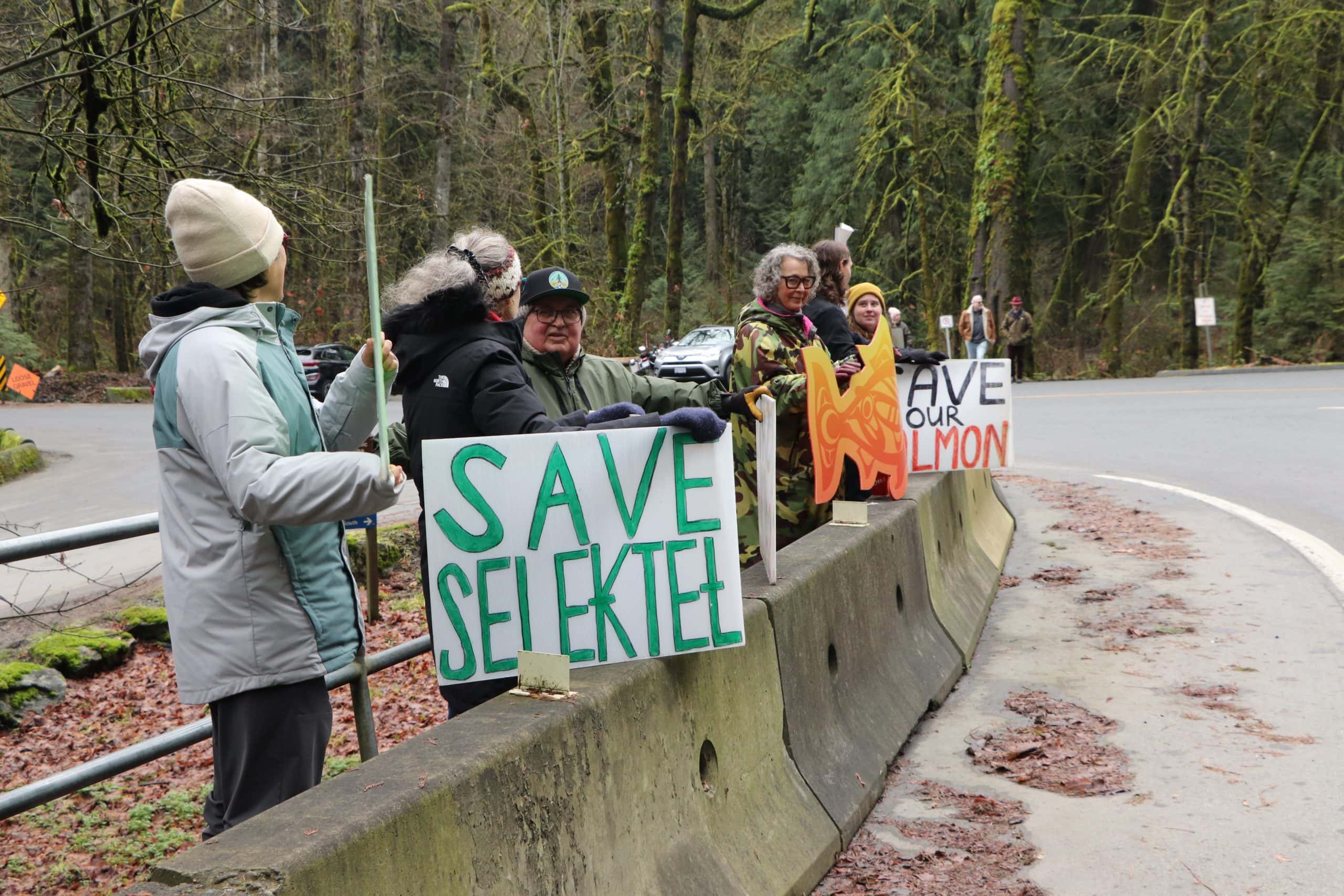
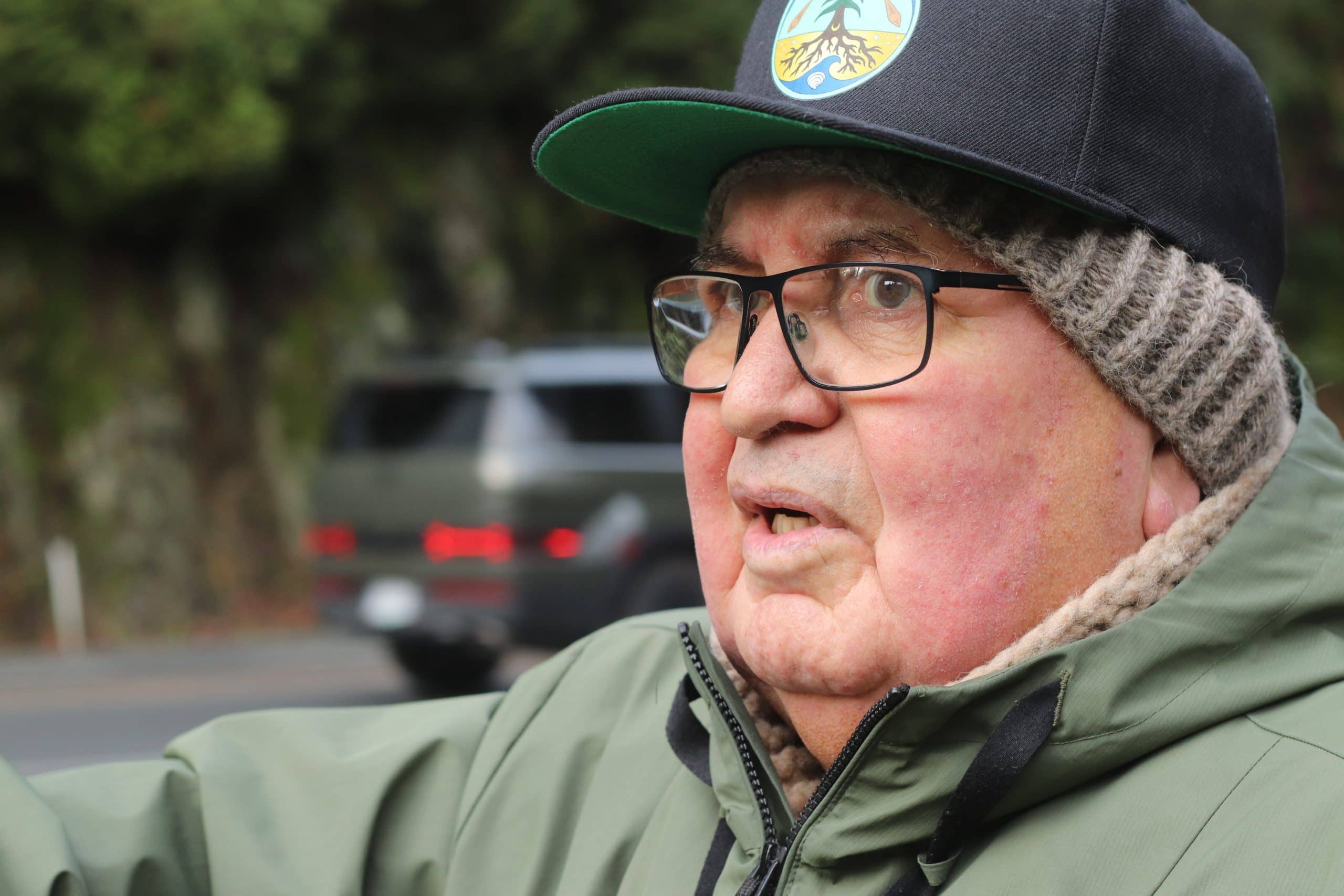
It’s December 30, 2025. Olsen grins, surrounded by supporters who wave at cars and shake their own homemade signs. But it wasn’t always this way. When he first started out, it was just him, his granddaughter and a supporter from the local book club Olsen runs.
At his back is Goldstream Provincial Park, or as Olsen knows it, SELE₭TEȽ. At 477 hectares, it’s bigger than New York City’s Central Park, a verdant gem on the southern tip of Vancouver Island, just a 20-minute drive from Victoria. The park features waterfalls, Garry oak meadows, 600-year-old Douglas fir trees, flowering dogwood, western red cedar trees, Oregon grape and salmonberries.
In front of Olsen is the Malahat, a busy two-lane highway that cuts through the park and sees an average of 25,000 vehicles a day pass by. The park’s accessibility means more than 600,000 people visit each year to camp, hike and hang out. Many come in the fall to watch the huge runs of chum, Chinook and coho salmon that return each year to spawn in the Goldstream River.
What prompted Olsen to go out there in the early months of 2023 was learning of a proposal put forward by the province to widen the Malahat that would catastrophically affect the adjacent Chinook and coho salmon spawning habitat in the Goldstream River.
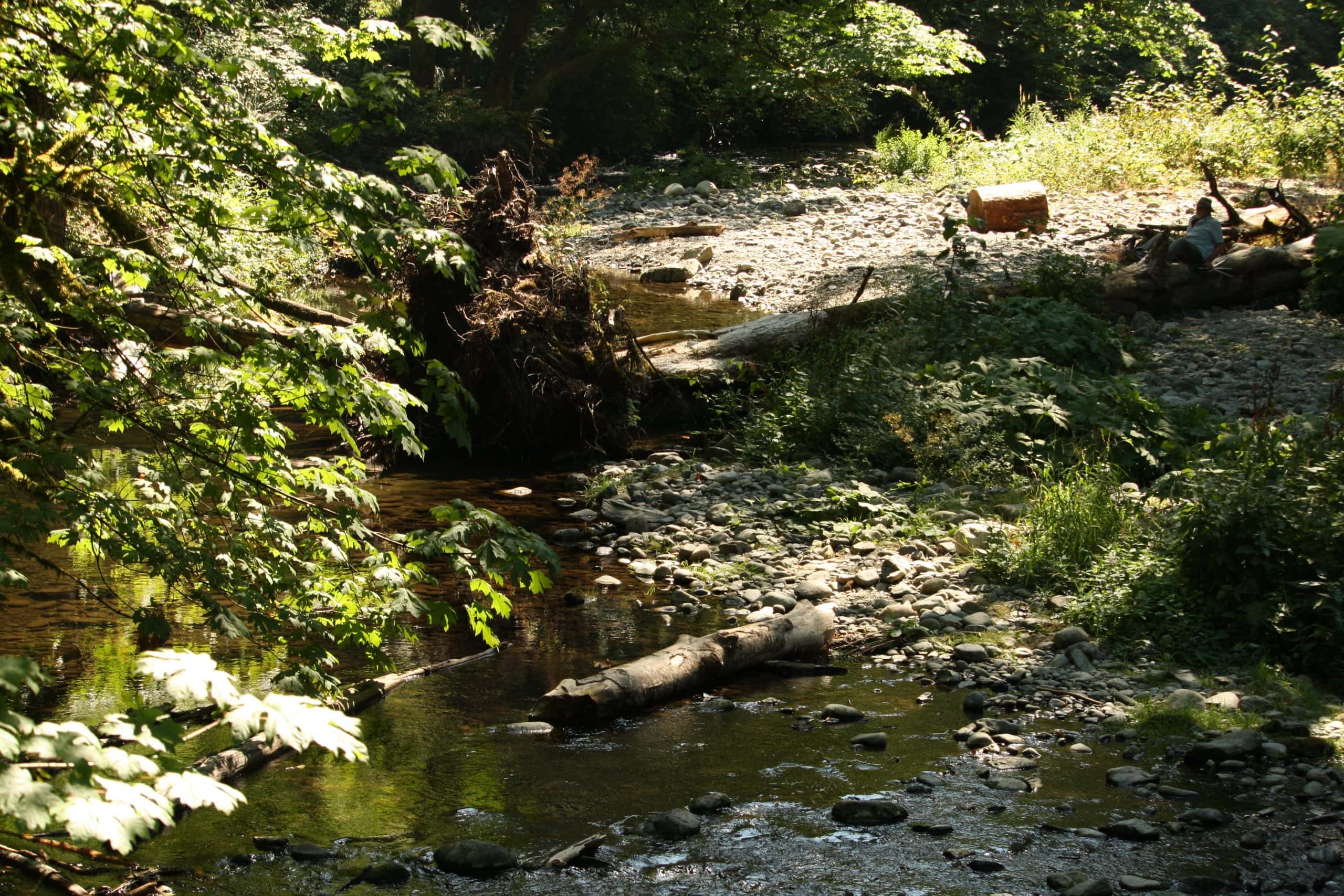
According to the province, the highway expansion, estimated in 2024 to cost $162 million, was needed to improve safety and reliability along a 1.7-kilometre section that bisects the park.
One part that especially concerned Olsen was the expected “permanent loss or alteration of aquatic salmonid and amphibian habitat” next to the Goldstream River. This impact and others were detailed in a 139-page environmental assessment report commissioned by the province and completed in 2024 by consulting firm McElhanney. The area’s Chinook and coho salmon spawning habitat falls directly within the project’s footprint.
Within half a kilometre of the project site, at-risk species were likely to be affected, including western screech owls, northern red-legged frogs, wandering salamanders and the endangered sharp-tailed snake. Expand that to within five kilometres of the project site and that list lengthens to at least 200 endangered and threatened species possibly affected.
Olsen was also horrified to learn that, among a host of other environmental issues, approximately 715 trees would also be removed from an area along the highway during construction.
He thought about the owls and nesting birds, about the spe’uth (bears) that make their homes in SELE₭TEȽ and fed beside him while he and other nation members harvested fish for winter. He thought of how the noise and vibration from excavation and rock blasting might affect the vulnerable salmon fry, hiding out in the darkness under fallen logs in river pools until they were big enough to head to the ocean.
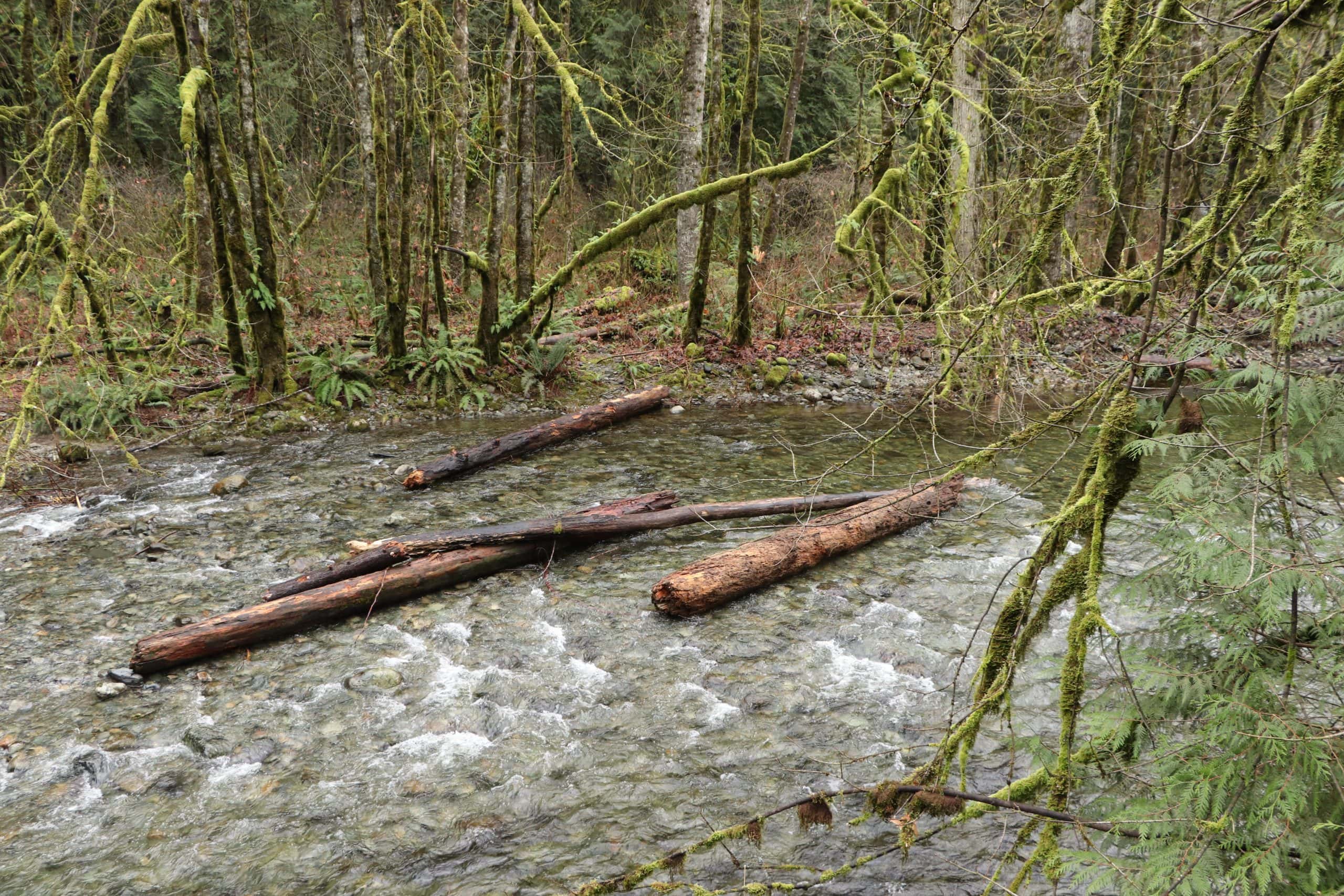
“The canopy that creates the coolness of the water in the stream — if that disappears, those fish will disappear, because then the water starts to get too hot. It’s about 12 degrees difference from the sun to the shade. So that’s what started me,” he says. “I thought, ‘Yeah, I can do this. I can be the voice for the salmon.’ ”
Every Tuesday for the last three years, Olsen wakes up at about 5 a.m. in the house his grandfather built, on the W̱JOȽEȽP Tsartlip reserve. He heads down to the beach right outside his door on the Saanich Inlet and starts his day with a prayer at the water’s edge.
“I meditate about what I would like to see in my day,” he says.
After his prayer, Olsen heads to a local café for some toast and tea.
Typically, a group of supporters show up to tag along with him to Goldstream Park. Others meet him there. Some are members of local churches and the Wilderness Committee, or participants in Olsen’s Indigenous authors book club.
One of those book club members is Christine Willes, a settler from a group called Goldstream Protectors that helped organize a protest with Olsen and others at the legislature in October.
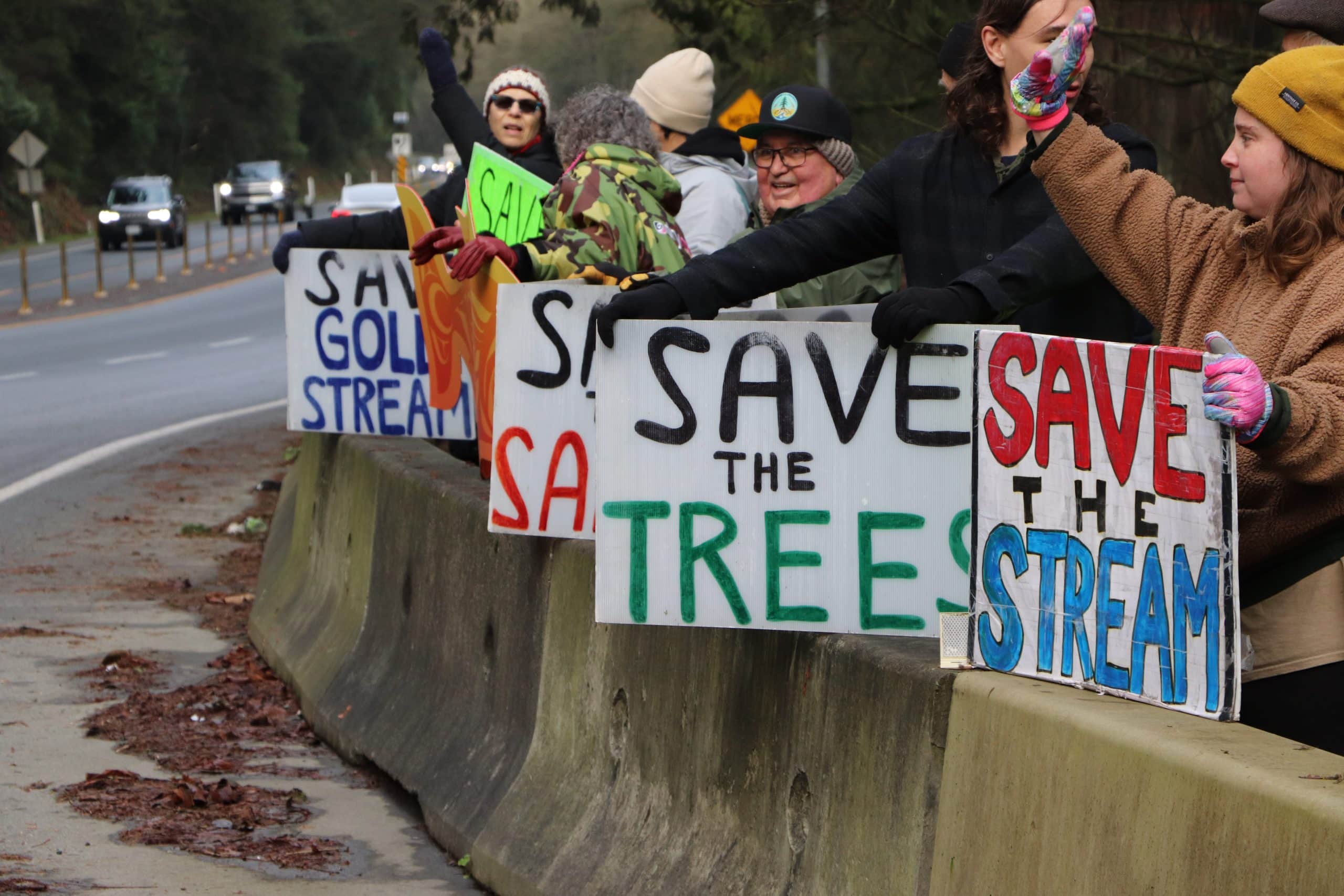
“What he says to anybody who asked him is, ‘Well, I can go and stand by the side of the highway,’ ” she says. “And that’s what he says to other people. ‘Do what you can.’ So I thought, well, I can go stand on the side of the highway too.”
For Olsen, this fight is now broader than the highway project. It’s a flashpoint in a much larger and contentious discussion around Indigenous land rights, title and reconciliation that has consumed the province, and has repercussions for the entire country. It’s also about the ability for Indigenous people to make land decisions in their own territory.
To the W̱SÁNEĆ people, of which Tsartlip are a part, SELE₭TEȽ is one of their oldest fishing villages, arguably protected by a treaty put to paper 174 years ago which clearly states they retain the rights to their village sites and to hunt and fish on those lands as they always have.
It’s one of 14 treaties negotiated in the 1850s by James Douglas, then-Governor of Vancouver Island, with the local First Nations. For many, the existence of these treaties may come as a surprise, as it’s well known that most of the province’s land mass was never ceded by its original inhabitants.
Known collectively as the Douglas Treaties, multiple court cases since the 1960s have re-affirmed these treaty-protected rights, for both the W̱SÁNEĆ and the other Vancouver Island nations who signed them in the 1850s.
This fight to hold colonial governments to their word is what has kept Olsen out on the highway for three years.
‘It rightfully belongs to us’
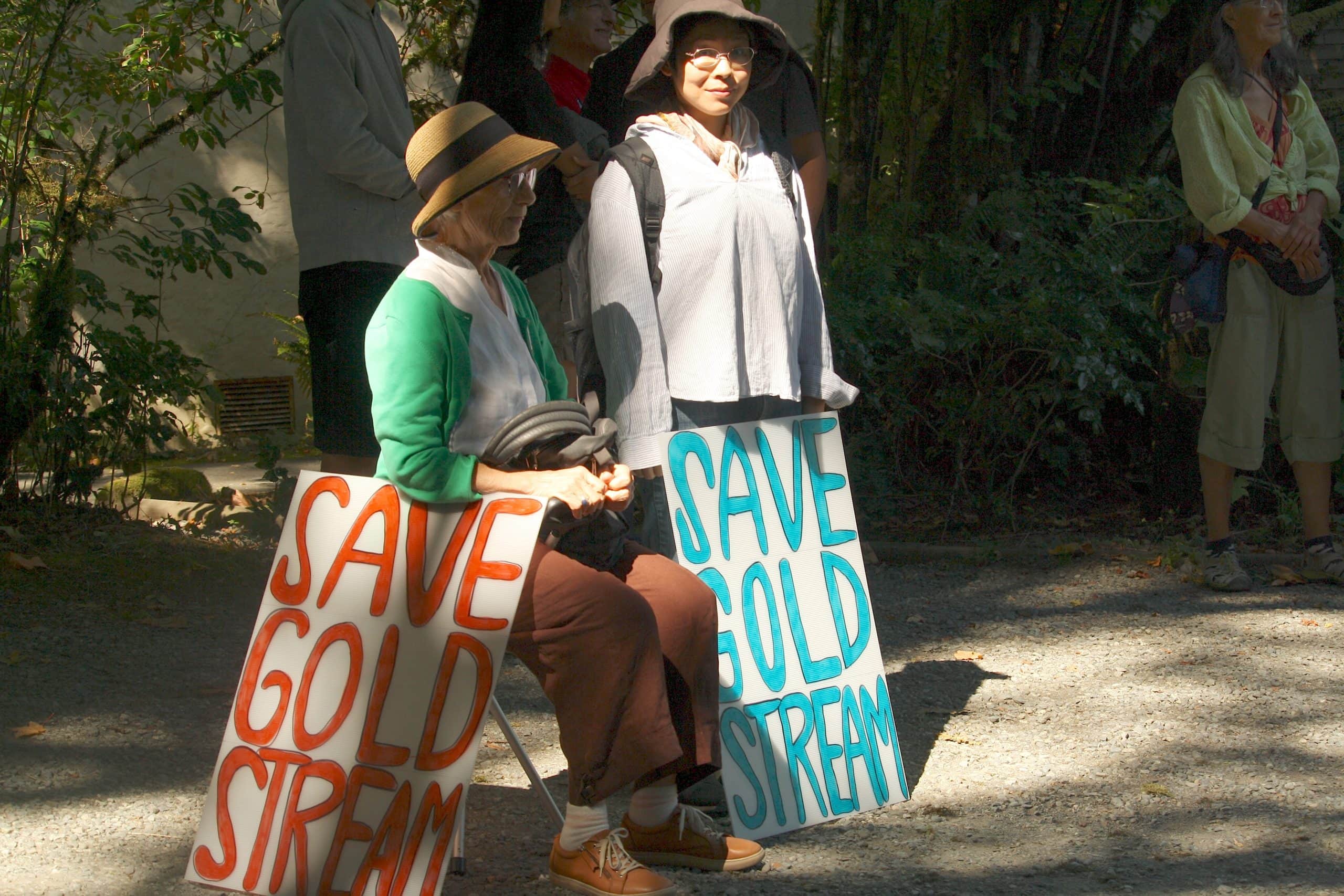
On its website, the B.C. government states Goldstream Park was “given to the people of British Columbia by the Greater Victoria Water Board in 1958.”
But the actual history is far more complicated.
“It rightfully belongs to us,” stated Jean Baptiste Paul, Tsartlip First Nation member and son of then-chief Thomas Paul, in an article published in the Daily Colonist on March 27, 1956. “We have never given it up, and never been offered anything for our fishing and hunting grounds there.”
Jean Baptiste recalled how he had hunted and fished at Goldstream as a child. He told the Daily Colonist that all of the Saanich Inlet, from Cherry Point to the hills south of Goldstream was Indigenous territory, and had been identified as such by his grandfather, former Tsartlip Chief Ben Paul.
Tsartlip and Malahat members had built fish-smoking shacks near the river and his grandfather had also constructed a log cabin in the area. But one day when no one was there, all the buildings were burned down, Paul told the paper.
At the time, Paul’s resistance was reported as little more than a passing curiosity with headlines such as, “Prospect of city giving park to B.C. has West Saanich Indians on warpath.” On June 26, 1958 B.C. went ahead and designated the area a park in celebration of British Columbia’s centennial.
Goldstream became a tourist attraction. Even though it was not yet officially open, the campground was quickly packed with vacationers. Newspaper columnists sung the praises of Goldstream’s beauty and touted its quick accessibility from Victoria. In the fall of 1960, thousands of onlookers crowded into Goldstream to watch the salmon run, a practice that continues to this day.
However, these thousands of new visitors brought with them a host of new problems, says Eric Pelkey WEC’KINEM, hereditary chief of the Tsawout First Nation. Sometimes when nation members are down at the river harvesting fish, visitors to the park will confront them.
“They start cussing us up and down, saying that we’re destroying the fishery. We tell them, we have the right. We have the right to do this, to carry on our fishery and to just leave us alone. But there’s still a lot of racism that comes out at that time. People think we’re torturing the fish,” Pelkey says.
The W̱SÁNEĆ carry on regardless. More recently, people have also been coming out there to support them, he adds.
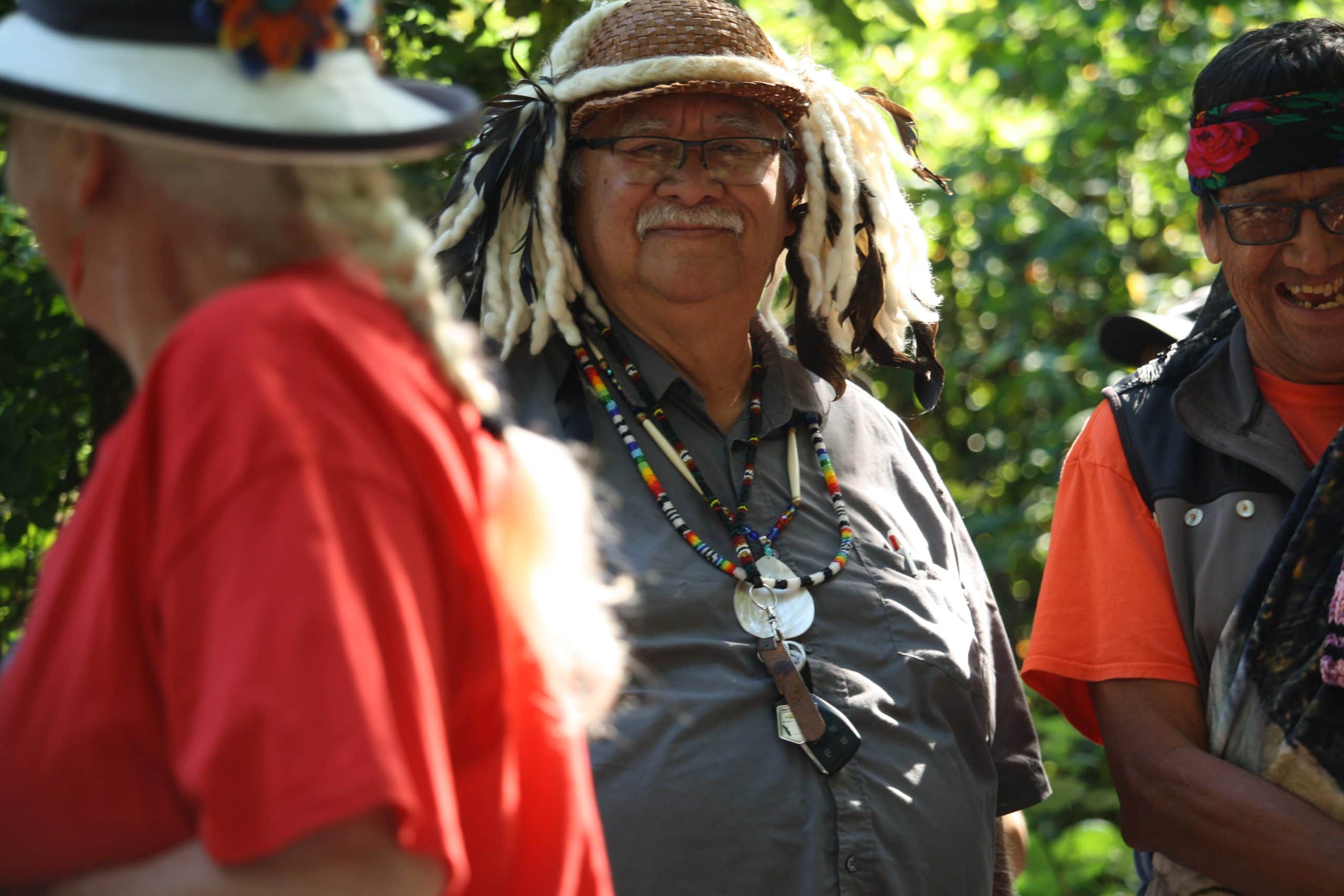
Pelkey sits at a picnic table in the park, the gentle rush of the Goldstream River behind him. Barrel-chested, his voice a deep, gentle baritone, he wears a ball cap-style hat woven from cedar bark and a wool and feather headband. A cream-coloured traditional knitted blanket is wrapped around his shoulders.
These accusations are especially misplaced because, he explains, it’s the W̱SÁNEĆ who constantly steward the area and conduct their own assessments to monitor the health of the fish.
For example, in 2023 the numbers of chum in the Goldstream were so low that nation members just went down to the river to observe. “Nobody took a fish,” according to Olsen, a long time volunteer at the Goldstream Hatchery.
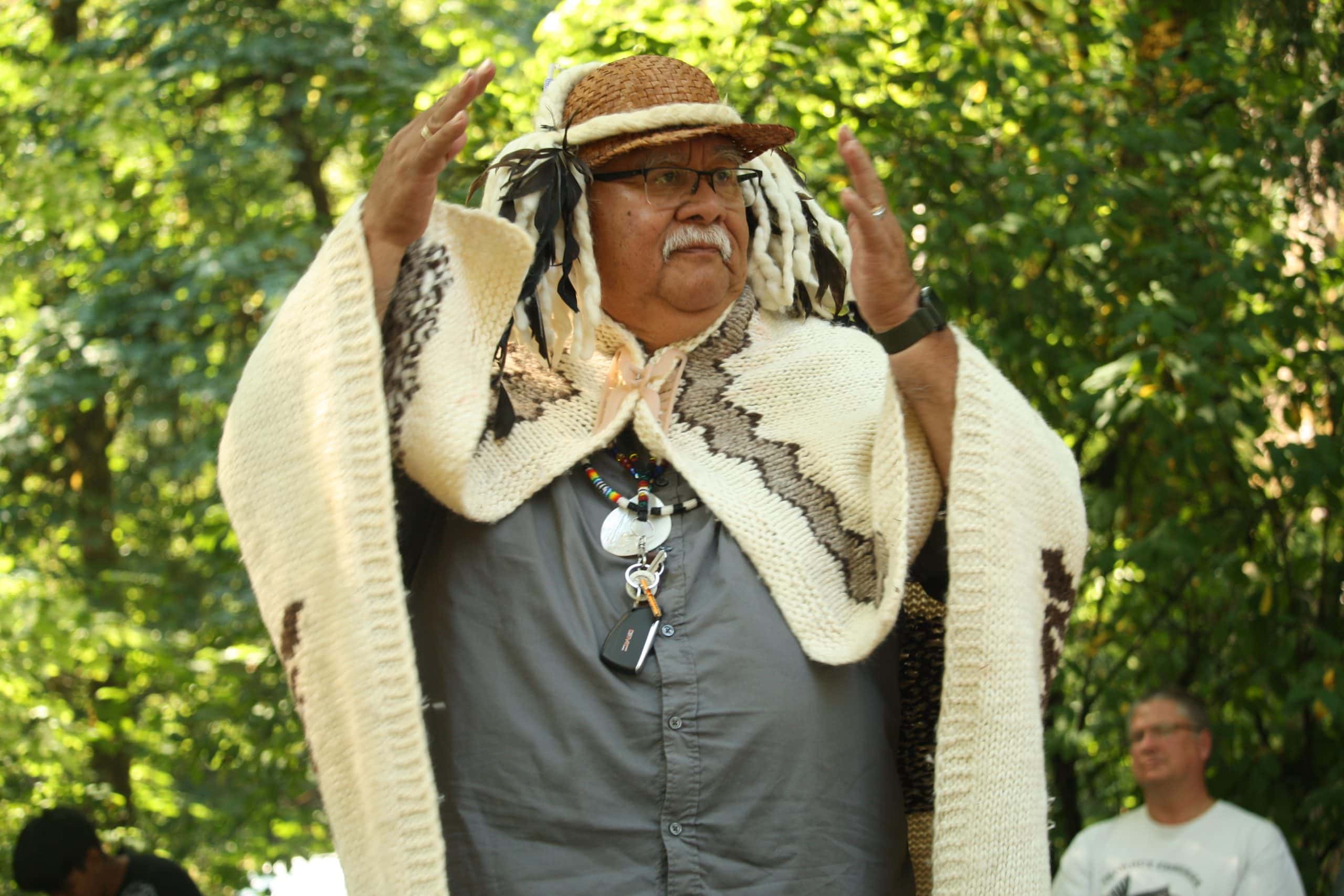
Most of the environmental problems in the area are due to settler activity in the first place, Pelkey points out. Commercial fishing boats that come down the Johnstone Strait along the coast of Vancouver Island and into the Strait of Georgia take most of the salmon before they can even reach the Goldstream River, he says. In 2011 a fuel tanker truck crashed in the area, leaking tens of thousands of litres of gasoline and diesel into the river caused further stress on the salmon.
Members from all W̱SÁNEĆ nations harvest chum, Chinook and coho salmon from the Goldstream River as a winter food supply, and have for generations. When it’s smoked, the chum can last all winter, Pelkey says.
“I remember growing up, and we always had that smell in our house, because my parents would have sacks of smoked chum on top of our cupboards, burlap sacks,” he says.
A village displaced
In 1877, the Indian Reserve Commission parcelled out a fishing reserve along the south end of Finlayson Arm, an extension of the Saanich Inlet where the Goldstream River feeds into the ocean. However Goldstream Reserve no. 13, as it’s called, sits at the base of Mount Finlayson instead of in the area of the river where the community still harvests fish.
“They carried out the survey of the old fishing village, but the surveyor is the one that took it from here and put it over there, off on the side of the mountain, instead of surveying where our village was,” says Pelkey. “This whole area here used to be filled with longhouses all along the river. Right over there, where that overhang is there, is actually where our family’s longhouse used to be.”
He turns and points over his shoulder, to a structure not far from Goldstream Park’s gravel parking lot.
“I was not aware of that until maybe I was in my 30s, when my grandfather asked me to bring him out here. We parked over there, walked down. And he said, ‘Oh, what is this building?’ ”
He told his grandfather, Marshall Pelkey, that it housed the washrooms and that this was now a public park. He became upset, Pelkey recalls.
Known as the “saltwater people,” the ocean is entwined within everything the W̱SÁNEĆ do, Pelkey says.
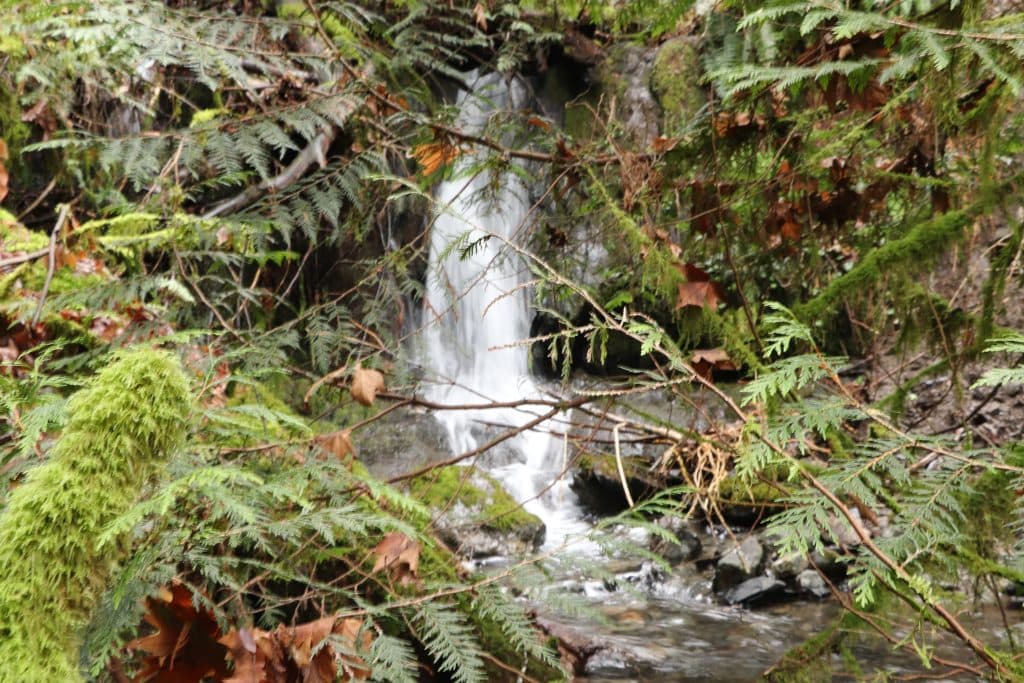
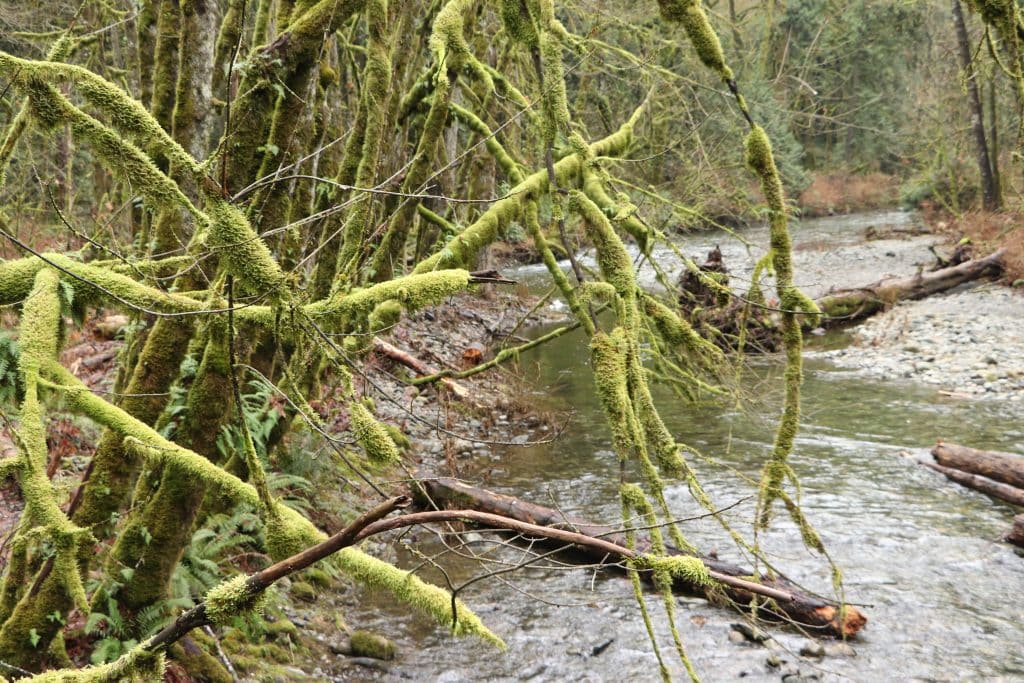
The W̱SÁNEĆ have maintained a wide and complex network of traditional reef net fishing sites throughout their territory, which encompasses what are currently known as the San Juan Islands, Boundary Bay, the Saanich Inlet and Saanich Peninsula. These reef net sites are not just places to harvest food, but are part of a wider spiritual and community practice.
In and around Goldstream Park, community members also use streams that feed into the area for ritual bathing, and host a first salmon ceremony each fall to greet their returning salmon relatives. This is in an area right beside the province’s proposed road work site.
“Our people always fished here, no matter where the reserve was. Every winter, our people came here to fish. Conservation officers always tried to stop us, but we always just kept on and dared them to take us to court,” Pelkey says.
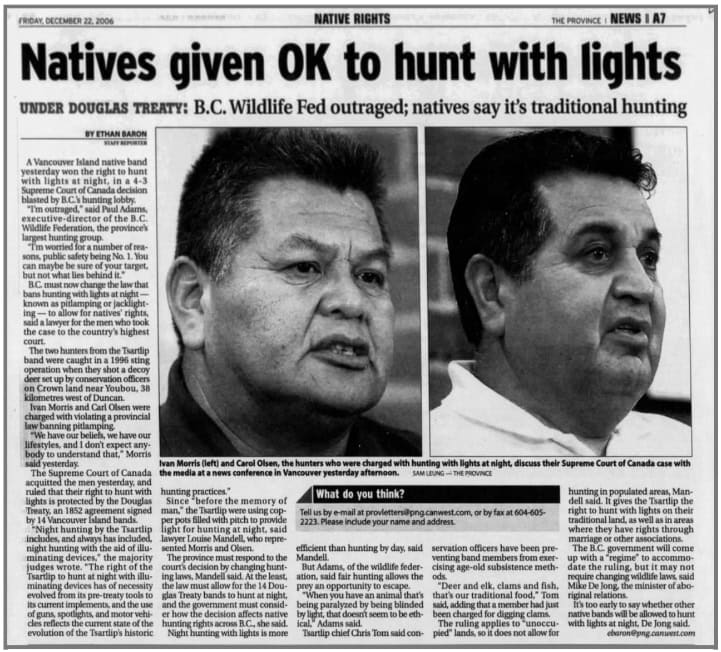
That’s exactly what happened one evening 30 years ago, when Olsen and another Tsartlip member, Ivan Morris, were caught hunting by conservation officers on their territory and arrested.
To hunt and fish as formerly: what the Douglas Treaties really meant
Though it was early evening, it was already getting dark on Nov. 28, 1996, when two men, driving in the woods near Youbou, spotted what appeared to be the glow of deer eyes through the trees.
They were showing two boys — eight and twelve years old — how to hunt at night with the help of a light. It was something their families had safely done for generations, but was previously done with burning pitch and bows and arrows.
Morris pulled the vehicle over. Olsen took aim and fired a few shots. He then passed the rifle across the two boys to Morris, who got out of the vehicle and squeezed off two more.
They soon got a nasty surprise. The deer they shot at was, in fact, a decoy, complete with reflective eyes, set up by provincial conservation officers to trap illegal hunters. The vehicle was quickly swarmed by officers and the two men were arrested, Olsen recalls.
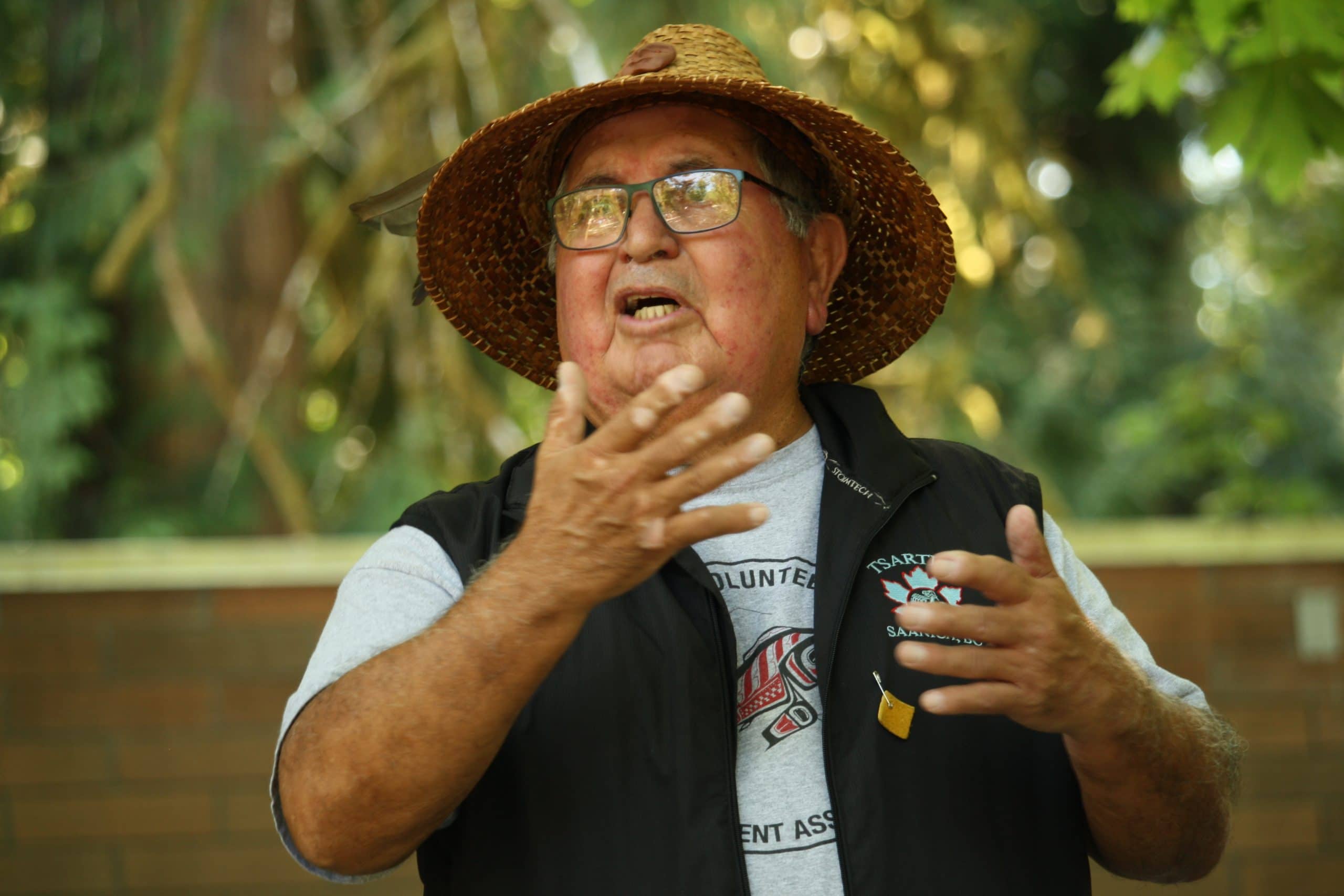
“There were probably a dozen or more conservation that surrounded us and even manhandled the kids that were there, threw them up against the hood of the car to search them,” he said.
The two were charged with hunting with a firearm during prohibited hours and hunting with an illuminating device, under provincial wildlife legislation. The subsequent trial revolved around the Crown’s argument that yes, Morris and Olsen had a right to hunt, but that did not include the right to hunt in a way that was “inherently unsafe,” as the trial judge put it.
At trial, the men’s lawyers countered with a vigourous legal defense. Not only were they using safe practices, they argued, their right as Tsartlip members to hunt as they always had was protected under the North Saanich Treaty of 1852, negotiated between nation members and Douglas.
The case dragged on for 10 years. Initially both men were convicted and it was upheld by the B.C. Court of Appeal. However, when it got to the Supreme Court of Canada, the convictions were overturned in a 4-3 vote.
Under consideration was the relevant text of the North Saanich Treaty, which guaranteed that village sites and enclosed fields were to be kept for the W̱SÁNEĆ and their children’s use, though the land itself was to become the “property of the white people for ever.” However it also clearly stated that its signatories were at liberty to hunt and carry on their fisheries “as formerly.”
But there are essentially two versions of what happened with the signing of the treaties — the written settler version backed by Douglas and others’ accounts, and the Indigenous oral version told through history by W̱SÁNEĆ members.
It’s generally understood that on Feb. 7 of 1852, Douglas met with 10 W̱SÁNEĆ members to agree on what became the South Saanich Treaty. He then requested W̱SÁNEĆ chiefs come to another meeting on February 11 during which he negotiated with 118 “men with beards,” as he later described them, in what ended up as the North Saanich Treaty.
Historians have different theories on why these two agreements were negotiated separately, but it’s important to understand the context in which they were negotiated. For a prior treaty with the Songhees Nation, Douglas said he asked the chiefs to sign marks at the bottom of a blank sheet of paper, later adding details above it that resulted in the acquisition of the area’s South Island. Experts believe it’s possible Douglas did the same thing as with the W̱SÁNEĆ as he did with the Songhees, and got them to sign blank paper.
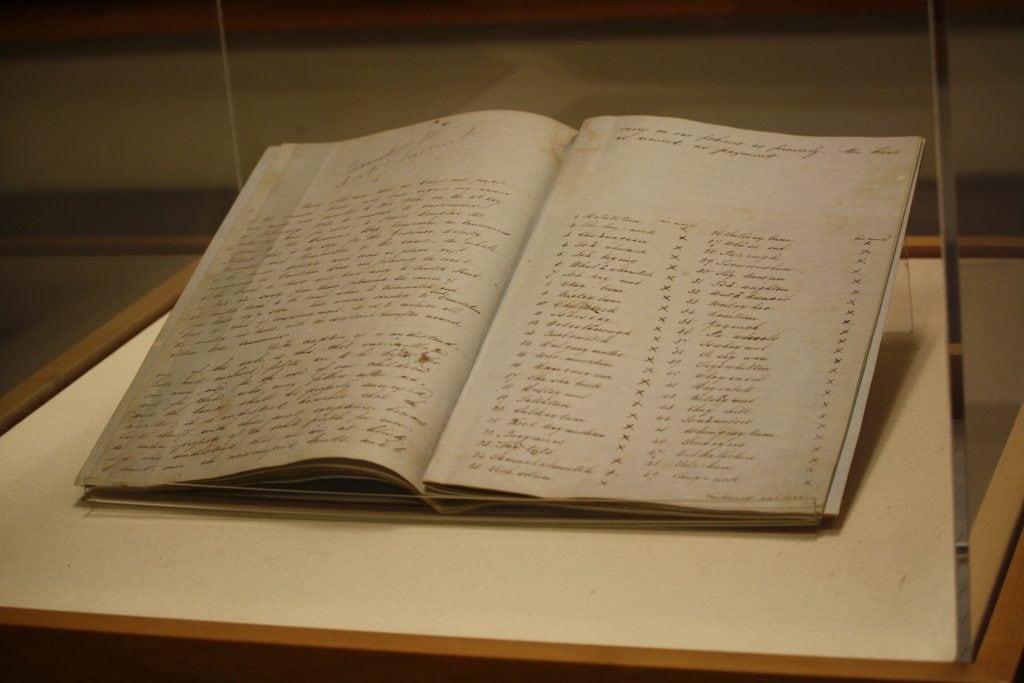
Adding to the complications, the X marks on the North Saanich Treaty that represented signatures “were forged” in that they were supposedly signed by W̱SÁNEĆ members “but were in fact made by the clerk of the Hudson’s Bay Company,” declared Justice Douglas Lambert, in Olsen’s B.C. Court of Appeal case.
There is no evidence that the First Nations signatories saw the agreements after the fact, were given a copy, or knew what text was later added.
To this day, the text of the Saanich Treaties does not match W̱SÁNEĆ’s own oral version, which asserts that the treaties were likely agreements to share the land, not surrender it.
On this point, the court also came to a stunning conclusion in its final ruling, in Olsen’s favour: “The Douglas Treaties were the reflections of oral agreements reduced to writing by agents of the Crown” and that those oral promises made when the treaty was agreed to “are as much a part of the treaty as the written words.”
As the people who wrote the Douglas Treaties down were not the Indigenous people, the court “had to take into account what was the evidence of Indigenous people about what they thought the treaty meant,” says lawyer Louise Mandell, Olsen and Morris’s representative and one of the founding partners of Mandell Pinder, a law firm that specializes in Aboriginal and treaty rights law.
This was important for the legal cases that were to follow, she adds.
There are other reasons that the W̱SÁNEĆ think the treaties were likely land sharing agreements meant to stave off tensions that had arisen at that time for a variety of reasons, including a dispute over timber being harvested by settlers in Cordova Bay.
Given that the Indigenous population on Vancouver Island at this time was approximately 11,700 people, compared with a settler population of about 700, there wouldn’t be any motivation for the W̱SÁNEĆ to sell off all their land, says Joni Olsen, the policy and negotiations manager for the W̱SÁNEĆ Leadership Council and Carl Olsen’s daughter.
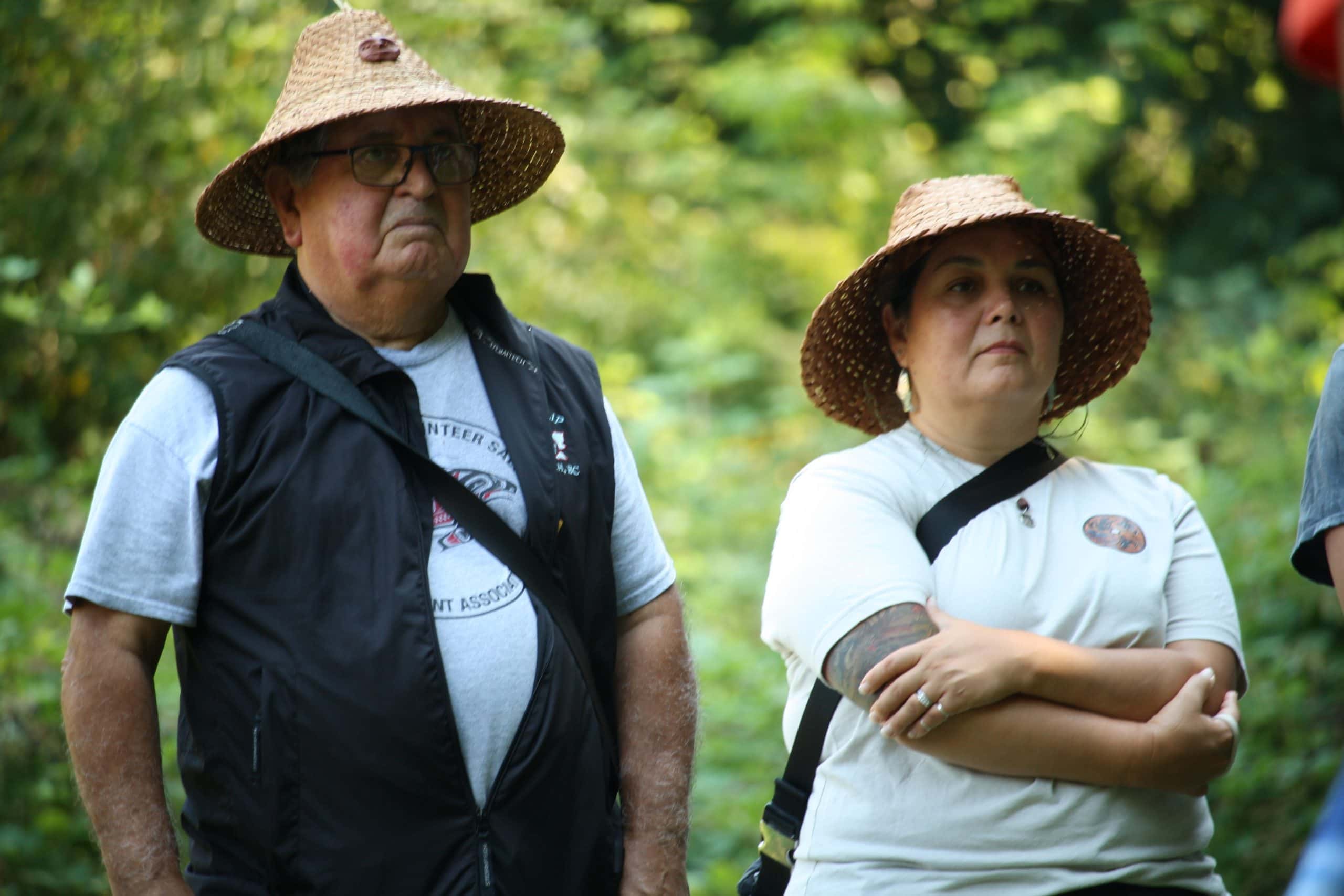
“The concept of selling land at that point in history was not a thing for W̱SÁNEĆ people,” she says, especially in the context of B.C. being the last place in Canada that settlers came. “Maybe on the east coast, where they had been settled hundreds of years before, there were probably those concepts there already, but that didn’t happen here.”
Furthermore, the idea that the W̱SÁNEĆ would sell land in exchange for a “payment” of blankets doesn’t make sense culturally, and represents a fundamental lack of understanding around what gifting means to their people, Joni says.
“I mean, historically, to access land you would have married somebody’s daughter or something like that. There would have been an exchange. And it could have been through Potlatch, where you had an exchange of things like blankets. But it wasn’t to own. It was to share. It was to have access to.”
Last February, Joni helped negotiate a joint statement with the provincial and federal governments to acknowledge W̱SÁNEĆ’s oral version of the treaties. It states that “though Canada and British Columbia have long considered these agreements to be land purchase agreements, W̱SÁNEĆ oral histories hold that they were agreements to settle disputes and establish peaceful relations between the W̱SÁNEĆ Nation and the European settlers.”
But these peaceful relations remain a challenge when it comes to negotiations over the future of Goldstream Park.
Moving Indigenous court victories into the real world
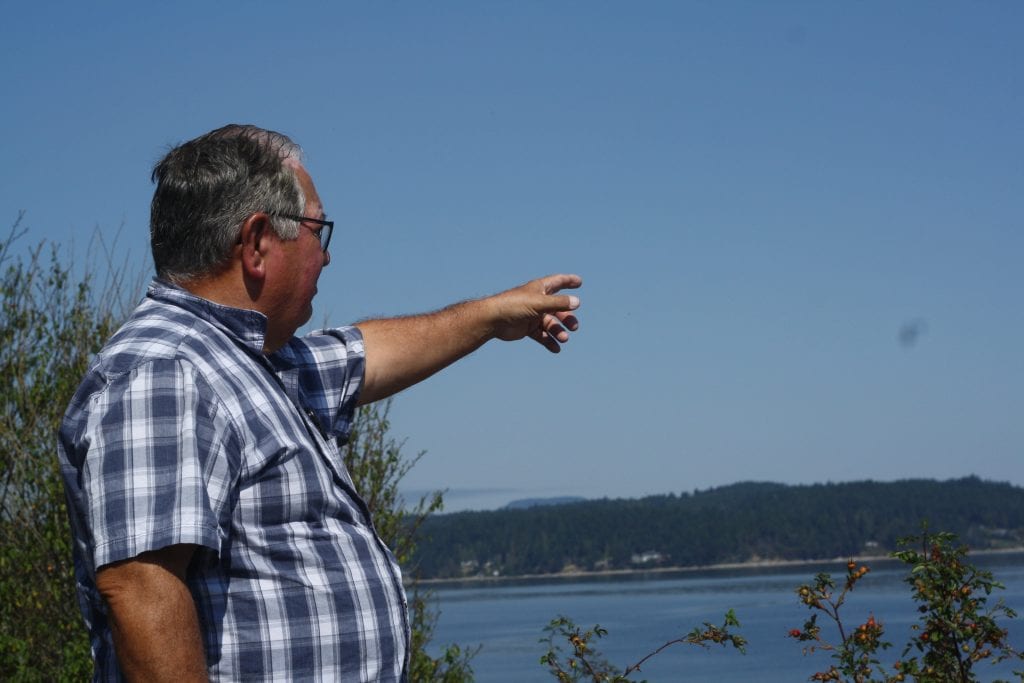
Olsen stands on an outcropping of stone known as “The Rock.” It’s a scenic spot along Mill Bay Road in the Cowichan Valley that looks out across the waters of the Saanich Inlet, which is fed by the Goldstream River. In the distance are the western shores of the Saanich Peninsula; beyond that, a scattering of islands.
The sun is bright, and he cups a hand over his forehead as he looks across the water.
“When I was a kid, this bay was full of salmon. You could see it,” he says. “You really could see it.” These waters and lands were his garden and food source growing up.
“It’s where we harvested food plants, medicine plants, and berries. And when you come to the ocean like this, we harvested our food from the ocean. In fact, I was in my early teens before I even had a store-bought meal. It was like fish, ducks, deer, clams, oysters, seal meat. That was my diet before, up until maybe the mid ’60s,” he says.
Though he was raised as a hunter and a fisherman, his father taught him those skills in private, under a cloud of fear.
“Most parents in our communities suffered from fear. Fear of losing their kids because of how the residential school would just take you away if there was a problem. They actually lived with that fear right up till the end, and so they never taught us on land here. My dad always taught me when we were out fishing on the boat, when there was nobody around. Nobody to come and take us away,” he says, overcome with emotion. “That’s how it affected the treaty as well. They had to go outside or to the islands to teach us our ways.”
That fear has continued to affect the exercising of their Douglas Treaty rights because those rights are still disrespected and uncertain, he adds.
“It only verifies the rights that I have, that’s what the Douglas Treaty does. Because that’s what we did before, hunting and fishing, being taught with hands-on teaching,” he says. “That fear is still there, because of the inability of the government to come and sit down with you to implement that court ruling.”
Of the five historical court cases that involved Douglas Treaty rights — including Olsen’s — each one resulted in victory. And every case presented its own legal challenge.
“It wasn’t as if we sat around, thinking about what all we have to do to win whatever,” says Mandell, the lawyer who represented Olsen and Morris. “In every case, we nuanced what the arguments were going to be, and we built the law — gradually.”
In the 1980s Mandell worked on the 1987 Saanichton Marina case, around a development company’s intention to dredge and develop a commercial marina in Saanichton Bay that was home to eel grass beds, crabs, salmon and trout.
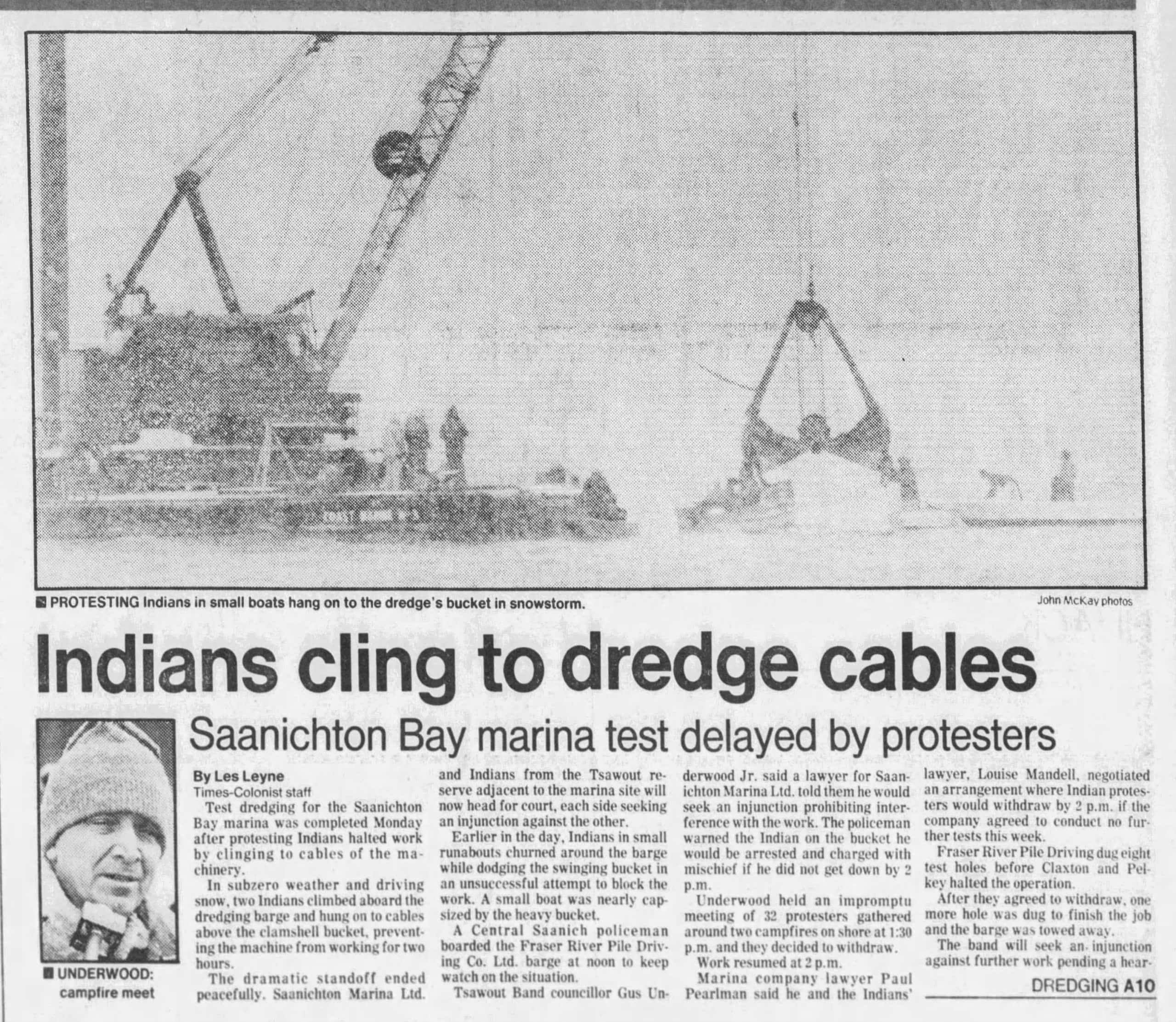
The legal team wondered how they could assert the treaty “not as a shield but as a sword,” Mandell says. Rather than defend themselves from persecution, they would now assert their rights proactively, to protect the crab fishery and the Tsawout Nation’s traditional fishing grounds.
Essentially, Saanichton Marina Ltd.’s argument was that the “right to fish as formerly,” as stated in the treaties, meant the company could simply pick up and move the eel grass habitat elsewhere. The fish would still be there to harvest, so what was the problem?
The court agreed with Tsawout’s lawyers that found that a fishery is actually the place where fish are harvested, and the right includes the nation’s capacity and the capacity of a nation to care for it, so they’re not deprived of that right.
“It’s both the incidental aspect and also the place itself. It’s not the right to put your fish net in the water and pull out a fish. It’s the right to continue to protect and harvest and steward and be reciprocal, inside the place that the fishing is happening,” Mandell says.
This was a crucial and far-reaching finding, and directly relevant to the fight at Goldstream Park — the concept that nation members not only had the right to fish as formerly, but to protect their harvest.
It’s been a rallying cry for Olsen ever since.
“My relatives fought for that. And the decision that came out of there was that they not only had the right to hunt and fish as formerly, they have the right to protect what they hunted and fished as formerly,” says Olsen. “That’s why I’m here. I’m protecting what belongs to us, our relatives that come up the stream that feed us.”
However, Mandell says there is a huge difference between winning a case and translating that legal victory into political action.
“I can’t tell you how many times we came home from the Supreme Court of Canada thinking we had died and gone to legal heaven, only to find out nothing much changed on the ground. I think that’s the difference between winning a legal point and actually having the capacity to move that victory into shifting the political landscape,” Mandell says.
Olsen, standing on the side of the Malahat protesting for the protection of Goldstream, embodies that distinction.
Despite decades of court cases and historical agreements which upheld the W̱SÁNEĆ people’s rights not only to their village site but also to their fishing grounds at SELE₭TEȽ, despite three years of weekly protests to highlight these rights, it appeared the government’s $162-million highway improvement plan was poised to go ahead.
That is, until Olsen received a phone call in February this year from some members of the W̱SÁNEĆ Leadership Council to tell him they had received some news.
‘Do what you can’
The province had an announcement to make about the Malahat highway. The widening project was being paused. The leadership council members congratulated him.
In a February news release, the province said additional work was required “to address environmental considerations in this sensitive area of Goldstream Park” and understand the project’s impacts.
“I thought, ‘Well, that’s great,’” Olsen says. But he also doubts whether the government will keep its word.
“In the past we’ve had meetings with businesses and government offices and in our longhouses here and come to agreements with them. Then not even a couple of days later, they break those agreements,” he says.
“This could be one of those issues. You know they said they were pausing it, and in their statement, they talk about how they need to better understand the environment and do more research on the environment there, which tells me we were right in thinking that they didn’t really have an environmental plan.”
From the beginning, the province wanted W̱SÁNEĆ members to accept their environmental assessment without question, Olsen says. But he always felt that there was something odd about being asked to accept something without fully agreeing to it. From what nation members could see, the environmental risks were obvious — even from the government’s own assessment report.
The purpose of the environmental assessment was to identify issues, and “some of these considerations were brought to light through that process,” Ministry of Transit and Transportation spokesperson Murray Sinclair stated in an email.
“This does not mean the report was incomplete. The purpose of an environmental assessment is to identify issues, and some of these considerations were brought to light through that process,” Sinclair stated. Given the complexity of the site and the sensitivity of the habitat, addressing those issues will take time, he added.
The ministry is currently conducting a review of crash data in the area as part of an update to its 2012 study of the Highway 1 Malahat corridor.
What about Olsen’s concern that the project is merely on pause, and not actually cancelled?
“It’s possible the project could be revisited in the future. However, there is no timeline or estimate for when that might occur,” stated Sinclair.
This is why, for now, Olsen has decided to keep up his weekly protests.
“We want better decisions made about Goldstream and protecting the watershed especially. It’s about protecting the whole area,” he says. “It’s really important that we recognize where we stand in the whole thing. I’m not going to leave. I think they expected me to leave. We’re still there.”
On-the-ground reporting for this story is made possible with support from Carleton University’s Peter Stursberg Award in Conflict Journalism and Media Studies. As per The Narwhal’s editorial independence policy, no foundation or outside organization has editorial input into our stories.