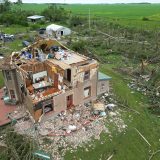
Ksi Lisims LNG in Prince Rupert, B.C., and the North Coast transmission line in the province's northwest have both been added to the federal government's fast-tracked projects list. The B.C. government has promised they would add thousands of jobs and billions in economic development to the province and country — but details are in short supply.
Photo: Province of British Columbia / Flickr
LNG exports in British Columbia, shrinking protections in Ontario and broken trust in Alberta: as governments hit the development fast lane, The Narwhal’s reporters are keeping pace
Before I get to our latest reporting on big moves across the country to “build, baby, build” — some good news! Since Tuesday, 64 of you have joined us as the newest members of The Narwhal! We’re nearly halfway to our goal of bringing on 150 members in September, so our reporters can keep up their impactful work.
As one of our newest members wrote: “In an age where it feels like most folks around me get their news off of Facebook, I really value true investigative journalism that takes the time to dig up information, not just create clickbait. Thank you!”
This week, the federal government cheered the approval of the massive Ksi Lisims LNG facility on British Columbia’s northwest coast — perhaps partly in an effort to score some political points on Prime Minister Mark Carney’s quest to “build, baby, build.” Government talking points may leave a different impression, but it’s not clear that any of the recent measures to streamline major projects had any bearing on this process, which marched along as expected over the last several years.
Technicalities aside, the question of whether a facility producing 12 million tonnes of liquefied natural gas annually is good for Canada, and worthy of fast-tracking, is complicated — there will of course be costs and benefits.
The federal energy minister touted Ksi Lisims as “designed to be low-emission” and “powered by BC Hydro’s clean electricity.” But thanks to new reporting from northwest B.C. reporter Matt Simmons, we know that’s only part of the truth.
In fact, there are no power transmission lines to the project site — and none are expected before the facility comes online. That means the plant will burn natural gas in order to supercool more natural gas, in order to ship it overseas to in turn be burned. The emissions costs, by the B.C. government’s own assessment, will be “significant.”
Over in Ontario, the government is doing its part to pave the way for development. The province redrew the boundaries of a protected area in Port Hope, which effectively removed a hurdle that had stalled a proposed subdivision.
It’s part of a trend in Doug Ford’s Ontario: using the levers of power to remove protections for the environment, while making it easier to build (baby build).
Everything comes at a cost. Top political staffers in Alberta brushed up against some of those costs at a recent community meeting in the small town of Warburg. They faced shouts and jeers as they defended the government’s plan to clean up the mess made by oil and gas companies: unpaid rent, orphaned wells and environmental liabilities that add up to nearly $38 billion.
Prairies reporter Drew Anderson was at that meeting. No other journalists attended.
As governments across the country speed toward their development ambitions, our small team of reporters is keeping pace: reporting deeply on the impacts of decisions, for now and for the future, for better and for worse, thanks to readers like you who give what they can.
I’ve only mentioned a few of the deep and impactful stories The Narwhal tackled over her past week — I hope you’ll find a chance to peruse a few of the others as well, highlighted below.
More than 300 people joined The Narwhal on Tuesday for a lively discussion on solutions to the overlapping issues of housing and climate change in British Columbia. A big thanks to all who came — the whole team was delighted by the great questions and energy you brought to the conversation.
Reporters Steph Kwetásel’wet Wood and Shannon Waters shared insights from their reporting on how communities across the province are finding innovative ways to house people in a warming world, and answered some of the (more than 100!) questions you asked.
4 years after Fairy Creek, a new battle over B.C.’s old-growth forests looms in the Walbran Valley By Shannon Waters
A B.C. justice has granted an injunction against a group of people blocking a logging road on southern Vancouver Island. The decision paves the way for the RCMP to move in.
If you appreciate The Narwhal’s in-depth reporting on the natural world in Canada, join our pod as a new member today!(Bonus: you’ll be dog-walking in style with your new Narwhal tote bag!)