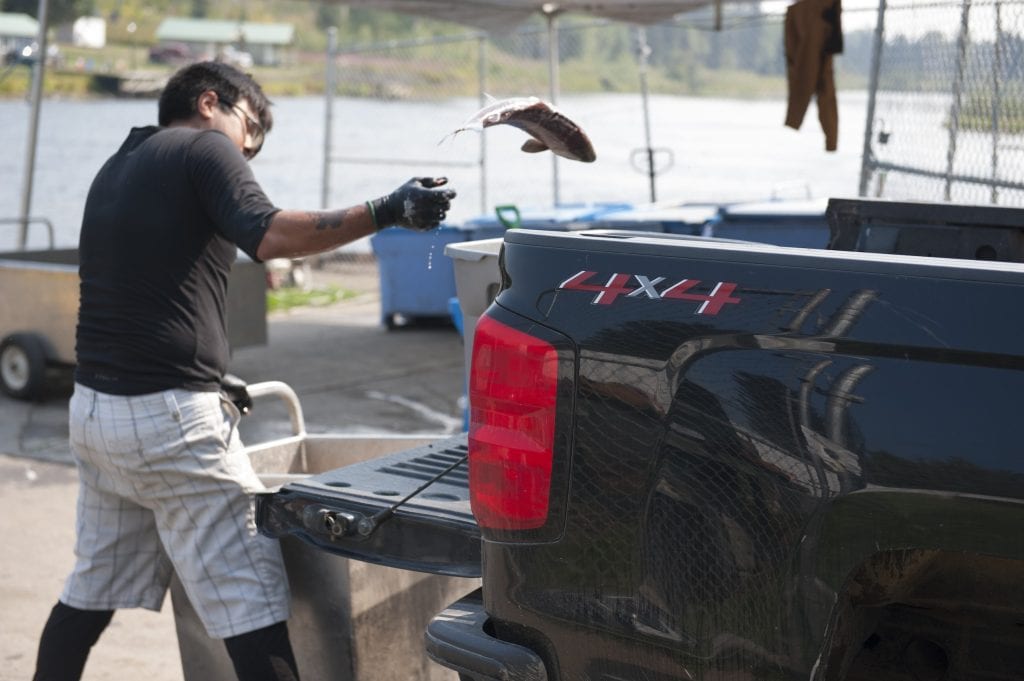
A gathering in Prince Rupert, B.C., marked ten years since a community came together to protect Lelu Island and surrounding waters under Indigenous law
“I see you all here fighting for one thing, and that’s for our salmon,” S’mooygyet (Chief) Algax’m Hax said at a gathering in Prince Rupert, B.C., earlier this month. “So goes the salmon, so do we.”
Living parts of their lives in alpine creeks and wetlands, traversing fast-flowing rivers and swimming in the vast oceans, salmon span ecosystems. Their decaying bodies, left half-eaten by bears or wolves on the forest floor, feed trees. Salmon connect people, too, sustaining coastal and interior communities alike.
Ten years ago, salmon brought Indigenous leaders and allies from across B.C. together in a powerful display of unity.
Facing the threat of a massive LNG facility about to be built in the delicate Skeena River estuary, commercial fishers, loggers, scientists, politicians and others stood in solidarity with the Hereditary Chiefs of the Gitwilgyoots, one of the Nine Allied Tribes of Lax Kw’alaams, signing a declaration protecting Lelu Island and the surrounding habitat under Indigenous law.
A few weeks ago, I took my eight-year-old with me to Prince Rupert, just a few kilometres from where juvenile salmon find refuge in the eel grass of the Skeena River estuary, to attend a gathering celebrating the anniversary. We listened to presentations about science and habitat restoration, threats and challenges, rights and responsibilities.
I’ve written a lot of stories about Indigenous stewardship over the years, and my little one has come along to a number of gatherings — most of which included eating some kind of salmon and listening to a lot of speeches. After the event, we picked up some sushi from my friend’s restaurant. As we ate, my kiddo turned to me and said it was at one of those gatherings where he first fell in love with salmon.
Sometimes it’s important to slow down and savour a moment. His words, the taste of sockeye, a feeling of togetherness.
My story this week, which you can read on our website, is much the same. Many at the event talked about the challenges facing salmon stewardship, from climate change to industrial expansion to economic pressures and beyond, and I don’t think we should shy away from facing the many problems of the world. But I believe it is worthwhile every now and then to pause and reflect on what has been done to protect what we hold dear.
Yesterday, the former Liberal environment minister announced his plan to resign his seat this summer after seven years in government.
Before that he was a Quebecois environmental hero, most famous for scaling the CN Tower in 2001 to unfurl a banner calling out Canada and the U.S. as “Climate Killers.”
Guilbeault’s exit marks the end of an era for Canadian environmental aspirations. But just because big government promises are no longer being made, it doesn’t mean the push to protect the planet is over.
Leah Borts-Kuperman might be a name you recognize — she’s contributed to The Narwhal as a freelancer for years.
Leah has a real knack for sniffing out important environmental stories, such as her award-winning investigation into contaminated Canadian military sites, so we are thrilled to be welcoming her to the team as a staff reporter! From her home in North Bay, Leah will be reporting on the people, animals and landscapes of northern Ontario.
Get to know Leah a little better, and learn what motivates her as an environmental journalist, by reading this Q+A.
This week in The Narwhal
Carney will give tax breaks to oil companies that capture carbon ... to pump more carbon By Drew Anderson
Critics warn Canada’s plan to subsidize companies that capture pollution only to use it to produce more oil is counterproductive — here’s what you need to know.