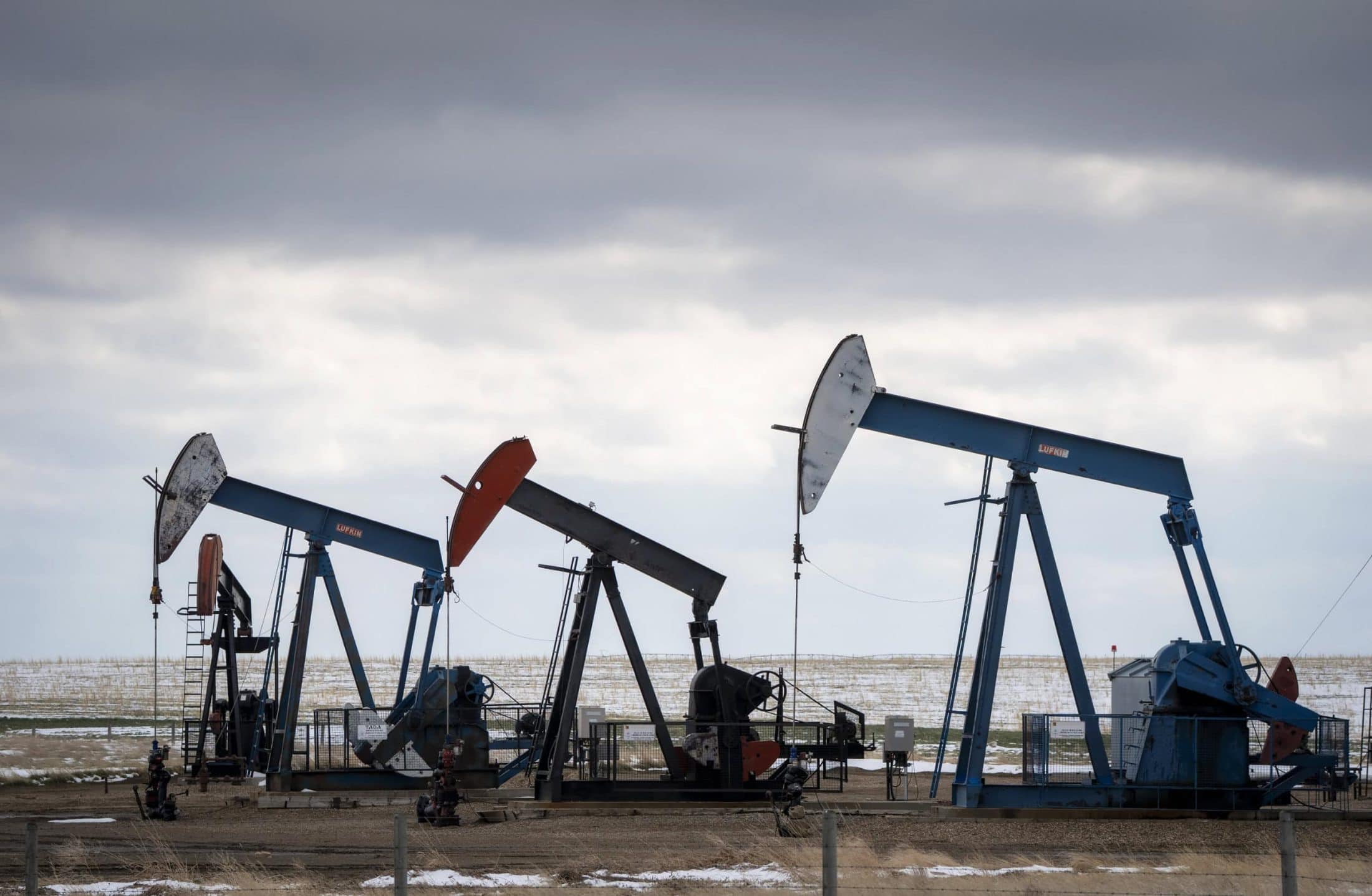
Former Alberta governments have tried — and failed — to reform a system where ranchers collect revenue for oil and gas wells on public grazing lands.
Photo: Todd Korol / The Narwhal
A last-minute tip threw a wrench in a month-long investigation into public land, public money and cattle ranching in Alberta. The issue was bigger than we thought
Last Friday night, The Narwhal’s Prairies reporter Drew Anderson sat down on the couch, excited for a moment to breathe after wrapping a big investigation, set to publish the following week.
Then his partner mentioned something she had stumbled across, related to his reporting. She had meant to share it earlier but, well, Drew had been so busy.
Cue the panicked 10:48 p.m. message to his editor (that’s me!).
“It was like, oh my God, I want to cry,” he recalls. “I’m going to have to change my story.”
Drew and web developer Andrew Munroe had already spent weeks crunching the numbers. Thanks to the late-night tip, Drew realized there were some data points he had overlooked. Turns out, the figures in his investigation were even bigger than we had thought.
The updated analysis revealed big stakes in a complicated story: one involving cattle ranchers, oil and gas companies, a faltering regulatory system, politics, power and taxpayer money.
Drew’s investigation, published in three parts this week, details how the Alberta government allows millions of dollars of public funds to wind up in the hands of ranchers who graze cattle on public land. He found an estimated $5 million in taxpayer money paid since 2021 to grazing leaseholders in one region of Alberta — on behalf of delinquent oil and gas companies.
Here’s the gist. In Alberta, ranchers can lease public land at below-market rates to graze their cattle. At the same time, oil and gas companies with wells on that public land must pay for loss of the land and impacts from their operations. The catch? In Alberta, that money doesn’t go to the provincial government, which owns the land, but to the rancher who leases it. And if the companies don’t pay? Well, that’s when taxpayers step in to cover the loss.
For decades, the government has been called on to fix the system, but it has not. An auditor general report 11 years ago found some ranchers were making five times more in oil and gas payments than what they paid to rent the land.
Ranchers say it’s fair compensation for the costs and hassles of wells in a grazing area, while some critics have dubbed it “cowboy welfare.”
Oh, and one recipient of those payments? None other than the ranching business of Alberta’s finance minister, Nate Horner. Drew’s analysis found the company has received an estimated $47,200 from the Alberta government since 2021 to cover unpaid bills for wells on leased grazing land. In theory, the province can go after delinquent companies. But previous reporting by The Narwhal found the province only recovers about one per cent of those costs.
This investigation is part of Who Pays?, our ongoing series about the connections between the environment and the economy in Canada. Check out more stories on the series landing page and in the roundup of recent reporting below.
Take care and date nerds,
Sharon Riley
Managing editor
P.S. Late-night texts from Drew about big money in oil and ranching are made possible by more than 7,300 members who support The Narwhal with a regular donation. Will you join them?
Another week, another deluge of nominations for The Narwhal’s in-depth journalism about the natural world in Canada!
Since last week’s newsletter, our reporting has been named a finalist for two National Magazine Awards and 11 (!) Digital Publishing Awards. We’re blushing — and honestly a tad overwhelmed!
Over at the Digital Publishing Awards, we’re up for the top award for general excellence in digital publishing. 2025 Indigenous editorial fellow Savannah Ridley is on the shortlist for emerging excellence. Our journalism is nominated nine more times across seven additional categories.
Over the past few weeks, The Narwhal has turned heads at six national and international awards programs — with 24 honours and nominations, and counting! Check out the full list on our website.
This week in Who Pays?
WATCH: From $25 an hour to $4,995: salaries on either side of the climate crisis Produced by L. Manuel Baechlin
Executive editor Denise Balkissoon breaks down which Canadian workers profit off activities that cause climate change — and who gets paid to cope with it. For more videos like this, follow The Narwhal on YouTube and TikTok.
Ontario cities are preparing buildings for the climate crisis. Bill 98 will make that more expensive By Fatima Syed READ MORE
Counting up receipts: one of Canada’s worst wildfire seasons cost at least $500M By Julia-Simone Rutgers READ MORE
Climate change is increasing northern Ontario cattle herds — and beef prices By Leah Borts-Kuperman READ MORE
Guardian programs are investments in our future — but Canada’s investment in them is uncertain By Santana Dreaver READ MORE
That feeling when you realize your month-long investigation needs a tiny bit more work. Sponsor more Hallmark moments like this one by becoming a member of The Narwhal today!