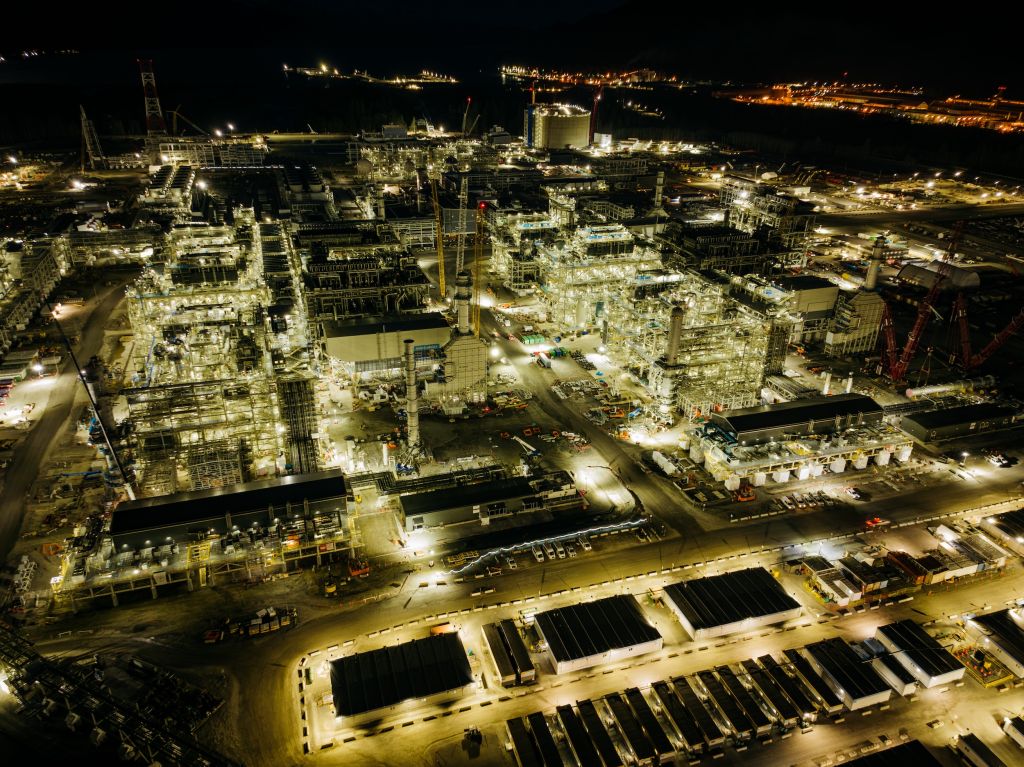
In Kitimat, B.C., LNG Canada recently achieved a milestone, shipping the first load of supercooled natural gas to buyers in Asia.
Photo: Marty Clemens / The Narwhal
Hi! Carol, here. Before I hand this off to Matt Simmons, who will tell you about his latest reporting from northern B.C., I have some wonderful news to share.
I asked you to stand with us in our fight, and did you ever: more than 1,000 of you stepped up. We blew through our goal of raising $60,000, with the total now at more than $94,000 — and counting. That’s incredible, but it still only represents a fraction of the total costs that will be required to take this case as far as it needs to go. And unlike the RCMP and the Attorney General of Canada, we can’t draw on taxpayer dollars to fund our case.
— Carol Linnitt, co-founder, interim executive director and editor-in-chief
And now, here’s Matt with more on this week’s top story:
When I recently caught up with some residents of Kitimat, B.C., my first question was about the flares. As LNG Canada gets going, its startup procedures include burning fiery plumes of natural gas. I live in the north and photos and videos have circulated social media for months. In June the flames got as big as 90 metres high and could be seen from more than 50 kilometres away.
“I just came to my front door again and I’m looking at it and there’s lots of black coming out of there,” Dustin Gaucher, a Haisla cultural researcher, told me on a phone call. He lives more than a dozen kilometres away and said it still “sounded like a rocket ship going off all night” when the facility first started its flaring.
Thanks in part to that flaring, the small coastal town can now call itself “the LNG capital of Canada,” Kitimat Mayor Phil Germuth told me when I called him up this month. That’s because on June 30, the liquefaction plant successfully filled the first of an estimated 170 ships per year with supercooled natural gas destined for buyers in Asia. “It’s been a long journey to get here, to have the plant up and running — we’re very happy that it is done,” he said.
We talked with residents on boats and at the docks, sat at kitchen tables and in book-lined living rooms. We gazed through a barbed-wire fence at the town within the town that was set up to house thousands of construction workers. We watched the endless plume of smoke coming from the aluminum smelter known locally as “Uncle Al” from the shoreline in Cʼimaucʼa (Kitamaat Village). We wandered through a tidal marsh habitat offset project in Minette Bay as shorebirds chattered from the water.
Then and now, it’s clear there are complicated trade-offs in a town “built by industry,” as the mayor puts it. “People understand that every once in a while, you’re going to have to put up with something to get the bigger goal in the end,” Germuth told me.
But whether the trade-offs are worth it is, of course, a matter of perspective. After my article was published this week, one reader who lives closer to the industrial megaproject reached out to share how the facility is impacting his quality of life.
“We experience constant daylight, window-shaking, rumbling,” Michael Rolica, an electrician, told me in an email, adding that some kind of soot is coating his property. “Now my family and my animals are having breathing problems. I cannot sit outside as it smells of burnt plastic. The sound has kept me awake for three days, even with earplugs.”
There’s no question that life with LNG, a new industry in B.C., is a dramatic change for people in Kitimat and beyond. As a resident of the north, it’s a change for me, too, and I’m here to listen to folks about what it means to them.
Take care and remember change is the only constant,
The climate is in chaos. Housing is unattainable. This First Nation is building homes to face turbulent times By Steph Kwetásel’wet Wood
Heiltsuk Nation is just one Indigenous community in B.C. working to build homes that are affordable, energy-efficient and grounded in culture.