If you haven’t filed your taxes yet, let me be the 100th person to remind you: there’s one week left. It’s the time of year when we all take a long, hard look at our financial situations — and this year, that look is especially hard, as bleak geopolitics show up as tariff and transportation costs on every one of our bills.
Affordability always ranks near the top of Canadians’ list of concerns. Today, that chronic stress is an acute worry. In response, the federal government and many of its provincial counterparts have positioned rapid resource extraction as essential to the country’s economic sovereignty and stability. Time is of the essence, they say, which is why a flurry of fast-tracking legislation that reduces environmental oversight is pragmatic, not a problem.
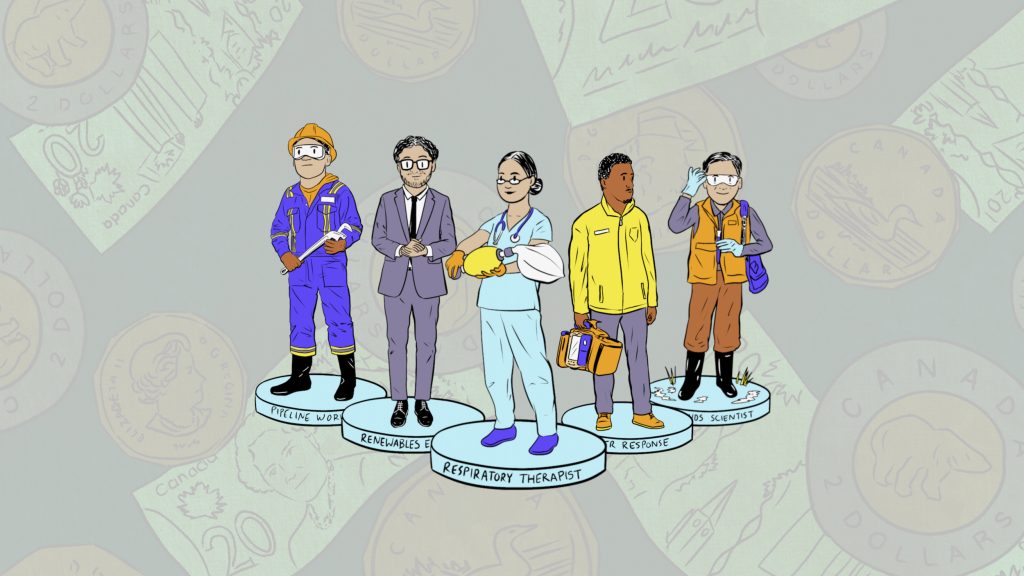
At The Narwhal, our job is to complicate that narrative. So we’re launching a series today called Who Pays? It’s about the connections between the environment and the economy in Canada — and the cost of ignoring those links.
One of those bills comes to a whopping $146 billion: Health Canada’s estimate of the cost of air pollution-related illnesses in 2018. Who pays for that?
As Ontario reporter Carl Meyer explains in a story published today, it’s all of us. From asthma to Lyme disease to mental-health distress, he explores what continued burning of fossil fuels is costing our bodies — and our wallets.
It’s true that plentiful oil and gas reserves put Canada in a decent position to withstand global fuel price shocks. It’s also true we need to move on to other trading partners after the breakup of our situationship with the United States. Even so, the political sales pitch we’re being handed — that extracting resources and shipping them across the ocean is a sure route to economic stability — is simply not that simple.
Poorly managed resource extraction contributes to environmental instability, and an unpredictable environment also brings economic stress. The effects of climate change are a problem today, including for our pocketbooks.
For example: a 2024 deep freeze knocked out more than 90 per cent of the wine grapes in British Columbia’s Interior, sending the industry into crisis. And as editor Paloma Pacheco writes in a Who Pays? story published today, the province’s effort to rescue local winemakers has left some with a lingering tax headache.
B.C. quickly responded to the dearth of fruit by allowing small- and mid-sized producers to make wine from imported grapes. The program was a lifesaver, but it came with a catch: beyond a certain sales volume, the taxes owed on a bottle of wine could soar as high as 89 per cent — including on bottles made only from B.C. grapes.
Producers can’t get out of the new tax scheme until all their wine from imported grapes is gone — leaving some considering desperate measures. “I’ve taken the position that if I had 1,000 cases of imported wine left over at the end of March next year, I’d dump it before I’d stay in the program another year,” one winemaker told Paloma.
Over the next week or so, Who Pays? will take a broad look at where environmental costs are emerging across Canada — and who is and isn’t paying their fair share. We’ll also examine the real, dollar value of protecting the lands and waters that are a significant source of jobs, food security and good health for millions of people. Visit this special landing page every weekday for fresh stories — plus a glimpse at some pretty mind-boggling statistics.
Let us know what you think about the series and how you calculate the balance between environmental and financial stability. Oh, and do your taxes (sorry!).
Take care and T4,
Denise Balkissoon
Executive editor
P.S. Who pays for our journalism? More than 7,300 readers like you. Become a member today if you believe independent Canadian reporting matters.
It’s been quite the week here at The Narwhal, as we celebrate a growing list of award nominations for our reader-funded reporting about the natural world in Canada.
Notably, The Narwhal is a finalist for the Canadian Journalism Foundation’s prestigious Jackman Award, which honours journalism that makes a social impact through courageous and original reporting. Our investigation into compliance and enforcement issues in B.C.’s oil and gas sector, led by northwest B.C. reporter Matt Simmons in partnership with the Investigative Journalism Foundation, made the shortlist for that prize.
We’re also on the shortlist for the Canadian Journalism Foundation’s award for climate solutions reporting. Freelancer Chloe Williams and photographer Gavin John earned that nod for their story about a bold plan to save the melting sea ice around Cambridge Bay, Nunavut.
And the Canadian Association of Journalists has named The Narwhal a finalist in four award categories:
Scoop: Matt and Zak Vescera, reporter with the Investigative Journalism Foundation, revealed that oil and gas giant TC Energy successfully lobbied the federal government to gain access to sensitive information gathered by Canada’s spy agency
Labour reporting: Matt earned a second nomination for his investigation into sexism and gendered violence in the tree-planting industry
Emerging Indigenous journalist: Savannah Ridley’s body of work as The Narwhal’s 2025 Indigenous editorial fellow earned her spot as a finalist
Data journalism: Manitoba reporter Julia-Simone Rutgers and Malak Abas, reporter with the Winnipeg Free Press, analyzed and mapped the unequal impacts of a transit overhaul in Winnipeg
In addition to the CAJ nomination, Julia-Simone’s reporting on Winnipeg’s transit overhaul is up for a Nonprofit News Award, in the community champion category. She earned an additional nomination, in the explanatory category, for her story on the impacts of tariffs on farmers in Canada and the U.S.
We share these honours with members of The Narwhal, who make these stories possible with their generous financial support. Will you join them?Become a member, for any monthly or annual amount, to help bring more stories like these to light.
Photo: Chris Young / The Canadian Press
Not cool!
In perhaps the most perfect and unscripted allegory for the climate emergency, Toronto Fire spent most of Earth Day hosing down a giant ice structure — built as a publicity stunt to promote Drake’s upcoming album. I’m all for a good cultural hype moment, but this one was anything but cool.
Parts of Ontario are literally flooding (a growing problem, as I explained in this video), and here we were dealing with an unnecessary deluge in a parking lot because the installation became, predictably, a nuisance and a safety hazard. And who pays for that? Taxpayers, of course.
But hey, maybe I’m not giving the local celeb enough credit. Drake: if you’re reading this and actually wanted to make an ironic point about climate change, please call me on my cellphone — I’d love to talk!
— Fatima Syed, Ontario reporter
This week in The Narwhal
Alberta Energy Regulator suspends MAGA Energy 18 months after approving 170-well takeover By Drew Anderson
The suspension follows an investigation by The Narwhal into MAGA Energy. Want to help make more reporting like this possible? Support public-interest journalism by becoming a member today.