





 9 min. read
In 2019, municipalities across Ontario declared a climate emergency. The backdrop was a groundswell of attention to global warming, including tens of thousands of people filling the streets around Ontario’s legislature in September, demanding urgent action on climate change.
The demonstration was part of the Global Week for Future, inspired by Swedish climate activist Greta Thunberg’s Fridays for Future movement. Young people marched alongside families, seniors and environmental advocates. The crowd outside Queen’s Park in Toronto was so large that some demonstrators couldn’t hear the speakers addressing the rally.
Table of Contents
Lyn Adamson, co-chair of the environmental advocacy group ClimateFast, spent months helping organize the demonstration. “It was something I’d never seen,” she said. “I’d never seen that kind of mobilization.”
Mississauga and Brampton had declared an emergency in June, while Toronto City Council joined the list the week after the march. In the country’s largest city, council called for accelerated action to reduce greenhouse gas emissions and asked city staff to examine how Toronto could reach net-zero emissions by 2040.
Seven years later, municipalities across the Greater Toronto and Hamilton Area have introduced new climate policies, invested in energy-efficient buildings and expanded programs aimed at reducing emissions. But despite that progress, emissions are not falling quickly enough to meet many of their targets.
With Ontario’s municipal election approaching on Oct. 26, environmental advocates say the next four years will be critical in determining whether cities can turn their commitments into measurable results. And the term will take municipalities to 2030, a deadline attached to several major greenhouse gas reduction targets.
In Toronto, decisions about building emissions standards and retrofits, and transportation investments remain outstanding. Mississauga’s next council is expected to consider an updated emissions reduction plan in early 2027 and Brampton faces questions about how much progress it is actually making on its climate commitments.
And progress across the province has been slowed by the Ontario government stepping in to prevent cities and towns from instituting ambitious strategies it said could impede development.
Here’s a look at some of the commitments and progress made by municipalities, as they welcome the next municipal council to take the helm.
Climate action hasn’t kept pace with promises
Greenhouse gas emissions across the Greater Toronto and Hamilton Area represent 46 per cent of Ontario’s emissions. They reached approximately 54.7 million tonnes in 2024, a modest increase of 1.1 per cent from the previous year, according to the latest carbon emissions inventory from the Toronto Atmospheric Fund.
Buildings accounted for 45 per cent of regional emissions, largely from natural gas used for heating and electricity generation. Transportation made up another 37 per cent.
Overall emissions remain far from where they need to be to reach net-zero targets that were developed in line with the United Nations and global scientists to stave off some of the worst effects of climate change.
The Atmospheric Fund, an agency of the City of Toronto, estimates the region would need reductions of approximately 11 per cent every year to meet its collective 2030 climate targets.
Gabriella Kalapos, executive director of Climate Action Partnership, said municipalities have made progress since 2019, particularly in understanding where emissions come from and identifying opportunities to reduce them. “It’s nowhere near the level of action that’s actually needed to respond to this climate emergency,” she said.
Toronto has strengthened its climate plans, but targets remain out of reach
For Adamson, Toronto’s climate commitments aren’t just about reducing greenhouse gas emissions. They’re about making everyday life easier for residents, whether that’s because cycling is safe, public transit is reliable or utility bills are lower because homes use less energy.
She believes progress has been too slow.
Under its TransformTO climate strategy, the city has set a target of reducing community-wide emissions by 65 per cent below 1990 levels by 2030, and ultimately reach net-zero emissions by 2040.
Toronto acknowledges it is not on track to meet that goal. In 2023, the city released its most recent inventory of greenhouse gas emissions, finding community-wide emissions were just 35 per cent below 1990 levels. Buildings accounted for 55 per cent of emissions, followed by transportation at 36 per cent.
In an email to The Narwhal, James Nowlan, executive director of City of Toronto’s environment, climate and forestry division, wrote that buildings and transportation remain among the most challenging sources of emissions to address because many of the necessary changes extend beyond the city’s direct control.
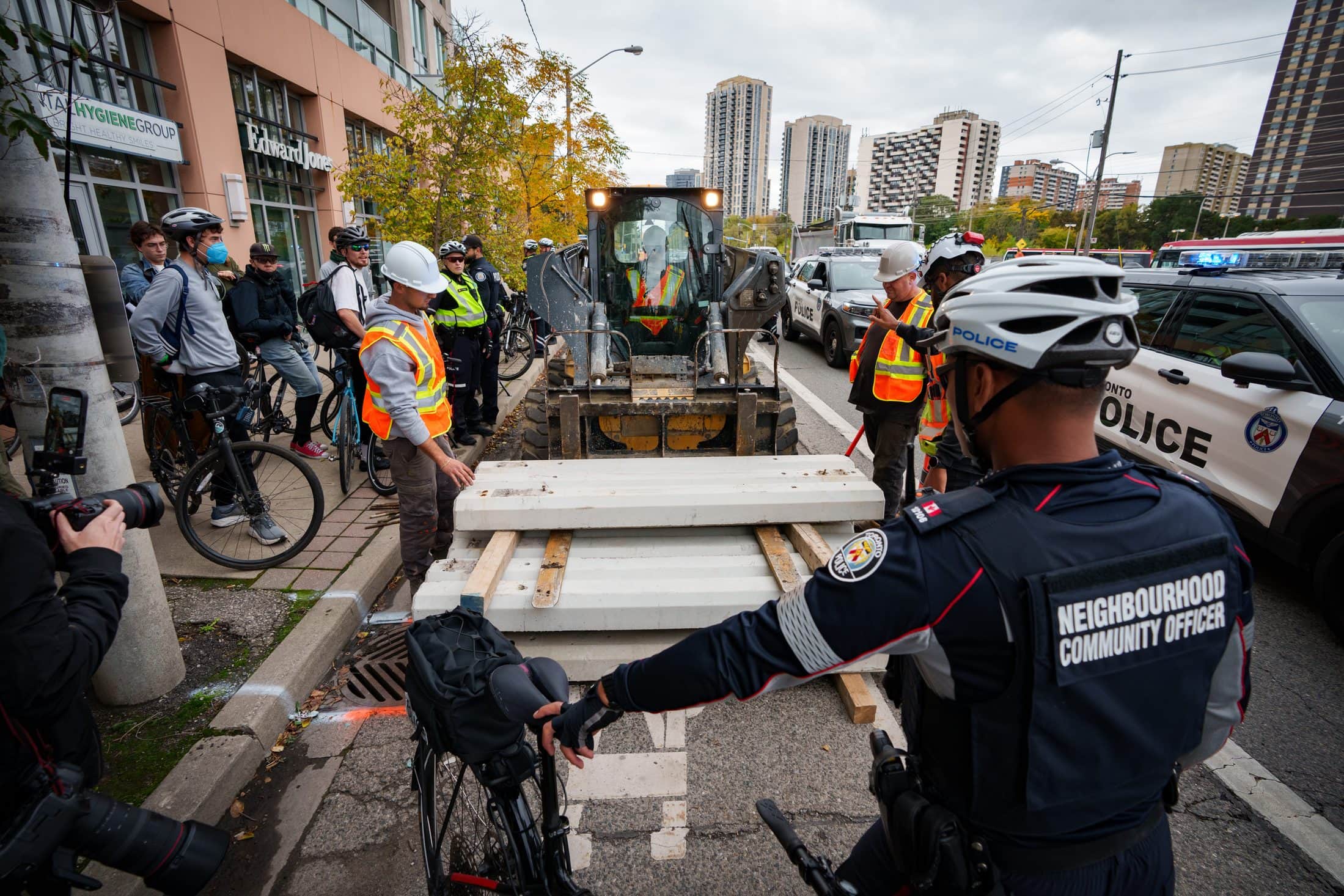
Take the city’s multi-year battle with the provincial government to maintain some existing bike lanes and build more on main arteries of the city. Right now, the province is winning, having dispatched crews on a $48-million job to rip lanes out of major streets in the middle of the election campaign.
Premier Doug Ford’s government has also clamped down on how municipalities can implement green building standards. It restricted municipalities from mandating any green building features that go beyond provincial requirements. This put the Toronto Green Standard, a framework that has shaped development in Canada’s largest city for more than 15 years, in the crosshairs.
The standard required developers to incorporate features — such as bicycle parking, electric-vehicle charging stations and green roofs — to reduce emissions and improve resilience to climate change. The province has argued that standardized development requirements can help speed up construction during a housing crisis.
Environmental advocates, however, say the changes undermine municipal authority, including the ability to address local climate priorities. Kalapos said municipal progress on energy-efficient development policies has been complicated by provincial intervention.
“If you don’t have a supportive framework for climate action at the provincial and federal level, municipalities are really hamstrung to be able to move forward on their targets,” she said. “We are not going to meet this climate change imperative off the property tax base.”
The city is still developing emissions standards that would see building owners gradually reduce emissions through upgrades and retrofits. But provincial legislation will prevent Toronto from making the changes mandatory.
“It’s all voluntary. There is no deadline for anything,” Adamson said, arguing that relying on voluntary measures makes it difficult to achieve the scale of change needed.
Still, cities are trying. In Toronto, a new TransformTO action plan outlines further measures to reduce emissions between now and 2030, including support for community-led initiatives.
The city budgeted more than $2 billion in 2026 for emissions-reduction initiatives, including ongoing support for a bike share program and household composting.
In Mississauga, emissions are not falling fast enough
In neighbouring Mississauga, the city reports progress on 59 of the 89 actions outlined in its 2019 climate change action plan, a 10-year municipal roadmap aimed at reducing emissions by 40 per cent by 2030 and 80 per cent by 2050. The plan was adopted months after council declared a climate emergency in June 2019.
Only 13 of the actions are considered fully complete, standalone actions, such as developing a program that diverts dog waste from landfills and converts it to energy and a strategy on increasing urban agriculture. Another 46 items, like gradually replacing municipal vehicles with electric alternatives, are mostly complete, with work ongoing and possibly evolving.

Carrah Bullock, Mississauga’s supervisor of climate policy, said the original plan was designed to lay the groundwork for future climate action, but did not include ways to measure its direct impact on emissions. The city is now updating its climate plan to better track the reductions associated with individual initiatives.
Despite this progress, Mississauga acknowledges, like its neighbouring cities, that it is not on track to meet its 2030 emissions targets. In fact, preliminary 2025 data suggest that emissions may have been higher than 2024, due largely to issues that, once again, are in the provincial government’s hands.
Ontario’s power grid has become less clean since 2021, when it was 94 per cent emissions-free. That number is now below 90 per cent, due largely to nuclear plants being taken offline for refurbishment. Having cancelled hundreds of renewable energy projects upon taking office in 2018, the Ford government has relied mainly on natural gas to replace them. The Atmospheric Fund reported that electricity-related emissions increased 28 per cent across the Greater Toronto and Hamilton Area in 2024 because of greater reliance on natural gas-fired generation.
The city has made progress on emissions reductions within its own buildings and vehicle fleet. Dianne Zimmerman, Mississauga’s environment manager, pointed to the introduction of a green standard for city-owned buildings, including a new fire station built to a net-zero standard. The city has also electrified municipal vehicles and equipment.
But reducing emissions from privately owned homes and commercial buildings remains a significant challenge. Bullock said a proposed community building retrofit program has been progressing more slowly than the city would like.
The city’s updated emissions reduction plan is expected to go before council in early 2027, followed by a separate climate resilience strategy focused on coping with extreme heat, storms and other effects of a warming planet.
Residents see both progress and setbacks in Brampton
David Laing, president and co-founder of the Brampton Environmental Alliance, regularly uses a bicycle for transportation. When Brampton began introducing cycling infrastructure in the years after declaring a climate emergency in 2019, he noticed the difference.
The improvements, he said, “made my life an awful lot easier and safer and more comfortable.”
But now, the city is reversing course, removing some of those bike lanes to make way for cars — such as on Howden Boulevard in the city’s Westgate neighbourhood — leaving him frustrated with what he sees as inconsistent decisions about transportation and climate action.
According to The Atmospheric Fund, transportation produced approximately 1.81 million tonnes of greenhouse gas emissions in Brampton in 2024, accounting for nearly half the city’s total.
It’s one example of why the city’s progress on community-wide emissions has been in question.
In 2019, Brampton released its community energy and emissions reduction plan, aiming to cut community-wide emissions by 50 per cent below 2016 levels by 2041, and at least 80 per cent by 2050.
Since then, it has taken steps to electrify public transit, including a $4-billion partnership in 2025 with U.K.-based company Zenobē to transition to as many as 1,000 electric buses over the next decade. And the city has developed an updated environmental master plan, subsidized building retrofits and launched a program to help local businesses reduce their energy use.
But the results of those efforts haven’t been published. Laing said the city needs to make it easier for residents to understand which climate commitments have been completed, how much money has been spent and whether emissions are actually declining.
Without that information, there’s little to keep city administration — and incoming mayors and councillors — accountable.