

 6 min. read
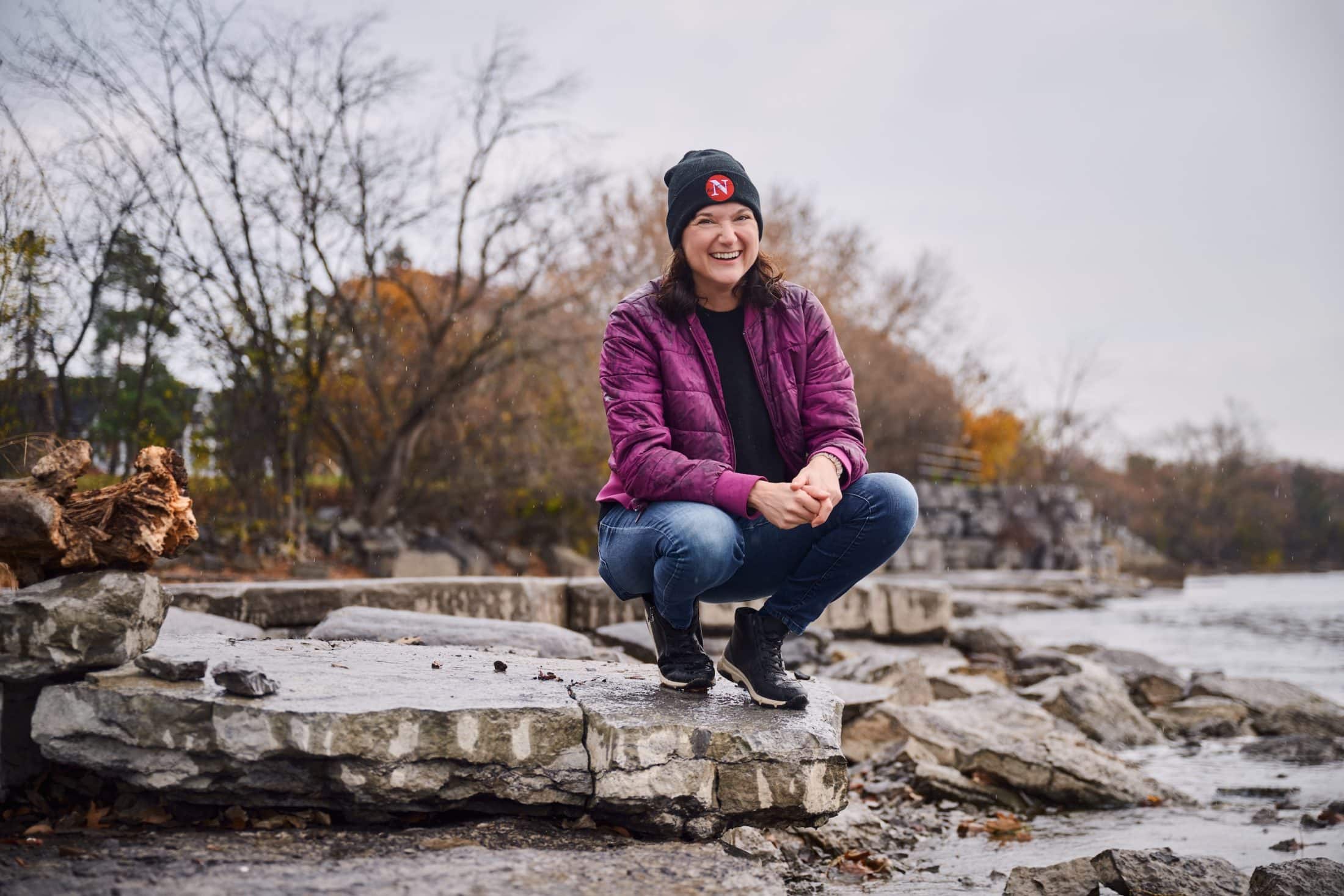
You’re most likely to find The Narwhal’s new senior reporter near water, but she’s not going with the flow — Anne Caroline Desplanques will brave -36 C weather, tipped canoes and more leeches than she can count in pursuit of a story.
Anne Caroline joins The Narwhal with years of experience wading through dense policy and searching for common ground to reach the heart of a story. Previously, she reported for Radio-Canada then Le Journal de Montréal, covering politics, science, environmental issues and Arctic defence.
Based on the Quebec side of the Kichi Sibi (Ottawa River), Anne Caroline speaks three languages — four, if you include her “rusty” Portuguese — that she learned growing up with a French father and Brazilian mother on the little Caribbean island of Guadeloupe.
Anne Caroline says you can’t understand Canada without understanding Quebec, and she’s already putting her multilingual prowess to work for The Narwhal by interviewing other francophones for her stories.
Read on to learn more about The Narwhal’s new senior national reporter, and what kinds of stories you can expect from her.
This conversation has been edited for length and clarity.
You’re The Narwhal’s first staff reporter based in Quebec. What does that mean to you?
To me it’s important, and I think it is a bold move for The Narwhal because, I don’t want to sound cliché, but the two solitudes are real in this country. As an immigrant, it took me years to understand that. But when I moved from Montreal to Ottawa, it really hit me in the face. I think there is such a huge gap between Quebec and the rest of the country.
In environmental reporting, it’s really puzzling, because so many key projects right now — pipelines, an LNG terminal on the St. Lawrence, a high-speed train — well, all of these things won’t happen without Quebec.
To me, you cannot be a national reporter in this country if you don’t understand Quebec, because nothing is going to happen without this province, like it or not. So, I’d like to do my small part to bridge that gap and maybe show that we have much more in common than we think.
What drew you to environmental journalism?
I’m always drawn to the water. I think it’s part of why I’m doing environmental journalism. I used to kayak to little islands that don’t exist anymore because of climate change.
When I was 14, I had to decide what I’m going to do with my life. At the time, I was into sports, competing in kayaking a lot, and I was looking for a career that would be connected to that. I loved writing and reading, and I was a big fan of a French sports journalist whose name is Nelson Monfort. He’s very famous for his deep, empathic interviews with athletes from around the world, and he would switch effortlessly on TV from one language to the other all the time. It blew my mind. I was like, ‘Wow, this is what I want to do.’ But in the end, I never covered sports — not once.
After I moved to Canada to go to university, I went back to Brazil, where my mom was from. I spent a lot of time in the Cerrado, which is Brazil’s savanna in the middle of the country, where I had an aunt who was a biologist. She devoted her life to studying native fruits and plants, things that you would never see anywhere else. That sparked my interest for biodiversity and for Indigenous stories too, because this is a region where there are a lot of Indigenous communities and, obviously, their life and their culture is very connected to the land. We talk about the Amazon, but actually the Cerrado is even more important to the world as a carbon capture niche.
What stories are you excited to dig into?
There are so many; it’s hard to tell you one. What I really like about this job is being out in the field with everyday people. Everyday, but extraordinary people. Even though I’ve covered Parliament Hill for a while, I hate political theatre. It’s really not my thing. What interests me is how the decisions made by politicians affect people’s lives for better or for worse.
That’s my compass when I write about toxic waste or logging or mining or geopolitics. I’m really always focused on people, and that’s where I want to go with my stories. So if you are an extraordinary, normal, everyday person out there, just write to me. I will listen.
What’s the story you’re most proud of?
When I look at the last few years, I would say my documentary La Guerre de l’Arctique, which I did with extraordinary colleagues about the state of Canada’s northern defense and how climate change is really driving a geopolitical revolution. It had many ingredients I really care about in my stories. It had shoe leather reporting alongside Inuit rangers. And it had data mapping, geopolitical analysis and incredible, beautiful images.
It was really important to me to have time, a luxury in our current journalism market, to have a full year to work on that. Doing this documentary really taught me a whole new language for storytelling.
Your reporting has taken you into the field quite a bit — has it ever led to adventures?
I once capsized very seriously in a rapid on the Broadback River. It was during a canoe trip with the Cree Nation. I went with them for a story, and I tipped over because I didn’t want to do portage. I tipped over in the rapid, and I was stranded on a rock in the middle of the rapid with my canoe for a long time, waiting for help. While I was waiting, I had leeches all over my legs, and I hate leeches! They’re always on me. Like if I end up in a river, they’ll find me wherever I am.
What’s the most awe-inspiring sight you’ve seen in Canada?
This country is so, so, so amazingly beautiful. During a snowmobile trip, I went very high north in Quebec, almost to the end of the tree line. A journalist who was with us, his feet got soaked, and it was -36 C. Picture a lunar landscape with barely a tree left because of a recent clearcut, and we were there, his feet soaking wet, cold. The Cree hunters we were travelling with set off in four directions and came back with enough wood to make a gigantic fire. They got it going in a second, and I remember feeling so amazed, so small, so useless, and yet so safe with these hunters.
It was my first big story with an Indigenous nation, and it made me realize how deep the knowledge of the land runs in these communities and how much strength it gives them. It stayed with me, and I always think about this image when I go back on the territory and I spend time with Indigenous communities.