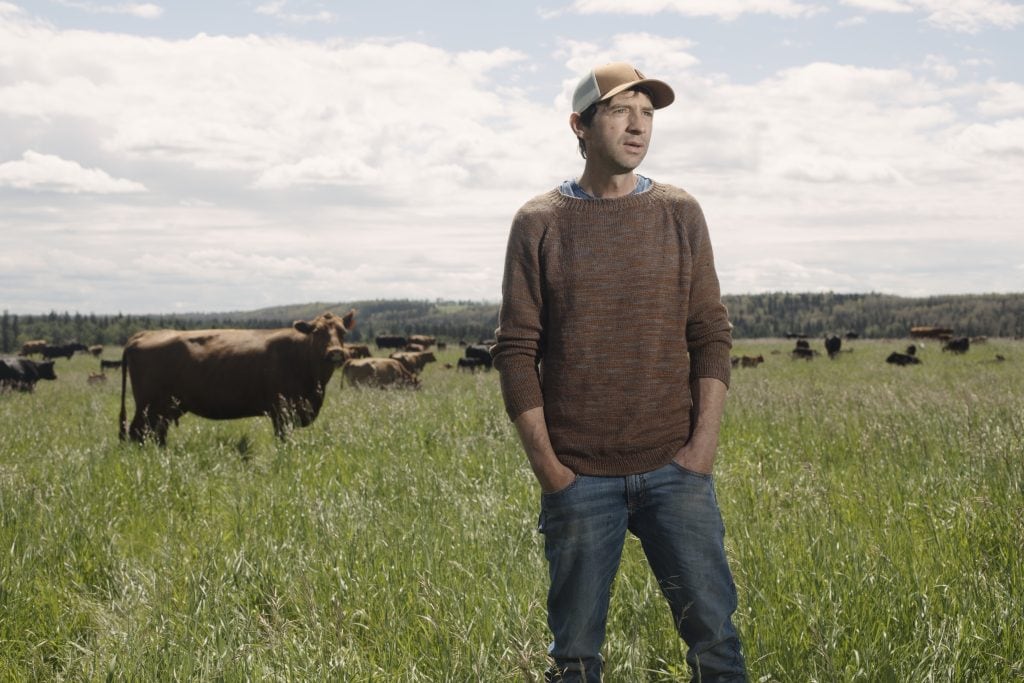
Cattle rancher Assar Grinde told Prairies reporter Drew Anderson he was spurred into action when the Lloyd Creek he depends on stopped flowing three years ago.
Photo: Amber Bracken / The Narwhal
Oil and gas companies are using billions of litres of water in Alberta. Local farmers and ranchers are worried about it — and invited Prairies reporter Drew Anderson to come take a look at the issue, firsthand
“We wanted to make sure that the river didn’t dry up because we thought that was crazy.”
That’s what cattle rancher Assar Grinde told Prairies reporter Drew Anderson in July, explaining why he had started digging into data from Alberta’s energy regulator and sounding alarms about fracking companies’ water use.
A creek on his farm, which feeds into a nearby river, ran dry three years ago. It was something he’d never seen before — and his family has farmed that land for generations.
The companies he was referring to have been using billions of litres of water to crack open the earth deep beneath the province, all in an effort to push oil and gas to the surface. And local farmers and ranchers who are fed up invited Drew to come see it firsthand.
So last month, Drew found himself in the morning rush at the Rimbey A&W, an hour and a half south of Edmonton. He jostled for space in a line for egg sandwiches and hashbrowns amid a crowd sporting boots, jeans and hats.
The locals had been watching the rapid expansion of the snaking network of hoses, used for fracking, laying across fields, drawing water from nearby creeks and rivers. And what happens to that water? For the most part, it’s gone forever — buried deep where the oil or gas used to be.
It’s why they sprang into action, coordinating with neighbours to take a stand against all the water use — or at least make sure it was being properly monitored.
Concerns about water scarcity might strike you as odd if you’ve seen the headlines about record-shattering rainfall in the Edmonton region this summer.
“But the sudden rush of water isn’t enough to quell the concerns of area ranchers and residents who watched that creek run dry and their drinking wells drop,” Drew writes. “They say the rain isn’t enough to make up for how much has been lost from the aquifers — the deep underground natural reservoirs that feed those wells.”
Farmers and ranchers have been calling on both the Alberta Energy Regulator and their elected officials to pay closer attention.
It’s why Drew wanted to go out into the field (literally — just look at him smiling in the passenger seat of that truck) to talk to locals about their complicated relationship with the industry. And with Alberta’s clear directive to double its oil and gas production, those water problems are likely to continue — or increase.
He’ll keep close watch as it unfolds. For now, go read Drew’s feature story — or listen to him read it to you! — and soak in the stunning snapshots of the trip by photojournalist Amber Bracken.
My Vancouver apartment often gets too hot in the summer. Because of the way my windows are set up, there’s no real way to add in an air conditioning unit, so I escape to our much cooler office during the day. There’s nothing I can do about it, really, and as it turns out: my landlord isn’t obligated to do anything, either.
Why’s that? As reporter Shannon Waters lays out in a recent story, there’s no provincial law in British Columbia that sets a maximum temperature in rental units. It’s not just me — only 45 per cent of B.C. households report having an air conditioner, lower than the national average of 68 per cent.
In Toronto, as reporting fellow Rajpreet Sahota writes, the city is mulling a bylaw that sets a maximum indoor temperature for rentals at 26 C, but it’ll likely be a year before it comes to council. In the meantime, residents like Beena and Peter Ruparelia, who Rajpreet talked to and photographed for her story, are seeing their thermostat climb to 40 C.
Both stories get into the inequities of increasingly hotter summers and what governments are doing — or not doing — to help renters.
Check out Shannon’s story here, and Rajpreet’s over here.
— Karan Saxena, audience engagement editor
This week in The Narwhal
Inside LNG Canada’s black cloud: docs reveal B.C. regulator was warned about smoke before approvals By Matt Simmons and Wil Crisp
One resident said he ‘wasn’t expecting black smoke,’ which can signal higher levels of toxic pollutants in the air. Another said she’s concerned about potential health impacts because she wants to have a family.
Doug Ford pushes a Canadian pipeline as Michigan shuts down Enbridge’s Line 5 update By Fatima Syed READ MORE
Wildfire smoke is bad for animals too — including your pets By Julia Roeder READ MORE
That feeling when it’s too hot indoors and you’ve gotta cool down. But quenching your thirst for good environmental coverage? There’s only one solution: our free, weekly newsletter. Tell your friends to sign up, too!