Humanity, I’m sure you’re aware, is grappling with a great existential question: how do we keep economic engines churning without pumping evermore carbon dioxide into the atmosphere, with devastating consequences for people, animals and the environment?
One suggestion is through various technologies under the umbrella of carbon capture and storage: gathering carbon dioxide that would otherwise linger in the air, and putting it back in the ground.
The potential for carbon storage could be big, but it hasn’t yet seen its glory days. According to the World Resources Institute, just 0.1 per cent of global emissions is captured and stored by technological means.
But, in the words of a legendary rock star, you can’t start a fire without a spark.
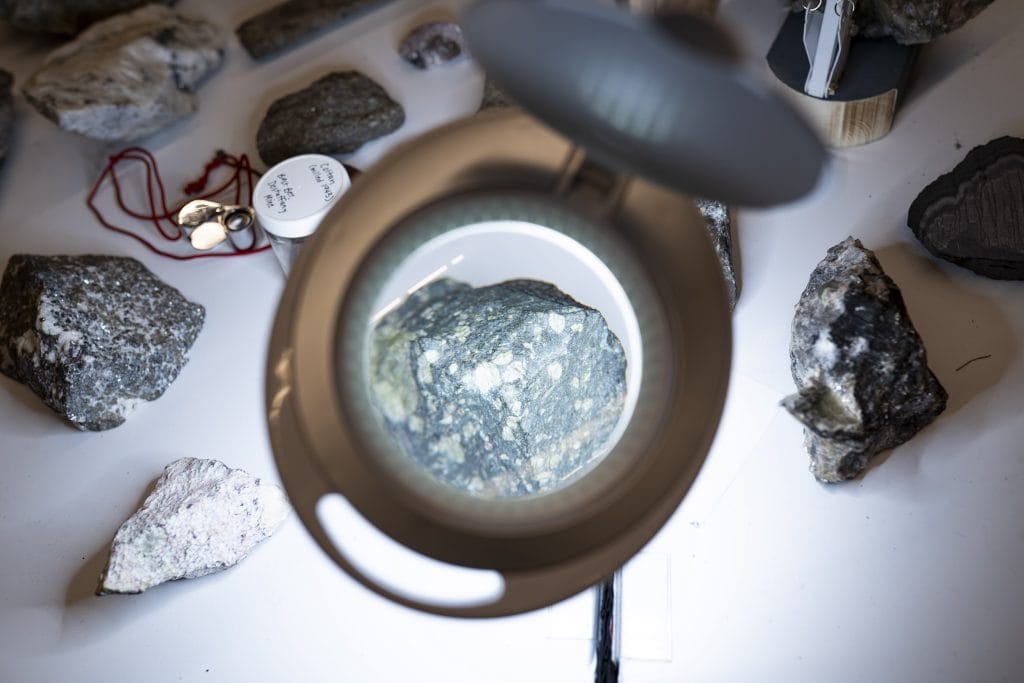
No, Bruce Springsteen isn’t involved in the project. The process instead relies on a different kind of rock star: brucite — a mineral with a hungry heart for soaking up carbon dioxide.
Canada Nickel estimates brucite in the waste rock at its planned Crawford Nickel mine near Timmins, Ont., could capture up to 54 million tonnes of carbon dioxide, offsetting the expected emissions impact of the mine itself roughly three times over.
Born in the UMR — that’s ultramafic rocks (Carl’s joke, not mine) — brucite reacts with carbon dioxide in a natural mineralization process, and it’s commonly found alongside nickel deposits. Other minerals do this, too, but when it comes to carbon mineralization, brucite is The Boss.
To speed up the mineralization process, though, brucite could use just a little help. Canada Nickel plans to source carbon dioxide, captured from other industrial facilities in the region, and bubble it through crushed waste rock — brucite takes care of the rest.
As Carl writes, both Prime Minister Mark Carney and Ontario Premier Doug Ford have a lot riding on the mine’s — and the brucite’s — success. It’s the first project to be both referred to the federal Major Projects Office and included on the provincial “One Project, One Process” list.
The research into brucite mineralization is promising, and Canada Nickel hopes to prove, for the first time, it can be scaled up to full commercial production.
P.S. If you want to chat more about mining, a couple Narwhals will be at the Prospectors & Developers Association of Canada convention in Toronto in early March. Drop us a line if you’d like to grab a coffee. We probably won’t make cheesy song references, but that’s not a promise!
RCMP Assistant Commissioner John Brewer, who was in charge of the enforcement actions that included Amber’s arrest in November 2021, took the stand on Wednesday. Some of his testimony was reported by Brenna Owen for The Canadian Press.
Brewer is slated to return to the stand Friday and next week, including for cross-examination by our legal team.
Though initially scheduled to wrap up next week, the trial is now expected to take a few extra days in court, to occur in the following weeks. Closing arguments will be heard in April.
The proceedings are open to the public. Details on attending, and more information about the case, can be found on this page.
Reap what you sow
Pick any wheat farmer in the Prairies, and there’s a good chance the seeds they sow are the fruits of federal government research.
For decades, scientists with Agriculture and Agri-Food Canada have helped Canadian farmers become more competitive and more climate resilient through applied research, such as developing new, hardier crop varieties.
But last month, Canada announced it will close seven agricultural research centres amid the Carney government’s civil service cutbacks. The decision has disappointed many farmers, who fear it will undermine their efforts to innovate, despite assurances from the federal government that it remains committed to advancing farm science.
Freelance journalist Delaney Seiferling spoke with Saskatchewan wheat growers to learn how federal research has impacted their farms — and why the cutbacks have them worried. Read her story here.
This week in The Narwhal
Is Alberta really running out of pipeline capacity? By Drew Anderson
Does Alberta need a new oil pipeline? Is the Trans Mountain pipeline full? Questions are swirling — here’s what you need to know.
‘Never been more urgent’: new conservation area in Canada’s North inches closer to reality By Julia-Simone Rutgers READ MORE
A massive transit overhaul — and ridership decreases that followed By Julia-Simone Rutgers READ MORE
What’s already happened with Alberta’s environment in 2026? By Drew Anderson READ MORE
Special delivery! The Narwhal’s newsletter promises fresh stories about the natural world in your inbox every Thursday. Tell your friends to subscribe!
Here at The Narwhal, we do journalism differently. As an independent non-profit, we’re accountable to you, our readers — not advertisers or shareholders. So we measure our success based on real-world impact: evidence that our reporting influenced citizens to hold power to account and pushed policymakers to do better.
Our stories have been raised in legislatures across the country and cited by citizens in petitions and letters to politicians.
Take our reporting on Alberta’s decision to allow cougar hunting in parks, which was cited in an official ethics complaint against the parks minister. And, after we revealed an oil and gas giant was permitted to sidestep the rules for more than 4,300 pipelines, the BC Energy Regulator started posting the exemptions it grants publicly.
This kind of work takes time, money and a lot of grit. And we can’t do it without the support of thousands of readers just like you.
Here at The Narwhal, we do journalism differently. As an independent non-profit, we’re accountable to you, our readers — not advertisers or shareholders. So we measure our success based on real-world impact: evidence that our reporting influenced citizens to hold power to account and pushed policymakers to do better.
Our stories have been raised in legislatures across the country and cited by citizens in petitions and letters to politicians.
Take our reporting on Alberta’s decision to allow cougar hunting in parks, which was cited in an official ethics complaint against the parks minister. And, after we revealed an oil and gas giant was permitted to sidestep the rules for more than 4,300 pipelines, the BC Energy Regulator started posting the exemptions it grants publicly.
This kind of work takes time, money and a lot of grit. And we can’t do it without the support of thousands of readers just like you.
Your access to our journalism is free — always. Sign up for our weekly newsletter for investigative reporting on the natural world in Canada you won’t find anywhere else.
Your access to our journalism is free — always. Sign up for our weekly newsletter for investigative reporting on the natural world in Canada you won’t find anywhere else.
As a journalist who has spent decades asking questions that cut through noise, I’m cautious where I place my trust. The Narwhal has earned it — through rigorous, independent reporting, careful, on-the-ground storytelling and a clear commitment to the public interest. It’s why I’ve become a member myself. Will you join me? The Narwhal needs to add 400 new members this month to keep telling these important stories. And if you join now, you’ll get a special tote bag as thanks.
Anna Maria Tremonti, founding host of CBC Radio’s The Current and member of The Narwhal’s board of directors
As a journalist who has spent decades asking questions that cut through noise, I’m cautious where I place my trust. The Narwhal has earned it — through rigorous, independent reporting, careful, on-the-ground storytelling and a clear commitment to the public interest. It’s why I’ve become a member myself. Will you join me? The Narwhal needs to add 400 new members this month to keep telling these important stories. And if you join now, you’ll get a special tote bag as thanks.