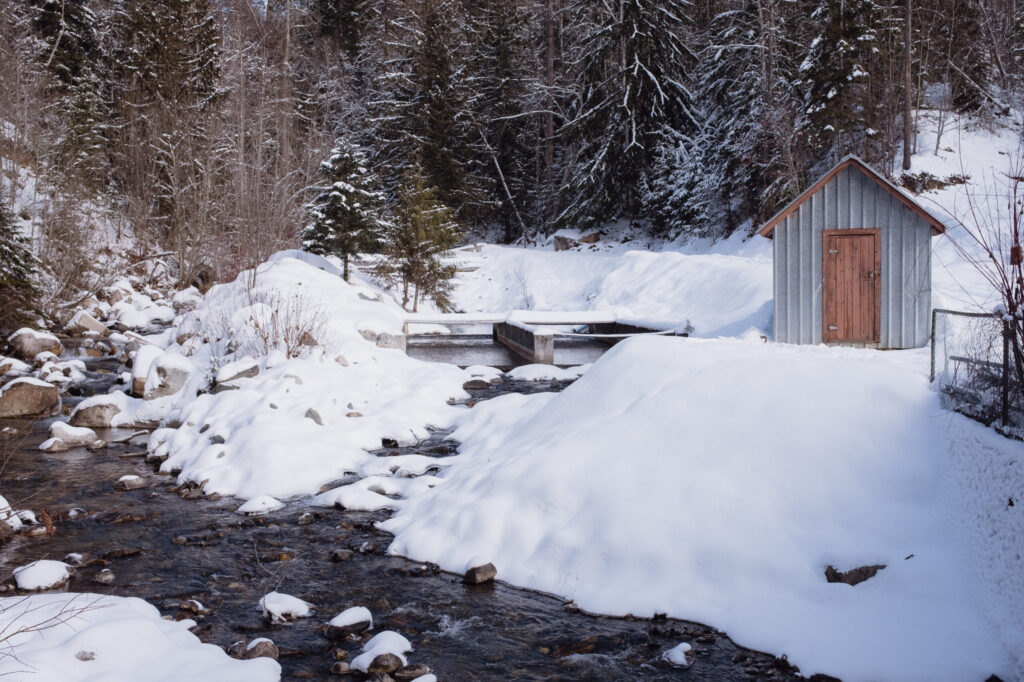
The small community of Wynndel, B.C., sources its water from the Duck Creek watershed. Residents worry that more logging in the area will have cascading impacts on the land and water.
Photo: Louis Bockner / The Narwhal
In 2019, the residents of Glade, B.C., learned they had no right to clean drinking water, after members of the Kootenay community waged a legal battle against forestry companies logging in their watershed. A judge sided with the timber companies, arguing that their economic interests outweighed the community’s concerns about its water supply.
A similar story has emerged in Wynndel, B.C. — another town in the drought-stricken region — as residents worry about planned logging in their watershed, Duck Creek. Here, in the Kootenays, logging on both private and Crown land is pretty widespread. One resident told reporter Steph Kwetásel’wet Wood that forestry in the area has gotten out of hand, and lack of management on sustainable practices has turned the practice into “corporate slaughter.”
“Watersheds are integral to ecosystems,” Steph told me, adding that the prospect of more logging has amplified concerns about water supply.
“The application to log the watershed has raised many questions around forestry practices in general: how much can be logged on privately-owned forests, and are private land rights or rights to a healthy environment prioritized?” Steph said. “An operator may try to operate sustainably, but just as easily can choose to leave nothing behind. The real point is B.C.’s system allows either outcome.”
As it turns out, about five per cent (or 4.5 million hectares) of B.C.’s forests are privately owned, which means that the public has little insight, and even less say, into what happens. One conservationist from Wildsight told Steph private land meant to be kept as forest can easily be switched for other purposes like real estate: “It’s a strip and flip mentality.”
Speaking of private forests, freelancer Julie Gordon published an explainer this week on just how logging is managed on private land in B.C., what protections exist and how First Nations rights are impacted.
The feds tried to hold the line in an invasive species battle — and lost. What’s next? By Julia-Simone Rutgers
Riding Mountain National Park was the frontline of the westward invasion, but Parks Canada now says stopping zebra mussels at the park is ‘no longer an achievable option.’
Eby vows to cut ‘red tape’ for B.C. resource and energy projects — citing tariff threats By Shannon Waters READ MORE
How the Greenbelt scandal is quietly shaping Ontario’s 2025 provincial election By Emma McIntosh READ MORE
New Alberta Energy Regulator CEO comes from a company sitting on 500 inactive oil and gas wells By Drew Anderson READ MORE
Ontario leaders’ debate: fact-checking all things environment — and there weren’t many By Fatima Syed, Emma McIntosh & Elaine Anselmi READ MORE
POV: Narwhal readers when they remember our reporters are keeping an eye on impacts to their water supply — and the environment around them. Tell a friend to sign up for our newsletter so they feel just as peaceful and relaxed!