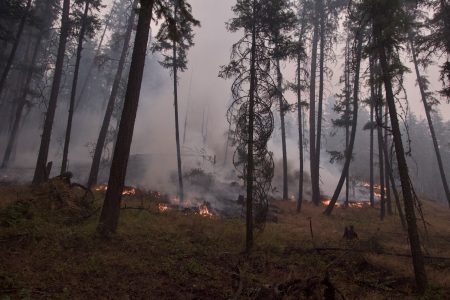


Wildfires in Canada have been intensifying in recent years, with 2023 and 2025 being the worst and second-worst wildfire seasons on record, respectively.
In 2026, Canada’s wildfire season began relatively quietly, with fewer fires burning per week compared to 2025. That began to change in early summer. By August, hundreds of fires had taken hold across the country, with hotspots in British Columbia, northern Manitoba and Saskatchewan, northwestern Ontario and northern Quebec.
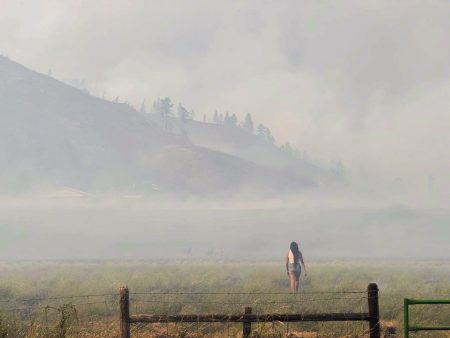
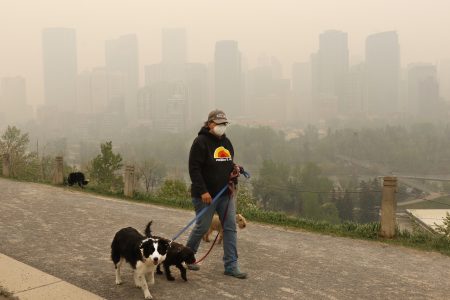
The 2026 fires have forced evacuations from First Nations communities in at least four provinces, and wildfire smoke has drifted over major population centres, including Metro Vancouver and the Greater Toronto Area, blanketing cities under a portentous yellow haze and prompting “very high risk” air quality warnings.
Smoke and wildfires are increasingly a feature of Canadian summers from coast to coast — and while it varies year to year, experts say “wildfire season” is here to stay.
Canada wildfire map

What causes wildfires in Canada?
The vastness of Canada means fire conditions, and its causes, vary considerably from one region to another. The majority of wildfires in Alberta are caused by human carelessness, while in B.C., it’s lightning. Drought in one area can bring high risk of fires, while in other parts of the country there’s plenty of rain.
Even still, dry conditions can settle across large landscapes, as in 2023, seemingly engulfing the nation in smoke. That smoke can travel far and wide, choking cities nowhere near an inferno and bringing wildfire to the forefront of the national consciousness.
What are the health risks of wildfire smoke?
Air pollution contributes to an estimated 15,300 premature deaths per year in Canada, and in recent years wildfires have become the most common cause of air quality advisories in the country.
Among other things, wildfire smoke contains particulate matter, which can include soot, dust and chemical particles. These particles are classified according to size, and the smaller ones pose the greatest threat to human health, because they can travel deeper into the lungs than larger ones. Fine particulates — or PM2.5 — found in smoke and other types of air pollution have been linked to damage in several organ systems, including the heart, brain and reproductive system.
Since 2005, the federal government has used the Air Quality Health Index to communicate the severity of air pollution. During Canada’s 2026 wildfire season, millions of people were living under skies that were so smoky the Air Quality Health Index reached its highest level.
Avoiding polluted air by staying inside and using air purifiers is the most effective protection, but avoiding strenuous outdoor activity and wearing a respirator can also help.
Canada air quality map
How do climate change and logging fuel wildfires?
As climate change progresses, the risks of wildfire in Canada are increasing — droughts, thunderstorms and weakened forests among them. Climate change is a global phenomenon, which Canada contributes to through the emission of greenhouse gases. Wildfires are also themselves huge contributors to emissions, creating a negative feedback loop.
Canada also continues to harvest huge quantities of trees, often replacing them with species that are more valuable for logging companies — and more prone to fire.
In other words, the conditions continue to change in favour of bigger and more frequent fires across the country.
As forests burn, it’s important to be clear about what causes wildfires — and what doesn’t — but also to focus on mitigation, preparedness and solutions for working with fires, particularly from Traditional Indigenous Knowledge.
So, what’s going on and what’s at stake when it comes to wildfires in Canada? The Narwhal’s got you covered:
 7 min. read