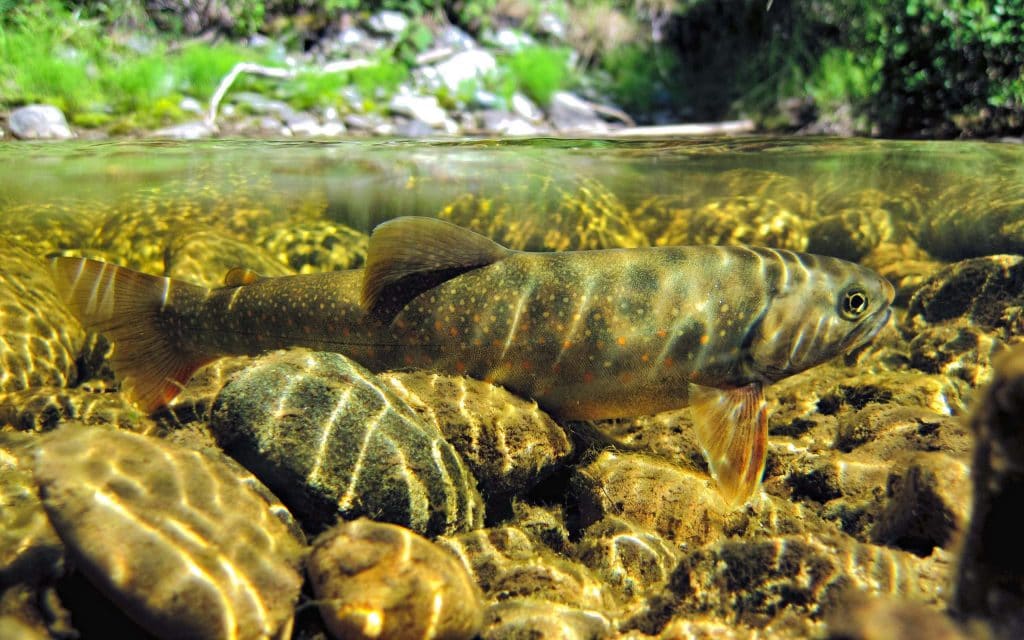
Char like this Dolly Varden species populate the Crooked River in northeastern B.C. and have long served as a vital food source for West Moberly First Nations. But amid mercury contamination, the nation is looking to raise fish in a year-round greenhouse.
Photo: troutnut / iStock
Food used to be abundant in West Moberly First Nations territory. The mountains were full of caribou, the woods dense with berries and the rivers so full of fish you could catch them by hand, Chief Roland Willson says.
But decades of resource extraction and development in northeast British Columbia have changed that: seismic lines and oil and gas drilling have fragmented the territory, depleting caribou populations; berries were sprayed with glyphosate and fish contaminated by mercury. Now, the nation’s members must bring food in from elsewhere. And since they’re at the end of a long supply chain that brings food to their grocery shelves, the fruits and vegetables are often old, spoiled and ready for the compost by the time they arrive.
“We have to start looking at how we sustain ourselves,” Roland told freelance journalist Zoë Yunker. “Not just West Moberly, but the people in the northeast.” They want to grow fresh food year-round in a 40,000-square-foot greenhouse — and be the first in Canada to do it using geothermal heat, an energy source in B.C. that has so far gone untapped.
The tectonic faults beneath B.C. not only put us at risk of a massive megaquake — don’t think about it!! — but they also produce an abundance of scalding hot water that can be pumped to the surface for heating and generating power.
Geothermal projects haven’t been a priority here in part because of their risks: the First Nation will need to drill deep into the earth and hope the reservoir it targets has enough water to carry heat to the surface. So even though B.C. has, in the words of one expert, “world-class” geothermal resources that could produce clean, consistent power, the province has focused on hydropower and gas, which are cheap in the southern part of the province, but expensive or unavailable in remote places like West Moberly.
“You’ve got these inexpensive fuel sources that have impaired, in a way, the kind of experimentation you’d have if the price were higher,” Glen Clark, former B.C. premier and current chair of the BC Hydro board, told Zoë.
West Moberly received feasibility funding from B.C. and Canada to explore geothermal, but now requires more funding to drill for water. As councillor Clarence Willson pointed out, the First Nation isn’t responsible for the contamination in its territories so shouldn’t be solely responsible for solving those problems either.
“Some of these people that are poisoning our food supply, they should help us with trying to have good food here,” he says.
Go here to read Zoë’s feature on West Moberly’s geothermal-powered ambitions to bring back fish and produce. It’s the third part in our Generating Futures series, which explores how B.C. First Nations are harnessing renewable energy sources in their communities.
Take care and take out the compost,
Michelle Cyca
Bureau chief, conservation and fellowships
Let’s face it: it can be hard to keep up with all the news. At The Narwhal, we know how privileged we are you’ve made our journalism a priority — but we also recognize you might not always have the time to sink your teeth into a 15-minute read.
So we’ve started experimenting with a new feature: bullet-point summaries at the top of many of our stories. Our journalists are taking the time to break down big pieces into three bite-sized takeaways. We’re hoping they pique your curiosity to read the full piece — but they can also just provide you with key insights if you’re short on time. Let us know what you think by replying to this email or tapping the “yes” or “no” feedback buttons on the summaries themselves.
And speaking of summaries: last week we published our very first “This month at The Narwhal” video across social channels. Video producer L. Manuel Baechlin gave a rundown of a few stories we published in February, covering everything from sand mining in the Prairies to environmental monitoring in the Ring of Fire.
Thanks for reading and watching, in whatever way works for you!
— Arik Ligeti, director of audience
This week in The Narwhal
‘No reason on earth’ to log endangered Canadian rainforest: scientist By Sarah Cox
Forestry companies hold licences to log in Canada’s inland temperate rainforest, home to endangered caribou and rare lichens. That makes a proposal for a new provincial park more urgent than ever.
Pushing for change in Canada’s lone deepwater Arctic port By Julia-Simone Rutgers READ MORE
Who’s rushing to buy Canadian oil and gas? Not Europe, says high-level EU diplomat By Carl Meyer READ MORE
A Nanaimo trail project reveals how B.C. fails to protect rare ecosystems By Amber Bracken READ MORE
Winter road salt is threatening Lake Simcoe and Ontario watersheds year-round By Leah Borts-Kuperman READ MORE
When the produce isn’t fresh and you decide it’s time to grow your own. Tell your friends to subscribe to The Narwhal’s newsletter for stories about energy solutions you won’t find anywhere else.