Carbon capture has removed only 68 million tonnes of emissions in Canada over a 24-year period — which is far less than oilsands emissions in a single year.
Photo: John Ulan / The Canadian Press
To catalogue Canadian leaders’ promises on this expensive technology that’s yet to be proven at scale, I had to go through national archives. The story is one of big dreams, with little results
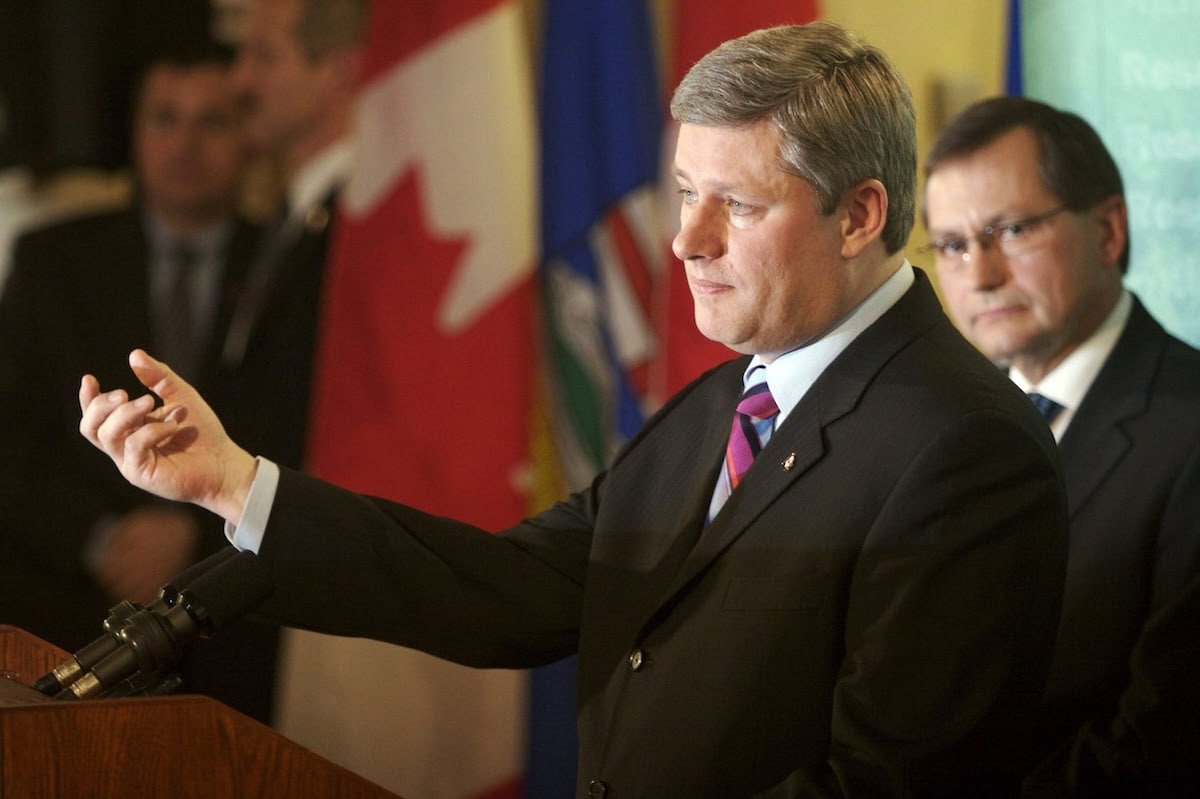
“Friends, the era of empty rhetoric on the environment is over. We’re taking real action that will produce real, tangible results.” — then-prime minister Stephen Harper, 2007
The Library and Archives Canada building is just down the street from Parliament Hill. It’s a charming time capsule, built in the mid-1960s with ceilings clad in long strips of square bubble lights. Its walls are covered in wood panelling and polished white brecciated marble. Inside, the quiet is punctuated by the sounds of researchers flipping pages or scrolling on microfilm readers.
In June, I was thrilled to get a chance to visit the building. I had made an appointment with an archivist to view some material related to carbon capture — which is the controversial technology that pulls carbon dioxide out of an exhaust stream, before it can enter the atmosphere and warm the Earth. It’s controversial because it’s never been proven at scale ... but more on that in a second.
For months, I’d been compiling a list of claims from federal politicians about how carbon capture technology could be used to lower industrial emissions in Canada. I’ve listened to politicians talk about carbon capture for my entire career as an investigative climate journalist. And the big gains they promise always seem to be just around the corner.
Cut to earlier in July, when news broke about Prime Minister Mark Carney’s push for a pipeline to the West Coast — in a deal which included a carbon capture and storage network in Alberta. It felt like the right time to piece together some of the big political statements made about carbon capture over the years, and compare it with the technology’s actual track record. (Spoiler alert: it’s not pretty.)
Even before the July announcement, that list of politicians had already grown quite long. But I was still missing the kind of killer quote that journalists hope to stumble upon — something that would illustrate just how long the arc of political support had been.
The archivist had helpfully loaded my material onto a desktop computer. One file was an old educational video produced with government support. Another included audio recordings of former prime minister Stephen Harper. When I flipped it on, I heard something that instantly made me smile.
Here was the Conservative prime minister speaking in Alberta in 2007, about what he dubbed “the exciting new technology called carbon capture and storage,” which he said could stop oilsands emissions from entering the atmosphere and store the carbon “deep underground where it will remain for eternity.”
The same story has been told to Canadians for 19 years, I realized, with little to show for it. But it was the confidence that imbued Harper’s next few lines that really sealed the deal for me.
“This is a dream that could truly change the world,” Harper declared that day. “Friends, the era of empty rhetoric on the environment is over. We’re taking real action that will produce real, tangible results.”
I knew oilsands emissions had climbed significantly since 2007, and that the deployment of carbon capture hadn’t kept pace. What I didn’t know was just how out of sync they are: the technology has removed only 68 million tonnes of emissions in Canada over a 24-year period. That’s far less than what comes out of the oilsands in a single year.
In reporting this story, Ontario’s estimated worst-yet wildfire season on record began unfolding, one that has left two First Nations communities destroyed (reporter Fatima Syed has more on that below). In this explainer, I tried to get at what the carbon capture promises mean — as the country burns.
It became clear to me that Harper’s description of carbon capture as a “dream” was more appropriate than he might have realized at the time. It was a dream then — and it remains largely a dream today.
Carl Meyer
Ontario and climate investigations reporter
P.S. Hello and welcome to the hundreds of new subscribers who visited The Narwhal at the Vancouver Folk Music Festival over the weekend! We’re thrilled to have you here. The winner of the paddleboard draw has been contacted via email — congrats to you!
In last week’s newsletter I mentioned the slow response to wildfires threatening First Nations communities in northern Ontario.
In trying to understand what went awry in the response from the province — and why several First Nations chiefs are calling for resignations and a public inquiry — I found that Premier Doug Ford had been presented with dozens of recommendations to improve emergency response in the region over the years.
The Ontario government largely ignored them … and then the fires came. Read the story here.
Rajpreet Sahota grew up in Brampton, Ont., and by the time she was in high school she'd decided her goal was to one day become a television news anchor.
Only in her 20s, Rajpreet has already achieved that goal — and moved beyond it. These days, she says her preferred journalistic practice is “less about sitting behind the anchor desk and more about being out in the community.”
That approach will serve her well at The Narwhal, where she recently became our first-ever community and policy reporting fellow. During her 10-month fellowship, Rajpreet will report on how environmental policy affects racialized communities in Ontario. Get to know Rajpreet with this Q+A.
This week in The Narwhal
How to make a $60 air purifier, as Canada’s wildfires rage on By Shannon Waters
Three-quarters of Canadians are worried about poor air quality due to wildfire smoke. In B.C., people are learning to build effective, low-cost air purifiers.
For decades, Attawapiskat First Nation has endured diesel contamination. Now it’s taking Canada and Ontario to court By Rajpreet Sahota READ MORE
How Vancouver’s abandoned boats became everyone’s problem By Anjini Snape READ MORE
That feeling when Canada’s political leaders promise carbon capture will soon deal with our emissions, with little to show for it after two decades. Tell your friends to subscribe to The Narwhal’s newsletter for reporting that dives deeper.