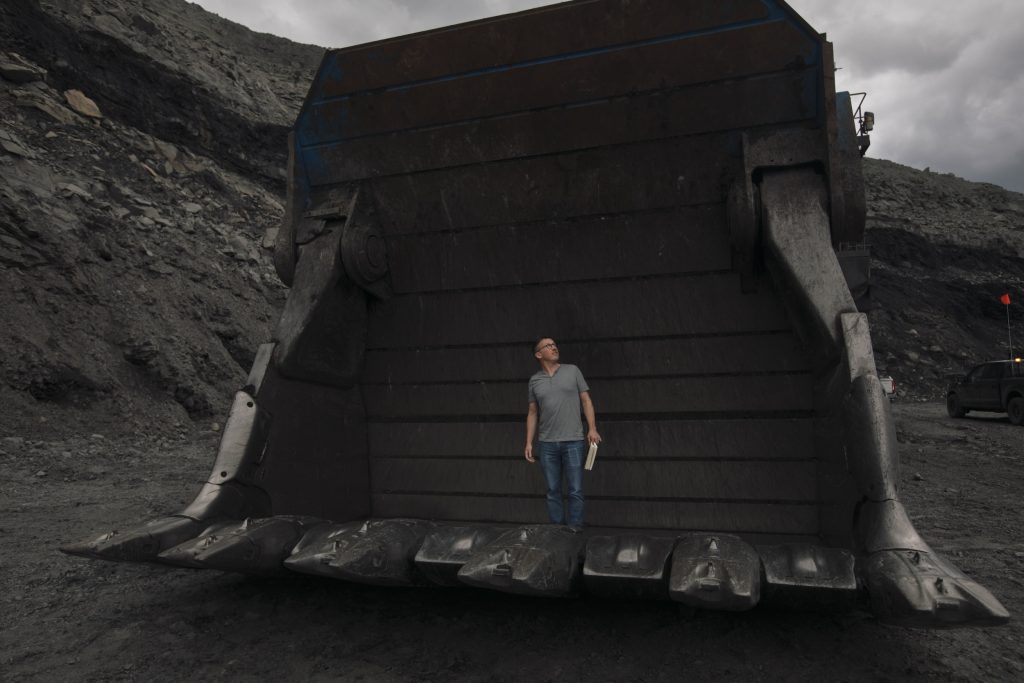
Have you ever stood in the bucket of a massive Hitachi EX5500 excavator, overlooking a mine in the foothills of the Rocky Mountains? I have, for a story we published today — but let me tell you about how I got there.
Earlier this summer, I got an email that surprised me. Not just because of what it said. It was the fact I got the email at all.
It was from an Alberta coal company.
Unfortunately, I’ve grown accustomed to my emails and phone calls being ignored by governments, companies and individuals alike. Accountability, once a cornerstone, has been supplanted by message control.
And on the rare occasion I get a response, there’s often no entertaining my request for an interview — just statements that provide no real answers. Without a conversation, it can become difficult to capture the full complexity of a story, which my fellow Narwhal reporters and I always strive to do.
So when this company not only responded to my email that had a series of hard questions about water pollution, but also invited me and photojournalist Amber Bracken to tour its sprawling Alberta mine and discuss things in person, I was thrilled.
From the bucket of the excavator, I could look out over a huge open pit, one small part of the mine, where coal has been dug up for decades. The 200-square-kilometre Coal Valley mine site — that’s 18 times the size of Calgary’s Nose Hill Park — is part industrial, part moonscape and … part nature.
And here’s the thing: that tour changed my point of view — or at least made it better informed.
It’s not to say that the mines in this region, which the province continues to debate, aren’t polluting. For another story, I dug into records from the Alberta Energy Regulator that showed 42 mining incidents had occurred since 2023, nearly all of which impacted water — and just six of those led to action by authorities. Sixteen of them were from Coal Valley, the mine I toured.
But after a full day of exploring the site, my perspective became more nuanced. It’s one thing to read a report about a spill — and it’s another to see its aftermath, and the containment efforts, with your own eyes.
You can read the story, accompanied by the photos Amber took, over here, and come to your own conclusions.
It made my job harder, no doubt. I had to write about the environmental impacts of a coal mine, the regulatory infractions that include dumping sediment in waterways, the scars on the land — all in a way that acknowledged the complexity.
On a human level, I also had to contend with how to write critically about a topic after spending a full day with three-dimensional, living, breathing (and likeable!) people, not a line in an email.
It’s the kind of experience that makes our journalism better. It’s definitely the kind of thing our polarized world needs more of.
A Narwhal investigation about wildlife killed by trains has been honoured with major international recognition. Reporter Ainslie Cruickshank and The Narwhal contributed a three-part investigative series to Off the Rails, a project of the Howard Center for Investigative Journalism in collaboration with media outlets across North America.
Check out the Collision Course series, with digital design by Andrew Munroe, here.
This week in The Narwhal
Hiking this Labour Day weekend? Don’t trust Google Maps By Michelle Cyca
Google Maps and AI don’t know the backcountry like an experienced hiker does. A search-and-rescue expert shares the tools and resources they trust — and what to do when technology points you the wrong way.
A massive LNG expansion could be coming to Metro Vancouver By Shannon Waters READ MORE
The joys — and grief — of summer camping in Canada By Arik Ligeti READ MORE
In Brampton, a largely immigrant community fights Canada’s biggest garbage incinerator By Prarthana Pathak READ MORE
What the devastating glacier collapse in Nepal tells us about Canada’s rapidly changing ice By Sara King-Abadi READ MORE
Alberta changes legislation to allow farmers to destroy many wetlands By Drew Anderson READ MORE
For the real scoop, it helps to get up close and personal. Tell your friends to subscribe to The Narwhal’s newsletter for stories by journalists who aren’t afraid to get their paws dirty!